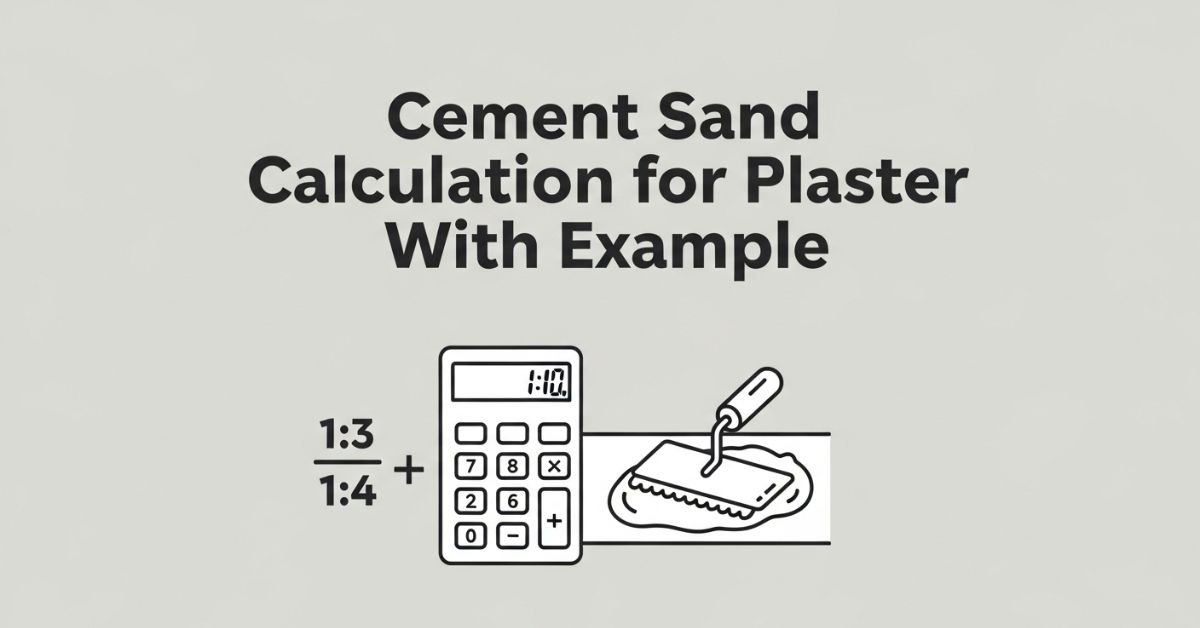
Plastering is one of the most important finishing works in construction, as it provides a smooth and durable surface to walls and ceilings. To achieve good quality plaster, it is essential to calculate the correct quantity of cement and sand before starting the work. This is where Cement Sand Calculation For Plaster With Example becomes very useful.
If plaster materials are not estimated properly, it can lead to issues such as uneven surface, cracks, or extra cost due to wastage. That is why engineers and contractors always use proper plastering calculation formula to determine material requirements in advance.
In this article, we will explain cement sand calculation plaster, plaster mix ratio, and step-by-step examples in both square meter and square feet. This guide is helpful for civil engineering students, site engineers, and homeowners.
Table of Contents
What Is Cement Sand Calculation For Plaster
Cement Sand Calculation For Plaster With Example is the process of estimating how much cement and sand are required for plastering a given wall area. It is based on plaster thickness, area of wall, and mix ratio.
Plastering is generally done in different thicknesses such as 12 mm or 15 mm depending on the type of surface. The quantity of materials changes based on thickness and mix ratio used.
By using proper wall plaster estimation, you can calculate materials accurately, reduce wastage, and ensure smooth execution of work.
Plastering Calculation Formula
The basic plastering calculation formula is:
Plaster Volume = Area × Thickness
Where:
- Area = Length × Height of wall
- Thickness = Thickness of plaster (in meters)
After calculating wet volume, we convert it into dry volume using a factor.
Dry Volume = Wet Volume × 1.33
This formula is widely used in plaster quantity formula and helps in accurate estimation of cement and sand.
Plaster Mix Ratio
The most commonly used mix ratio for plastering is:
1:6 (Cement : Sand)
This means:
- 1 part cement
- 6 parts sand
This ratio is standard for internal and external wall plastering. It is also known as 1:6 plaster ratio and is widely used in construction projects.
Choosing the correct mix ratio is very important for strength and durability of plaster.
Cement Sand Calculation For Plaster With Example
Let’s understand Cement Sand Calculation For Plaster With Example with a practical example.
Given:
- Wall area = 10 m²
- Thickness = 12 mm (0.012 m)
Step 1: Calculate Wet Volume
Volume =
10 × 0.012 = 0.12 m³
Step 2: Convert To Dry Volume
Dry Volume =
0.12 × 1.33 = 0.1596 m³
Step 3: Apply Mix Ratio (1:6)
Total parts = 7
Cement = 1/7 × 0.1596 = 0.0228 m³
Sand = 6/7 × 0.1596 = 0.1368 m³
Step 4: Convert Cement To Bags
1 bag = 0.035 m³
Cement =
0.0228 ÷ 0.035 ≈ 0.65 bags
Final Result
- Cement ≈ 0.65 bags
- Sand ≈ 0.137 m³
This is a complete Cement Sand Calculation For Plaster With Example.
Cement And Sand Required For 1 Sqm Plastering
For quick estimation, engineers use standard values.
For 12 mm plaster (1:6 ratio):
- Cement ≈ 0.65 bags per 10 sqm
- Sand ≈ 0.13 to 0.15 m³ per 10 sqm
So for 1 sqm plastering:
- Cement ≈ 0.065 bags
- Sand ≈ 0.013 m³
These values are useful for quick plastering calculation in sqm.
Plastering Calculation In Sq Ft
In many sites, calculations are done in square feet. So understanding plastering calculation in sq ft is also important.
Example:
- Area = 100 sq ft
- Thickness = 12 mm
Convert to square meter:
100 sq ft = 9.29 m²
Now apply same formula:
Volume =
9.29 × 0.012 = 0.111 m³
After dry volume and ratio, you can calculate cement and sand.
This method is widely used for practical plastering sand calculation.
Cement Required For 1 Sqm Plastering 1:6
For standard 1:6 plaster ratio, cement required for 1 sqm plastering is approximately:
- 0.065 to 0.07 bags
This value may slightly vary depending on workmanship and surface condition.
It is commonly used in cement sand calculation plaster for quick estimation.
Practical Use In Construction
The Cement Sand Calculation For Plaster With Example is used in material estimation, budgeting, and planning plaster work. Engineers use it to prepare quantity estimates and order materials accordingly.
It also helps in reducing wastage and ensuring proper use of materials. Contractors rely on this calculation for smooth workflow and cost control.
This makes plaster quantity formula an essential part of construction.
Benefits Of Plaster Calculation
Understanding Cement Sand Calculation For Plaster With Example provides several benefits. It helps in accurate estimation of materials, reduces wastage, and improves cost efficiency.
It also ensures proper quality of plaster and avoids issues like cracks or uneven surfaces. Proper calculation leads to better construction planning and execution.
Common Mistakes In Plaster Calculation
Some common mistakes include:
- Ignoring dry volume factor
- Using wrong thickness
- Incorrect mix ratio
- Unit conversion errors
Avoiding these mistakes ensures accurate wall plaster estimation and better results.
Frequently Asked Questions (FAQ)
What Is Cement Sand Calculation For Plaster
It is the method used to calculate cement and sand required for plastering using area and thickness.
What Is Plastering Calculation Formula
Plaster Volume = Area × Thickness
How Much Cement Required For 1 Sqm Plastering
Approximately 0.065 bags for 1 sqm plastering (1:6 ratio).
What Is Standard Plaster Ratio
The standard plaster mix ratio is 1:6 (cement : sand).
Conclusion
The Cement Sand Calculation For Plaster With Example is an important concept in construction that helps in estimating plaster materials accurately. By using proper formulas and mix ratios, engineers can calculate cement and sand easily.
Understanding plastering calculation formula helps in better planning, cost control, and quality work. With practice, this calculation becomes simple and very useful in real construction projects.
Read More: Column Steel Quantity Calculation Formula: Step-by-Step Steel Calculation with Excel and Examples