
In construction and water management systems, calculating the correct tank capacity is very important. Whether it is for residential use, commercial buildings, or agricultural purposes, proper planning of water storage ensures uninterrupted supply. This is why understanding water tank capacity calculation is essential.
If the capacity of a water tank is not calculated correctly, it may lead to water shortage or unnecessary construction cost. Engineers use proper formulas and methods to estimate the required storage capacity based on usage and tank dimensions. Accurate calculation helps in better design and efficient water management.
In this article, we will explain the Water Tank Capacity Calculation Formula, different types of tank volume calculations, and step-by-step examples. This guide is useful for civil engineering students, contractors, and homeowners.
Table of Contents
What Is Water Tank Capacity Calculation
Water tank capacity calculation is the process of determining how much water a tank can store. It is usually measured in liters or cubic meters and depends on the shape and dimensions of the tank.
The calculation is based on:
- Length, width, and height (for rectangular tanks)
- Radius and height (for circular tanks)
By using proper tank capacity formula, engineers can design tanks that meet water requirements efficiently.
Tank Volume Calculation Formula
The basic tank volume calculation depends on the shape of the tank.
For Rectangular Tank:
Volume = Length × Width × Height
For Cylindrical (Round) Tank:
Volume = π × r² × Height
These formulas are widely used in civil tank calculation and provide accurate results for water storage estimation.
Water Tank Capacity Calculation Formula
The standard Water Tank Capacity Calculation Formula is:
Capacity (Liters) = Volume (m³) × 1000
Since 1 cubic meter = 1000 liters, this conversion is used to find tank capacity in liters.
This formula is used in all types of water storage formula calculations.
Water Tank Capacity Calculation With Example
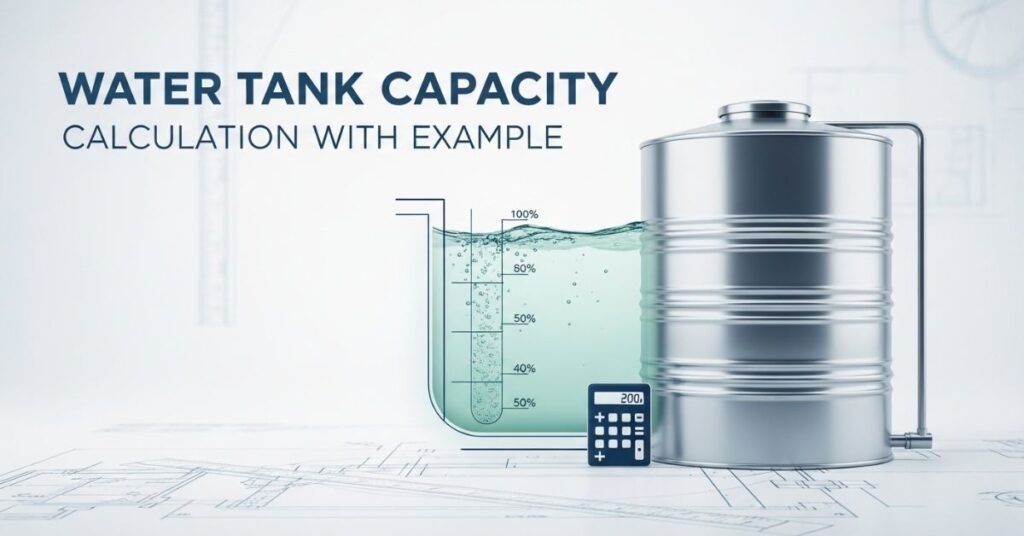
Let’s understand water tank capacity calculation with a simple example.
Example 1: Rectangular Tank
- Length = 2 m
- Width = 1.5 m
- Height = 1.5 m
Step 1: Calculate Volume
Volume =
2 × 1.5 × 1.5 = 4.5 m³
Step 2: Convert To Liters
Capacity =
4.5 × 1000 = 4500 liters
Final Result
Water tank capacity = 4500 liters
This is a basic Water Tank Capacity Calculation Formula example.
Round Water Tank Capacity Calculation Formula
For circular tanks, a different formula is used.
Formula:
Volume = π × r² × Height
Example:
- Radius = 1 m
- Height = 2 m
Volume =
3.14 × 1² × 2 = 6.28 m³
Capacity =
6.28 × 1000 = 6280 liters
This is the round water tank capacity calculation formula used in practice.
Water Tank Capacity Calculation In Feet
In many construction projects, dimensions are measured in feet. So understanding water tank capacity calculation formula in feet is also important.
Formula:
Volume (cubic feet) = Length × Width × Height
To convert into liters:
1 cubic foot = 28.316 liters
Example:
Volume = 100 cubic feet
Capacity =
100 × 28.316 = 2831 liters
This method is commonly used in water tank capacity calculation formula India.
How To Calculate Water Tank Capacity In Litres
To calculate tank capacity in liters, follow these steps:
- Measure tank dimensions
- Calculate volume using formula
- Convert cubic meters or feet into liters
This simple process is widely used in tank volume calculator methods and helps in quick estimation.
Practical Use In Construction
Water tank capacity calculation is used in residential buildings, commercial projects, and water supply systems. Engineers use it to design tanks based on daily water requirements.
It is also used in overhead tanks, underground tanks, and storage systems. Accurate calculation ensures sufficient water storage and efficient usage.
Benefits Of Tank Capacity Calculation
Understanding water tank capacity calculation provides many advantages. It helps in proper planning of water storage and avoids shortages.
It also reduces construction cost by avoiding over-designing of tanks. Proper calculation improves efficiency and ensures long-term usability.
Common Mistakes In Tank Calculation
Some common mistakes include:
- Using wrong dimensions
- Ignoring shape of tank
- Incorrect unit conversion
- Not considering actual usage
Avoiding these mistakes improves accuracy in tank capacity formula.
Frequently Asked Questions (FAQ)
What Is Water Tank Capacity Calculation
It is the process of calculating how much water a tank can store.
What Is Tank Volume Formula
For rectangular tank: Length × Width × Height
For circular tank: π × r² × Height
How To Calculate Water Tank Capacity In Litres
Multiply volume (in cubic meters) by 1000.
What Is 1 Cubic Meter In Litres
1 cubic meter = 1000 liters
Conclusion
Water Tank Capacity Calculation is an important concept in construction and water management. By using simple formulas and proper measurements, you can calculate tank capacity easily.
Understanding tank volume calculation helps in better planning, efficient water usage, and cost control. With proper knowledge, this calculation becomes simple and useful in real projects.
Read More: House Construction Cost Calculation: Per Square Foot Cost Guide With Example