

In modern construction projects, planning is not just about drawings and materials, but also about how efficiently a site can handle work. This is where construction site capacity calculation becomes a critical part of project management. Many projects fail or get delayed not because of design issues, but due to poor understanding of site capacity.
When engineers do not properly calculate site capacity, it leads to overcrowding, inefficient labor usage, and poor workflow. On the other hand, when construction site capacity calculation is done correctly, it improves productivity, reduces delays, and ensures smooth execution of the project.
In this guide, we will not only explain the formula but also cover practical planning, real-world factors, and how it connects with cost estimation tools like construction estimate calculator and residential construction cost per sq ft calculator.
Table of Contents
What Is Construction Site Capacity Calculation
Construction site capacity calculation refers to determining the maximum amount of work that can be performed efficiently on a site within a specific time period. It is not just about space, but also about how well resources are managed.
This calculation includes multiple components such as workforce capacity, equipment availability, material handling, and working hours. It helps answer a practical question:
👉 How much work can this site realistically complete per day?
Understanding this concept is important not only for engineers but also for contractors and project managers who are responsible for planning and execution.
Core Formula Of Construction Site Capacity
The basic formula used in construction site capacity calculation is:
Site Capacity = Productivity × Number of Workers × Time
This formula may look simple, but its accuracy depends on how well you estimate productivity and manage resources. For example, if worker productivity is overestimated, the final capacity calculation will be incorrect.
This formula is also indirectly connected with tools like construction material estimate calculator and construction estimate calculator, which help in planning materials based on expected output.
Step-By-Step Method To Calculate Site Capacity
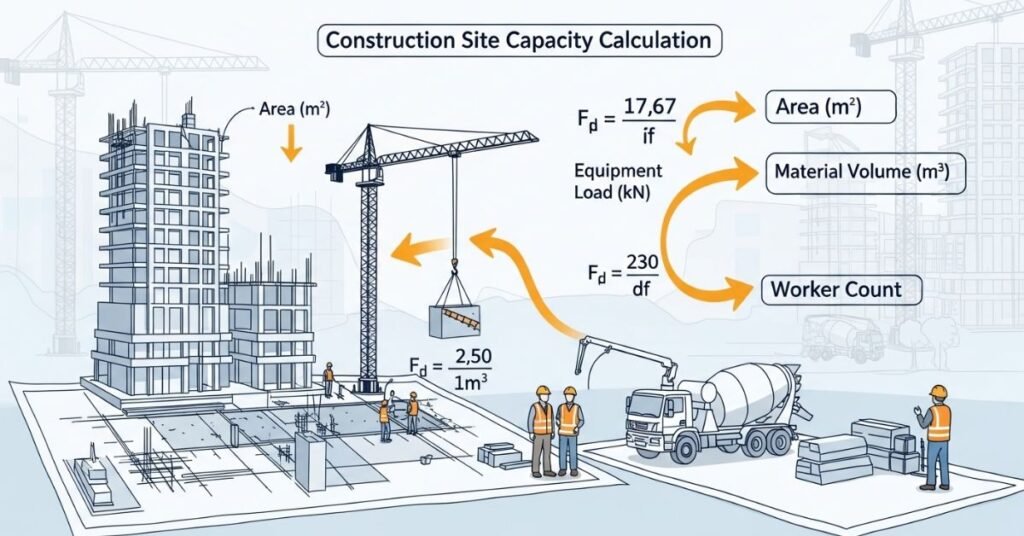
To make construction site capacity calculation more practical and useful, engineers follow a structured approach instead of relying only on formulas.
Step 1: Analyze Site Area And Layout
The first step is to understand the physical limitations of the site. This includes total working area, storage space, and movement area for workers and equipment.
A congested site reduces efficiency, while a well-planned layout increases productivity. This is why site layout planning is directly connected to capacity calculation.
Step 2: Evaluate Workforce Productivity
Worker productivity is one of the most important factors in construction site capacity calculation. It varies depending on skill level, type of work, and site conditions.
For example:
- Brickwork productivity = 1.5 to 2.5 m²/hour
- Concrete work productivity = 4 to 6 m³/day
Accurate estimation of productivity ensures realistic capacity calculation.
Step 3: Identify Equipment And Tools
Equipment plays a major role in increasing site capacity. Machines like mixers, cranes, and vibrators can significantly improve work speed.
Without proper equipment, even a large workforce cannot achieve high productivity. This is why equipment planning is a key part of construction site capacity calculation.
Step 4: Calculate Daily Work Output
Once all inputs are known, apply the formula:
Capacity = Productivity × Workers × Time
This gives you the total work output per day, which can be used for planning and scheduling.
Practical Example Of Site Capacity Calculation
Let’s take a realistic example to understand construction site capacity calculation in detail.
Given:
- Workers = 15
- Productivity = 2 m²/hour
- Working hours = 8
Calculation:
Capacity =
2 × 15 × 8 = 240 m² per day
This means the site can complete 240 square meters of work daily under ideal conditions.
However, in real projects, engineers often reduce this value by 10–15% to account for inefficiencies.
Advanced Factors Affecting Site Capacity
In real-world projects, construction site capacity calculation is not limited to formulas. Several advanced factors influence actual capacity.
1. Site Accessibility
If materials cannot be transported easily, productivity decreases.
2. Weather Conditions
Rain, heat, or cold can reduce working hours and efficiency.
3. Material Availability
Delays in material supply directly affect site capacity.
4. Safety Regulations
Proper safety spacing reduces overcrowding but may slightly reduce capacity.
5. Coordination Between Teams
Poor coordination between teams can slow down work even if resources are available.
Connection With Cost Estimation
One of the most important aspects of construction site capacity calculation is its connection with cost estimation.
Higher site capacity → Faster completion → Lower labor cost
This is why engineers often combine capacity calculation with tools like:
- House construction cost calculator
- Residential construction cost per sq ft calculator
- Construction estimate calculator
These tools help in aligning productivity with budget planning.
Construction Site Capacity In India

In India, construction site capacity calculation in India depends on local factors such as labor availability, site size, and construction practices.
Urban sites often face space constraints, which reduce capacity, while rural sites may have more space but lower mechanization. Engineers must adjust calculations based on these conditions.
Understanding local conditions is important for accurate and practical estimation.
Fire Exit Capacity And Building Capacity
Sometimes, site capacity is confused with building capacity. However, both are different concepts.
- Fire exit capacity calculation is related to safety and evacuation planning
- How to calculate building capacity refers to how many people a structure can hold
While these are separate from construction site capacity calculation, they are all part of overall project planning.
Practical Applications In Real Projects
In real construction projects, construction site capacity calculation is used for:
- Work scheduling
- Resource allocation
- Cost estimation
- Project timeline planning
It helps engineers make informed decisions and avoid delays.
Benefits Of Proper Site Capacity Planning
When construction site capacity calculation is done correctly, it provides several benefits:
- Improved productivity
- Better resource utilization
- Reduced project delays
- Lower construction cost
- Improved site safety
This makes it an essential part of modern construction management.
Common Mistakes To Avoid
Many engineers and contractors make mistakes while performing construction site capacity calculation.
Some common errors include:
- Overestimating worker productivity
- Ignoring site layout limitations
- Not considering downtime
- Poor coordination between teams
Avoiding these mistakes improves accuracy and project performance.
Frequently Asked Questions (FAQ)
What Is Construction Site Capacity Calculation
It is the process of estimating how much work a construction site can handle efficiently.
What Is The Formula For Site Capacity
Site Capacity = Productivity × Number of Workers × Time
Why Is Site Capacity Important
It helps in planning resources, reducing delays, and improving efficiency.
Can Site Capacity Affect Project Cost
Yes, higher capacity can reduce project duration and overall cost.
Conclusion
Construction site capacity calculation is not just a formula but a complete planning strategy that affects productivity, cost, and project success. By understanding site layout, workforce efficiency, and resource management, engineers can calculate capacity accurately.
When combined with tools like construction estimate calculator and house construction cost calculator, it becomes even more powerful for project planning. With proper knowledge and practical application, site capacity calculation can significantly improve construction outcomes.
Read More: How To Calculate Construction Site Capacity: Step-by-Step Planning Guide