
In construction work, concrete is one of the most important materials used for slabs, beams, and foundations. Among all structural elements, slabs require proper planning because they cover a large area and consume a significant amount of materials. This is why understanding concrete quantity calculation is essential before starting slab work.
If the quantity of concrete is not calculated properly, it can lead to shortages, delays, or unnecessary extra cost. Engineers always use standard formulas and methods for concrete slab calculation to ensure accurate estimation of materials like cement, sand, and aggregates.
In this article, we will explain Concrete Quantity Calculation For Slab, the concrete volume formula, and step-by-step material calculation. This guide is useful for civil engineering students, site engineers, and contractors.
Table of Contents
What Is Concrete Quantity Calculation
Concrete quantity calculation is the process of determining how much concrete is required for a particular structure. It includes calculating the volume of concrete and then finding the quantity of materials needed to prepare that concrete.
In slab construction, this calculation is very important because slabs cover large areas and require proper planning. The calculation helps in estimating cement, sand, and aggregates required for the work.
By performing accurate concrete estimation, engineers can avoid wastage and ensure smooth execution of construction work.
Concrete Volume Formula
The basic formula used in concrete volume calculation is simple and widely used:
Volume = Length × Width × Thickness
This formula is used for all types of slabs, whether it is a roof slab or floor slab. The dimensions must be taken in meters to get the volume in cubic meters.
This formula is the base of concrete slab calculation and is the first step in estimating concrete quantity.
Concrete Quantity Calculation For Slab
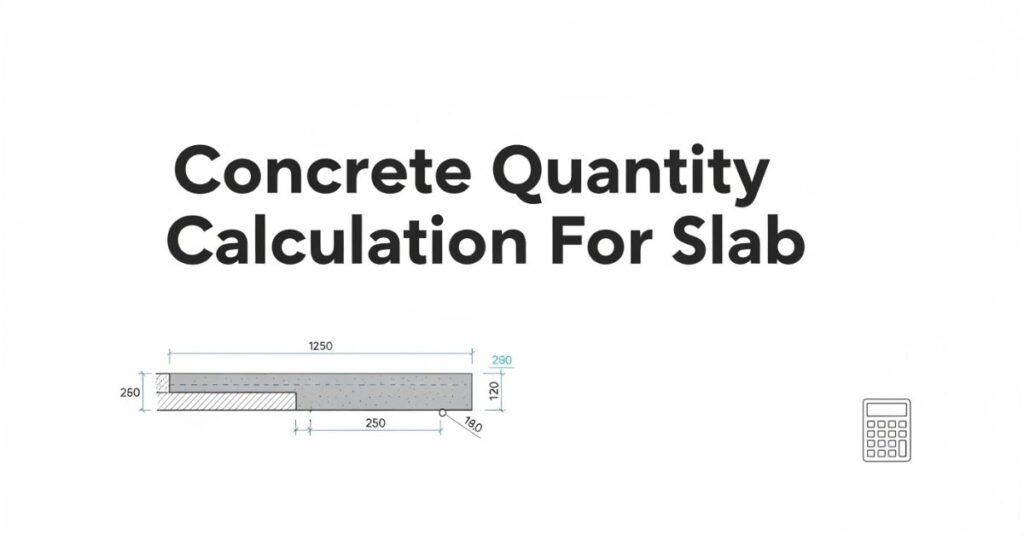
To understand concrete quantity calculation for a slab, we first calculate the volume of the slab and then convert it into material quantities.
Given:
- Length = 5 meters
- Width = 4 meters
- Thickness = 0.15 meters
Step 1: Calculate Volume
Volume =
5 × 4 × 0.15 = 3 cubic meters
This is the wet volume of concrete required.
Step 2: Convert Wet Volume To Dry Volume
Dry volume is calculated to account for voids in materials.
Dry Volume =
3 × 1.54 = 4.62 cubic meters
Step 3: Cement Sand Aggregate Calculation
Assume mix ratio = 1:2:4
Total parts = 7
Cement = 1/7 × 4.62 = 0.66 m³
Sand = 2/7 × 4.62 = 1.32 m³
Aggregate = 4/7 × 4.62 = 2.64 m³
Step 4: Convert Cement To Bags
1 bag = 0.035 m³
Cement =
0.66 ÷ 0.035 ≈ 19 bags
Final Result
- Cement ≈ 19 bags
- Sand ≈ 1.32 m³
- Aggregate ≈ 2.64 m³
This is a complete Concrete Quantity Calculation For Slab.
Concrete Mix Ratio Explained
The mix ratio defines the proportion of cement, sand, and aggregates used in concrete. The most common mix ratio for slab construction is 1:2:4.
This ratio provides good strength and is suitable for general construction work. In some cases, higher grade concrete like M20 or M25 is used depending on structural requirements.
Understanding mix ratio is important for proper cement sand aggregate calculation.
Concrete Quantity Calculation In India
In India, Concrete Quantity Calculation For Slab is commonly done using cubic meters. Standard values and formulas are followed for estimation.
Engineers also consider factors such as material wastage, site conditions, and mix design. Sometimes, contractors refer to Concrete quantity calculation for slab India charts or PDFs for quick reference.
This ensures accurate estimation and better project planning.
Concrete Quantity Calculation PDF / Tools
Many engineers use tools like:
- Concrete quantity calculation PDF
- Concrete calculator apps
- Excel sheets
These tools help in quick and accurate estimation. However, understanding the manual method of concrete estimation is always important for accuracy.
Practical Use In Construction
Concrete quantity calculation is used in planning, material estimation, and construction execution. Engineers use it to prepare quantity take-offs and order materials.
It also helps contractors avoid delays and ensure proper use of materials. This improves both efficiency and quality of construction.
Benefits Of Concrete Calculation
Understanding Concrete Quantity Calculation For Slab provides several advantages. It helps in accurate estimation, reduces wastage, and improves cost control.
It also ensures smooth construction workflow and better planning. Proper calculation leads to stronger and more durable structures.
Common Mistakes In Concrete Calculation
Some common mistakes include:
- Using incorrect dimensions
- Ignoring dry volume factor
- Wrong mix ratio
- Unit conversion errors
Avoiding these mistakes improves accuracy in concrete slab calculation.
Frequently Asked Questions (FAQ)
What Is Concrete Quantity Calculation
It is the process of calculating volume of concrete and required materials like cement, sand, and aggregates.
What Is Concrete Volume Formula
Volume = Length × Width × Thickness
How Many Cement Bags For 1 Cubic Meter Concrete
Around 6 to 7 bags for 1:2:4 mix.
Why Is Concrete Calculation Important
It helps in accurate estimation, cost control, and smooth construction work.
Conclusion
Concrete Quantity Calculation For Slab is an essential part of construction planning. By calculating volume and applying the correct mix ratio, engineers can estimate materials accurately.
Understanding concrete slab calculation helps in better planning, reduced wastage, and efficient construction. With proper knowledge, this calculation becomes simple and very useful in real projects.
Read More: Steel Quantity Calculation For Beam: Step-by-Step Reinforcement Estimation Guide