Understanding The Dry To Wet Volume Of Concrete Is One Of The Most Important Concepts In Construction Estimation. Whether You Are Casting A Slab, Column, Beam Or Footing, Accurate Calculation Helps Avoid Material Shortage And Extra Cost.
Many Beginners Make The Mistake Of Calculating Cement And Sand Directly From Wet Volume. That Leads To Wrong Estimation. In This Guide, You Will Learn The Correct Formula, Why 1.54 Factor Is Used, And Step-By-Step Material Calculation.
What Is Wet Volume Of Concrete?
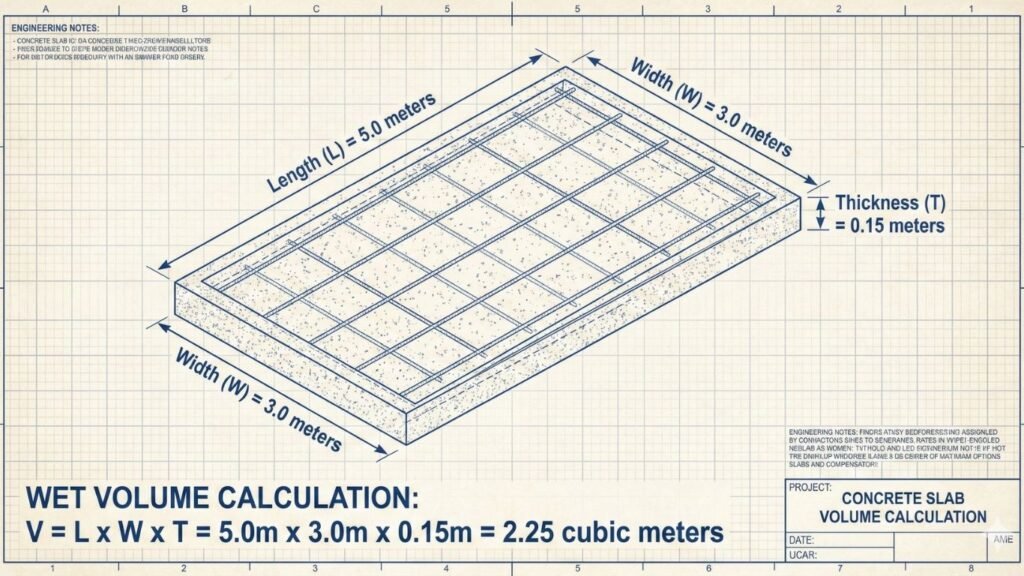
Wet Volume Is The Actual Volume Of Concrete Required For Construction After Mixing Cement, Sand, Aggregate And Water.
It Is Calculated As:
Wet Volume = Length × Width × Thickness
Example:
Length = 5 m
Width = 4 m
Thickness = 0.15 m
Wet Volume = 5 × 4 × 0.15
Wet Volume = 3 m³
This 3 Cubic Meter Is The Final Concrete Required On Site.
What Is Dry Volume Of Concrete ?
Dry Volume Refers To The Total Volume Of Dry Materials Required Before Adding Water.
When Concrete Is Mixed:
- Air Voids Reduce
- Materials Compact
- Volume Shrinks
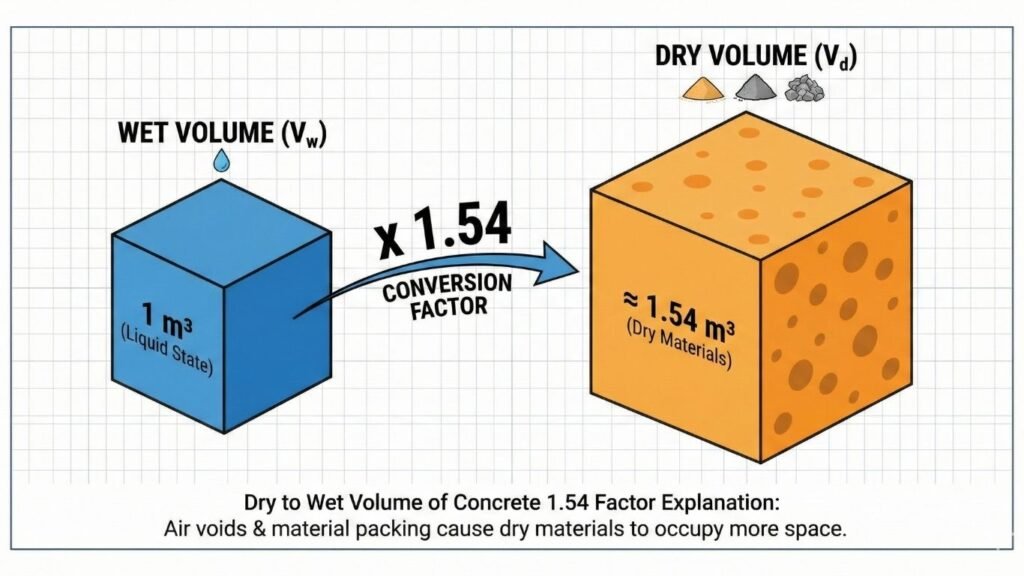
Because Of This Shrinkage, Dry Volume Is Always More Than Wet Volume.
Dry To Wet Volume Of Concrete Formula
The Standard Formula Used In Construction Is:
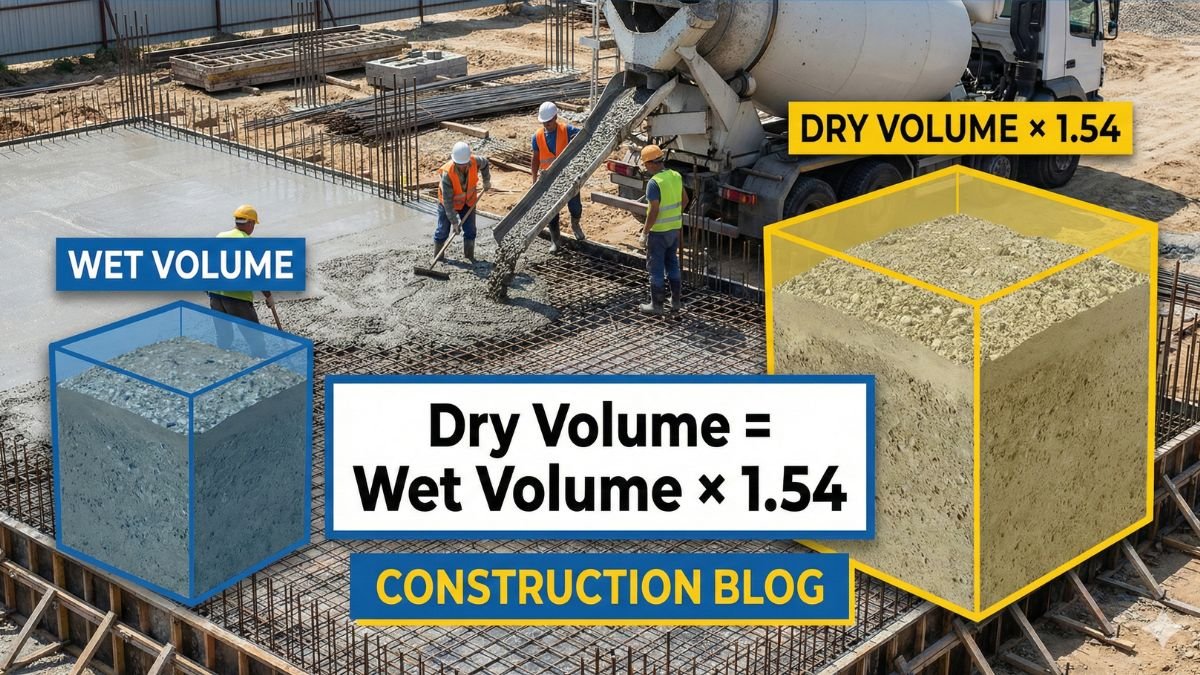
Dry Volume = Wet Volume × 1.54
The Value 1.54 Is Used To Account For:
- Air Voids In Aggregates
- Shrinkage After Mixing
- Compaction
- Minor Wastage
This Is The Most Important Formula In Concrete Estimation.
Why 1.54 Factor Is Used ?
Aggregates Contain Around 30–35% Voids
Sand Contains Around 20–30% Voids
Cement Fills Smaller Gaps
After Adding Water And Mixing:
- Materials Settle
- Volume Reduces
To Compensate For This Reduction, 54% Extra Dry Material Is Considered.
That Is Why:
Dry Volume = Wet Volume × 1.54
Step By Step Calculation Example
Let’s Continue With:
Wet Volume = 3 m³
Dry Volume = 3 × 1.54
Dry Volume = 4.62 m³
This Means 4.62 Cubic Meter Of Dry Materials Are Required.
Cement, Sand And Aggregate Calculation (M20 – 1:1.5:3)
Total Ratio = 1 + 1.5 + 3 = 5.5 Parts
Cement Quantity
Cement = (1 / 5.5) × 4.62
Cement = 0.84 m³
1 Cement Bag = 0.035 m³
Cement Bags = 0.84 ÷ 0.035
Cement = 24 Bags (Approx.)
Sand Quantity
Sand = (1.5 / 5.5) × 4.62
Sand = 1.26 m³
Aggregate Quantity
Aggregate = (3 / 5.5) × 4.62
Aggregate = 2.52 m³
Quick Conversion Table Dry To Wet Volume Of Concrete
| Wet Volume (m³) | Dry Volume (m³) |
|---|---|
| 1 | 1.54 |
| 2 | 3.08 |
| 3 | 4.62 |
| 5 | 7.70 |
| 10 | 15.40 |
Dry To Wet Volume In Cubic Feet
The Same Formula Applies:
Dry Volume = Wet Volume × 1.54
Example:
Wet Volume = 100 CFT
Dry Volume = 100 × 1.54
Dry Volume = 154 CFT
This Formula Works In Both Units.
Common Mistakes To Avoid
- Forgetting 1.54 Factor
- Mixing Units (Feet And Meter)
- Incorrect Mix Ratio
- Wrong Cement Bag Conversion
These Errors Can Increase Construction Cost.
Conclusion
The Dry To Wet Volume Of Concrete Formula Is Simple But Extremely Important In Construction.
Always Remember:
Dry Volume = Wet Volume × 1.54
Using This Formula Ensures Accurate Cement, Sand And Aggregate Estimation. Proper Calculation Saves Money, Reduces Wastage And Improves Construction Planning.
Master This Concept And Your Estimation Skills Will Improve Significantly.
Frequently Asked Questions (FAQ)
1. Why Do We Multiply By 1.54 In Concrete Calculation?
We Multiply By 1.54 To Compensate For Air Voids, Shrinkage And Compaction In Concrete Materials.
2. What Is The Dry Volume Of 1 Cubic Meter Concrete?
The Dry Volume Of 1 Cubic Meter Wet Concrete Is 1.54 Cubic Meter.
3. Is 1.54 Used For All Concrete Grades?
Yes, 1.54 Is Standard For Nominal Mix Estimation.
4. Can I Use Wet Volume Directly?
No, Using Wet Volume Directly Will Result In Lower Material Estimation.