In civil engineering and construction work, estimating materials accurately is very important. One of the most commonly used concepts in concrete estimation is the Dry Volume Of Concrete Formula. When concrete is mixed on a construction site, engineers usually start with the wet volume of concrete. However, the actual materials required such as cement, sand, and aggregates are calculated using the dry volume.
This difference occurs because materials like sand and aggregates contain voids, and some volume is lost during mixing and compaction. Because of this, engineers convert the wet volume into dry volume before calculating material quantities. Understanding the Dry Volume Of Concrete Formula helps engineers estimate cement, sand, and aggregates correctly and avoid material shortages during construction.
In this guide, we will explain the Dry Volume Of Concrete Formula, the concept of wet volume and dry volume, and a step-by-step example used in real civil engineering calculations.
Table of Contents
What Is Dry Volume Of Concrete
The Dry Volume Of Concrete Formula is used to convert the wet volume of concrete into dry volume for material calculation.
When concrete is mixed, the wet volume does not represent the actual quantity of raw materials required. This is because:
- Sand and aggregates contain void spaces
- Some volume is lost during mixing
- Materials compact during placement
To compensate for this difference, civil engineers increase the wet volume by a standard factor.
Typically:
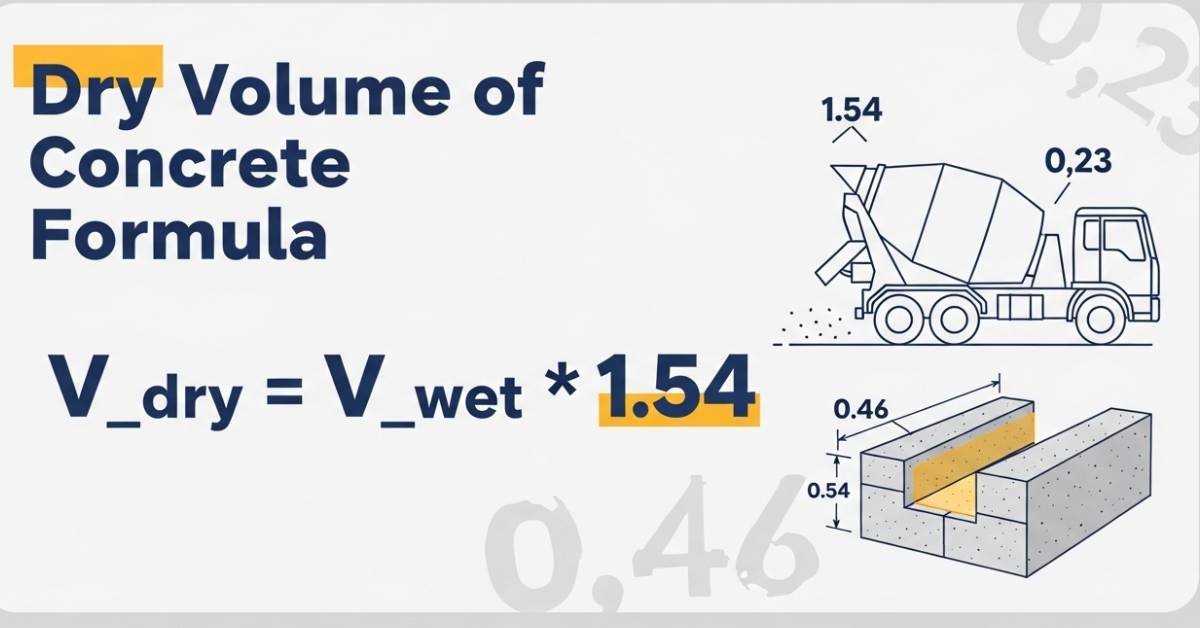
Dry Volume = Wet Volume × 1.54
This factor of 1.54 accounts for voids and material shrinkage during mixing.
Understanding the Dry Volume Of Concrete Formula is essential in civil calculation concrete work and construction estimation.
Wet Volume Of Concrete
Before applying the Dry Volume Of Concrete Formula, we first calculate the wet volume of concrete.
Wet volume refers to the actual finished volume of concrete required in the structure, such as:
- Slabs
- Beams
- Columns
- Footings
Wet volume is calculated using the simple concrete volume formula:
Volume = Length × Width × Height
For example, if a concrete slab has the following dimensions:
Length = 5 m
Width = 4 m
Thickness = 0.15 m
Then the wet volume of concrete will be:
5 × 4 × 0.15 = 3 cubic meters
This wet volume is then converted into dry volume for material calculation.
Dry Volume Of Concrete Formula
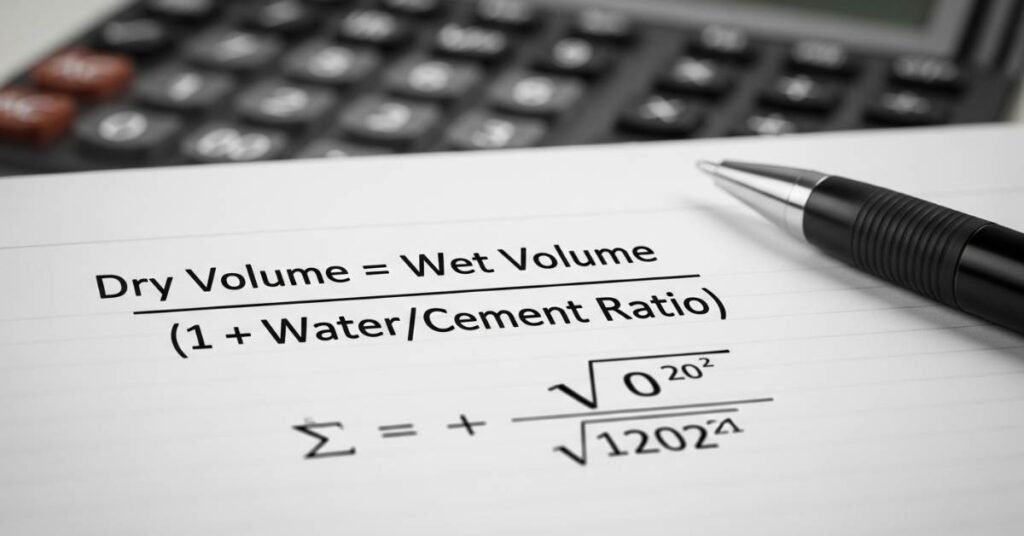
The commonly used Dry Volume Of Concrete Formula in construction estimation is:
Dry Volume = Wet Volume × 1.54
Where:
Wet Volume = actual concrete volume
1.54 = conversion factor used in civil engineering
The factor 1.54 is widely accepted in practical site estimation and is used in most dry volume calculation concrete methods.
This formula helps determine the actual quantity of cement, sand, and aggregates required for the mix.
Dry Volume Of Concrete As Per IS Code
According to common construction practices and guidelines used in India, the Dry Volume Of Concrete Formula as per IS code also uses an approximate factor between 1.52 and 1.57.
However, for estimation purposes, engineers generally use:
Dry Volume = Wet Volume × 1.54
This value is considered safe and practical for most construction calculations.
Because of this standard factor, the Dry Volume Of Concrete as per IS code is widely used in civil engineering estimation and construction planning.
Dry Volume Of Concrete In Cubic Meter (Example)
Let’s understand the Dry Volume Of Concrete Formula with a simple example.
Suppose the wet volume of concrete required for a slab is:
Wet Volume = 1 cubic meter
Now apply the formula.
Dry Volume = Wet Volume × 1.54
Dry Volume =
1 × 1.54
Dry Volume = 1.54 cubic meters
This means that to produce 1 cubic meter of concrete, the dry materials required will occupy about 1.54 cubic meters.
This concept is very important in civil calculation concrete and construction material estimation.
Wet Volume To Dry Volume Of Concrete (Step-By-Step)
The process of converting wet volume to dry volume of concrete is simple.
Step 1: Calculate wet volume of concrete
Step 2: Apply dry volume conversion factor
Step 3: Calculate material quantities
Example:
Wet Volume = 2 m³
Dry Volume =
2 × 1.54
Dry Volume = 3.08 m³
Now this dry volume is used to calculate cement, sand, and aggregate quantities.
This is the practical use of the Dry Volume Of Concrete Formula on construction sites.
Dry Volume Of Aggregate In Concrete
After calculating the dry volume, engineers divide the materials according to the concrete mix ratio.
For example:
Concrete Mix = 1 : 2 : 4
Total parts = 7
If dry volume is 1.54 m³, the materials will be:
Cement = 1/7 × 1.54
Sand = 2/7 × 1.54
Aggregate = 4/7 × 1.54
Using this method, engineers can calculate the dry volume of aggregate and other materials required for concrete.
This is why the Dry Volume Of Concrete Formula is essential for material estimation.
Dry Volume Of Mortar
The concept of dry volume is also used in mortar calculations.
For mortar estimation, the formula is slightly different:
Dry Volume Of Mortar = Wet Volume × 1.33
This factor is used because mortar contains smaller void spaces compared to concrete.
However, the Dry Volume Of Concrete Formula uses a higher factor of 1.54 due to the presence of coarse aggregates.
Practical Use In Construction
The Dry Volume Of Concrete Formula is widely used by:
- Civil engineers
- Construction contractors
- Quantity surveyors
- Site supervisors
It helps in:
- Concrete material estimation
- Cement bag calculation
- Construction cost estimation
- Site material planning
Without proper dry volume calculation concrete, construction projects may face material shortages or incorrect cost estimation.
Benefits Of Understanding Dry Volume Of Concrete
Knowing the Dry Volume Of Concrete Formula provides several advantages in construction projects.
Some important benefits include:
- Accurate cement calculation
- Correct sand and aggregate estimation
- Reduced material wastage
- Better construction planning
- Improved project cost control
Because of these advantages, the Dry Volume Of Concrete Formula is a fundamental concept in civil engineering.
Common Mistakes In Concrete Volume Calculation
Beginners often make mistakes while performing dry volume calculation concrete.
Some common errors include:
- Using wet volume directly for material calculation
- Ignoring the dry volume factor
- Using incorrect mix ratio
- Incorrect unit conversion
Understanding the Dry Volume Of Concrete Formula helps avoid these mistakes and improves estimation accuracy.
Frequently Asked Questions
What Is The Dry Volume Of Concrete Formula?
The Dry Volume Of Concrete Formula is:
Dry Volume = Wet Volume × 1.54
This formula converts wet concrete volume into dry volume for material estimation.
Why Do We Multiply By 1.54 In Concrete Calculation?
The factor 1.54 accounts for voids in sand and aggregates and the loss of volume during mixing and compaction.
What Is Wet Volume Of Concrete?
Wet volume is theactual finished volume of concrete required for a structure such as a slab, beam, or column.
What is 1.54 in concrete | example solved | Dry volume and wet volume of concrete | Civil tutor
What Is Dry Volume Of Mortar?
Dry volume of mortar is calculated using:
Dry Volume = Wet Volume × 1.33
This formula is used for mortar material estimation.
Conclusion: Dry Volume Of Concrete Formula
The dry volume of concrete formula is an essential concept used in civil engineering to estimate concrete materials accurately. Since concrete materials occupy more volume in dry form due to void spaces and mixing losses, engineers convert wet volume into dry volume using a factor of 1.54.
By applying the wet volume to dry volume of concrete conversion method, engineers can easily calculate the required quantity of cement, sand, and aggregates. This formula plays a crucial role in construction estimation, cost planning, and site material management.
Whether you are a civil engineering student or a site engineer, understanding the Dry Volume Of Concrete Formula will help you perform accurate material calculations in real construction projects.