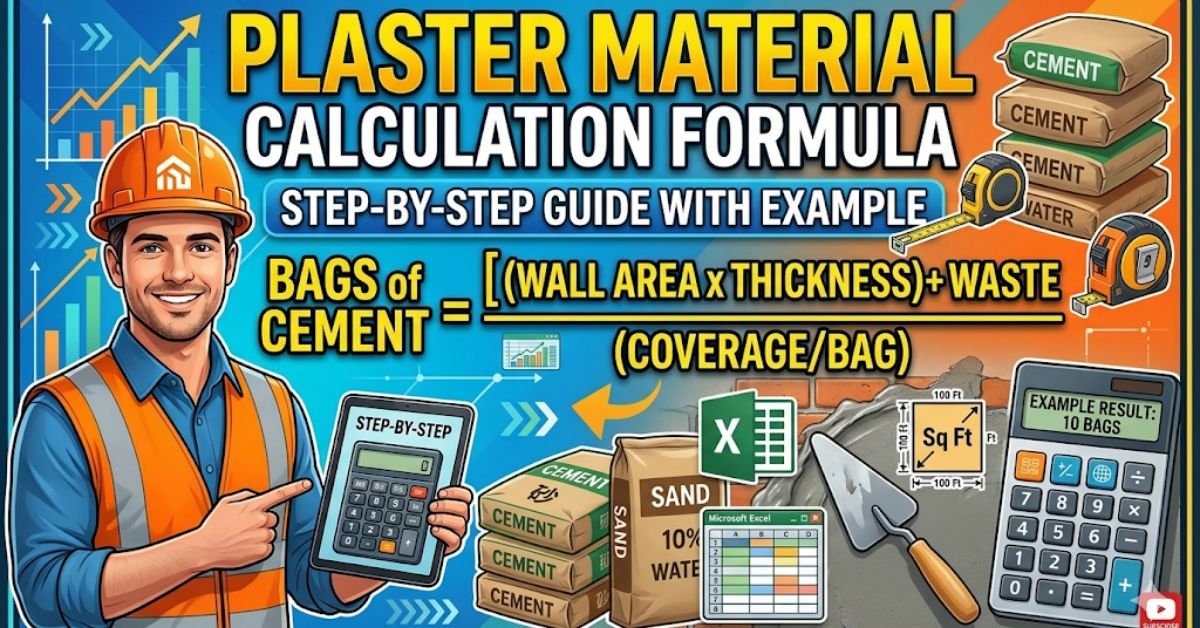
In construction work, plastering is an essential finishing process that provides a smooth surface to walls and ceilings. To ensure quality work and avoid material wastage it is very important to calculate the correct quantity of cement and sand. This is where the plaster material calculation formula becomes useful.
Understanding the plaster material calculation formula helps engineers, contractors, and homeowners estimate materials accurately and control project costs. Whether you are working on a small house or a large building proper plaster calculation ensures efficiency and durability.
In this article we will explain the plaster material calculation formula in a simple way, along with examples, sq ft and sqm methods and Excel calculation.
Table of Contents
What is Plaster Material Calculation?
Plaster material calculation means determining the amount of cement and sand required for plastering a wall or ceiling. It depends on
- Area to be plastered
- Thickness of plaster
- Mix ratio (cement:sand)
This calculation ensures that you use the right quantity of materials without wastage.
Plaster Material Calculation Formula
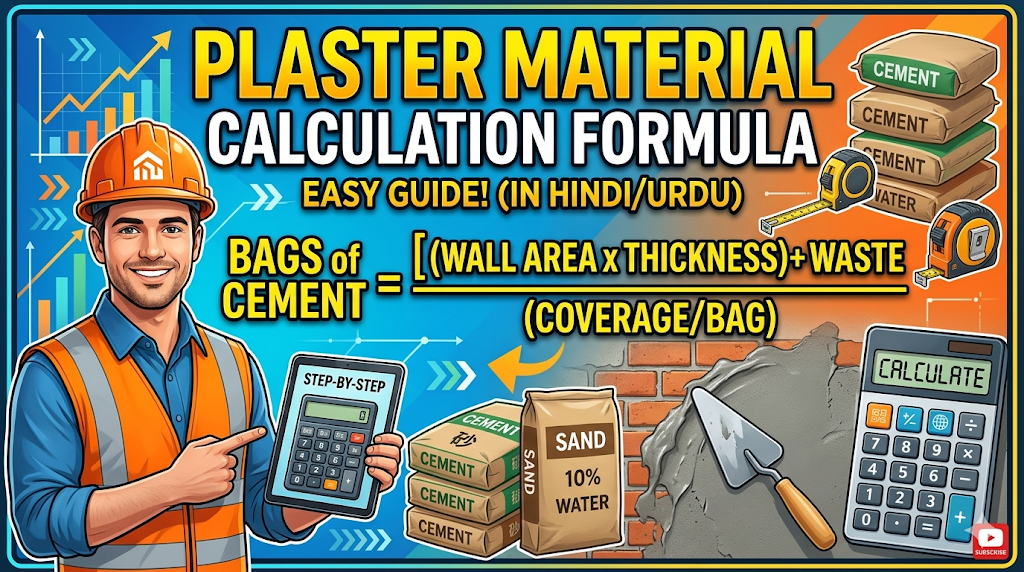
The basic plaster material calculation formula is.
Volume = Area \times Thickness
After finding volume, materials are calculated using mix ratio.
Step-by-Step Plaster Calculation
Step 1: Calculate Area
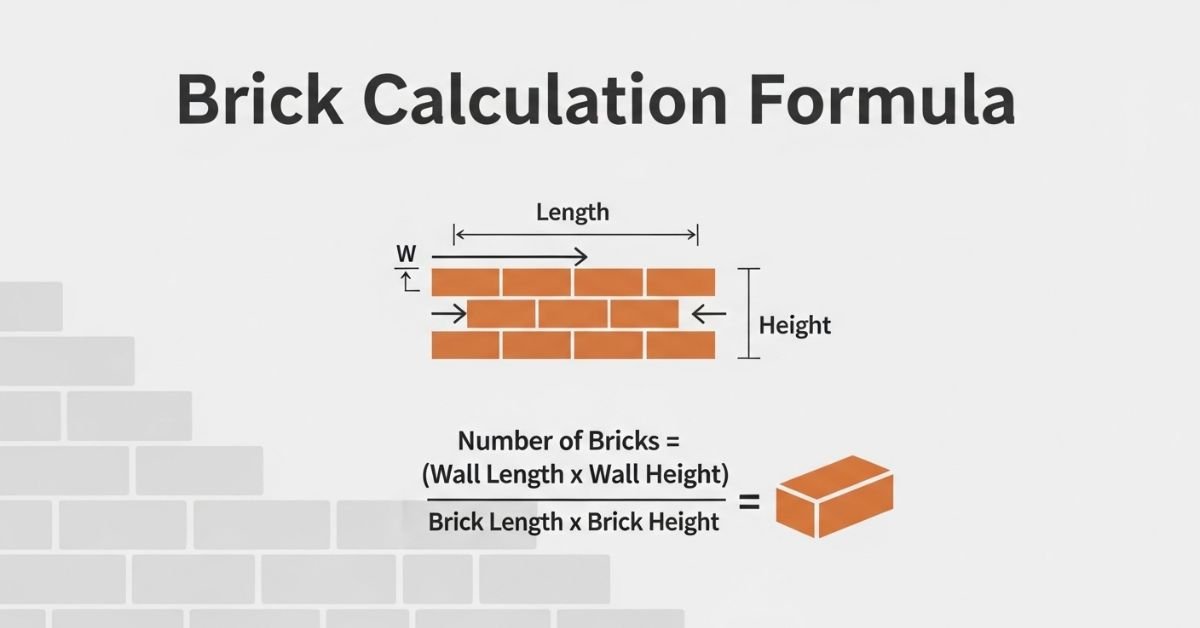
Area = Length × Height
Example
Wall length = 5 m
Height = 3 m
Area = 5 × 3 = 15 m²
Step 2: Thickness of Plaster
Standard thickness = 12 mm = 0.012 m
Step 3: Wet Volume
Wet Volume = Area × Thickness
= 15 × 0.012
= 0.18 m³
Step 4: Dry Volume
Dry volume = Wet volume × 1.33
= 0.18 × 1.33
= 0.239 m³
Step 5: Mix Ratio (1:4)
Total parts = 1 + 4 = 5
- Cement = 1/5 × 0.239 = 0.0478 m³
- Sand = 4/5 × 0.239 = 0.191 m³
Step 6: Convert Cement into Bags
1 cement bag = 0.035 m³
Cement bags = 0.0478 / 0.035 ≈ 1.37 bags
Final Result
For 15 m² plastering
- Cement ≈ 1.4 bags
- Sand ≈ 0.19 m³
This is how the plaster material calculation formula is used in practice.
Cement and Sand Required for 1 sqm Plastering
For standard plaster (12 mm thickness, 1:4 ratio):
- Cement ≈ 0.09 bags per sqm
- Sand ≈ 0.012 m³ per sqm
This quick data helps in fast estimation using the plaster material calculation formula.
Cement Plastering Calculation in Sq Ft
If area is given in square feet
1 sqm = 10.764 sq ft
Example
100 sq ft = 9.29 sqm
Now apply the same plaster material calculation formula after conversion.
Plastering Calculation in Sqm
The most common unit used in construction is square meter (sqm).
Using sqm simplifies calculations because thickness is already in meters. This makes the plaster material calculation formula easier and more accurate.
Plastering Calculation in Sq Ft Excel
You can use Excel for quick calculations.
Excel formula
- Area = Length × Height
- Volume = Area × Thickness
You can create a sheet where you enter area and thickness, and it automatically calculates cement and sand. This is very helpful for large projects.
Plaster Material Calculation Formula India
In India standard plaster practices are
- Thickness = 12 mm (internal), 15 mm (external)
- Mix ratio = 1:4 or 1:6
The plaster material calculation formula India follows the same steps but may vary slightly depending on site conditions.
Plaster Material Calculation Formula PDF
Many engineers use PDF guides for quick reference. You can also create your own PDF using this formula and examples for easy access on-site.
Explore More:Click here
Common Mistakes in Plaster Calculation
Avoid these mistakes while using the plaster material calculation formula.
- Ignoring thickness variation
- Not converting units properly
- Wrong mix ratio
- Not adding dry volume factor (1.33)
These mistakes can lead to incorrect estimation.
Tips for Accurate Plaster Calculation
- Always measure area correctly
- Use standard thickness
- Apply dry volume factor
- Double-check calculations
These tips will help you get accurate results using the plaster material calculation formula.
Conclusion
Plastering is a key part of construction and proper material estimation is essential for quality work. The plaster material calculation formula helps you calculate cement and sand accurately saving both time and money.
Whether you use manual calculation Excel or reference tables the basic concept remains the same With practice you can easily master plaster calculations for any project.
Read more:Dry Volume Of Concrete Formula: How To Convert Wet Volume To Dry Volume (With Example)