In construction work, plastering is a very important finishing process that gives a smooth and strong surface to walls. However, before starting plaster work, it is necessary to estimate the correct quantity of materials. This is where wall plaster quantity calculation becomes essential.
If cement and sand are not calculated properly, it can lead to material wastage, uneven surface, and increased project cost. That is why engineers always follow proper methods for cement sand calculation plaster to ensure accurate estimation.
In this article, we will explain wall plaster estimation, plastering calculation in square meter and square feet, and how to calculate cement and sand step-by-step. This guide is useful for students, contractors, and homeowners.
What Is Wall Plaster Quantity Calculation
Wall plaster quantity calculation is the process of estimating the amount of plaster required for a wall surface. It includes calculating cement, sand, and total plaster volume based on area and thickness.
Plastering is usually done in thickness of 12 mm or 15 mm depending on surface conditions. The quantity of materials depends on this thickness and the mix ratio used.
By performing proper plaster quantity formula, engineers can ensure accurate material planning and avoid unnecessary expenses.
Plastering Calculation Formula
The basic formula used in plastering calculation formula is simple and widely used in construction.
Plaster Volume = Area × Thickness
Where:
- Area = Length × Height
- Thickness = Thickness of plaster
After calculating wet volume, we convert it into dry volume:
Dry Volume = Wet Volume × 1.33
This formula is essential for accurate wall plaster estimation.
Cement And Sand Calculation For Plaster
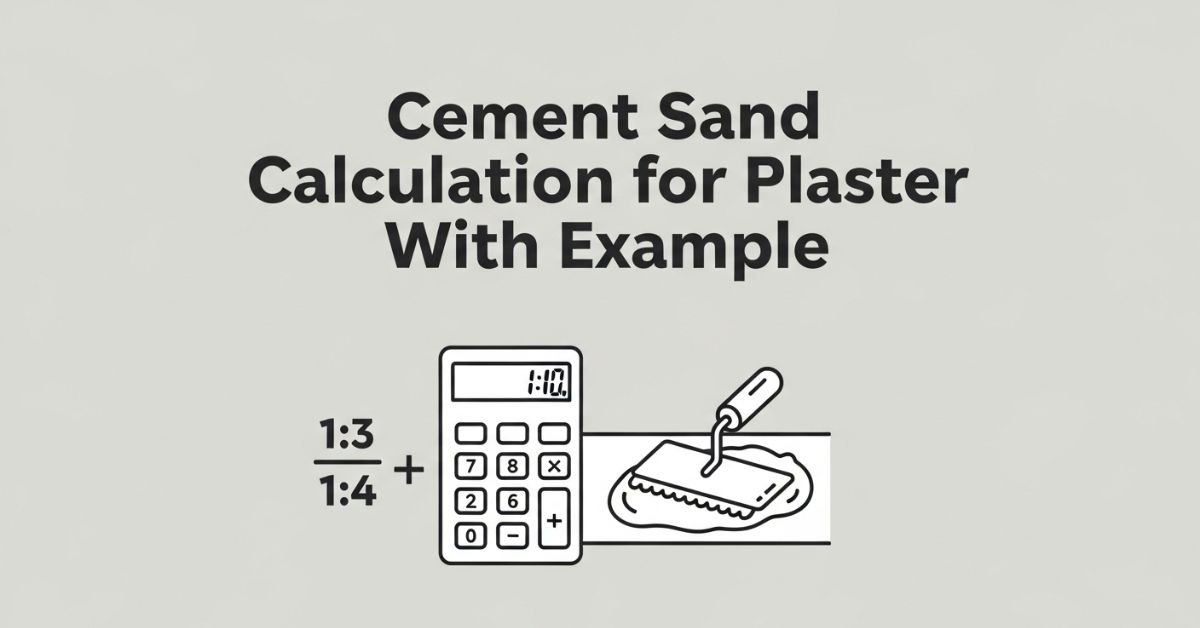
Once dry volume is calculated, the next step is to find cement and sand quantity using mix ratio.
For plastering, the standard ratio is:
1:6 (Cement : Sand)
Total parts = 7
Cement = 1/7 × Dry Volume
Sand = 6/7 × Dry Volume
This method is used in cement sand calculation plaster and ensures proper strength and finish of plaster.
Plaster Quantity Calculation With Example
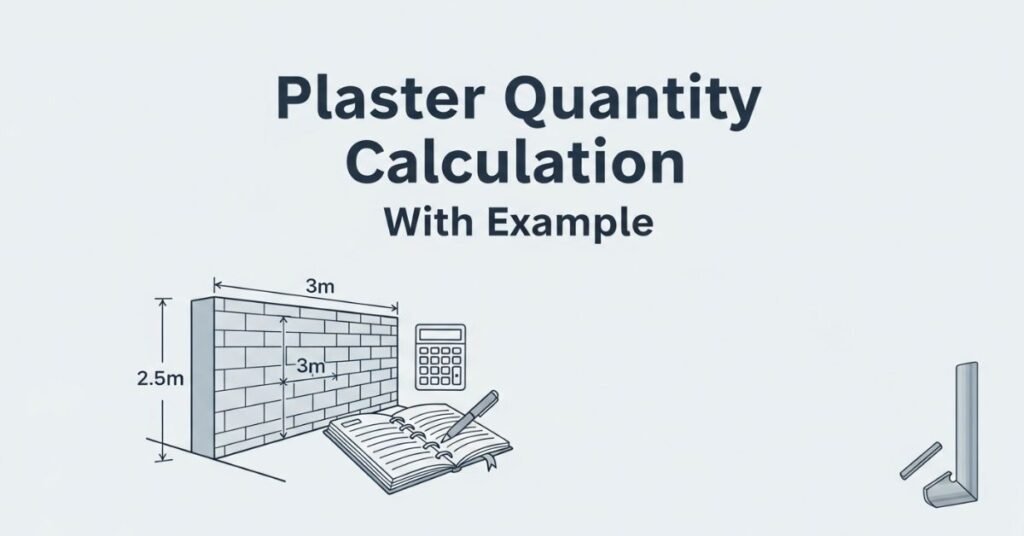
Let’s understand wall plaster quantity calculation with a practical example.
Given:
- Wall area = 12 m²
- Thickness = 12 mm (0.012 m)
Step 1: Calculate Wet Volume
Volume =
12 × 0.012 = 0.144 m³
Step 2: Convert To Dry Volume
Dry Volume =
0.144 × 1.33 = 0.191 m³
Step 3: Calculate Cement And Sand
Cement = 1/7 × 0.191 = 0.027 m³
Sand = 6/7 × 0.191 = 0.164 m³
Step 4: Convert Cement Into Bags
Cement =
0.027 ÷ 0.035 ≈ 0.77 bags
Final Result
- Cement ≈ 0.75 to 0.8 bags
- Sand ≈ 0.16 m³
This is a complete plastering calculation formula example.
Cement Required For 1 Sqm Plastering
For quick estimation, engineers use standard values.
For 12 mm plaster (1:6 ratio):
- Cement ≈ 0.065 to 0.07 bags per sqm
- Sand ≈ 0.013 to 0.015 m³ per sqm
These values are commonly used in cement required for 1 sqm plastering 1:6 calculations.
Plastering Calculation In Sq Ft
In many construction sites, dimensions are measured in feet. So understanding plastering calculation in sq ft is also important.
Example:
- Area = 120 sq ft
- Convert to sqm = 11.15 m²
Now apply same formula:
Volume =
11.15 × 0.012 = 0.134 m³
Then calculate dry volume and materials.
This method is useful for practical plastering sand calculation.
Plaster Mix Ratio Explained
The plaster mix ratio defines the proportion of cement and sand used in plastering. The most commonly used ratio is 1:6, which provides good strength and smooth finish.
For external plaster, sometimes 1:4 ratio is used for better durability. The selection of ratio depends on surface conditions and design requirements.
Choosing the correct mix ratio is important for long-lasting plaster work.
Practical Use In Construction
Wall plaster quantity calculation is widely used in construction for material estimation, cost planning, and execution of plaster work. Engineers use it to prepare quantity take-offs and ensure proper material availability.
Contractors use this calculation to avoid shortages and reduce wastage. It also helps in maintaining quality and consistency in plastering work.
This makes plaster calculation an essential part of construction planning.
Benefits Of Plaster Quantity Calculation
Understanding wall plaster estimation provides many advantages. It helps in accurate material calculation and reduces unnecessary wastage.
It also improves cost control and ensures smooth construction workflow. Proper calculation leads to better finishing quality and long-lasting plaster surfaces.
Common Mistakes In Plaster Calculation
Some common mistakes include:
- Not considering dry volume factor
- Using wrong plaster thickness
- Incorrect mix ratio
- Ignoring surface unevenness
Avoiding these mistakes ensures accurate plaster quantity formula and better construction results.
Frequently Asked Questions (FAQ)
What Is Wall Plaster Quantity Calculation
It is the method used to calculate cement and sand required for plastering a wall.
What Is Plastering Calculation Formula
Plaster Volume = Area × Thickness
How Much Cement Required For 1 Sqm Plastering
Around 0.065 to 0.07 bags for 1 sqm plastering.
What Is Standard Plaster Mix Ratio
The standard ratio is 1:6 (cement : sand).
Conclusion
Wall plaster quantity calculation is an important step in construction that helps in estimating cement and sand accurately. By using simple formulas and proper mix ratios, engineers can calculate plaster materials easily. Understanding cement sand calculation plaster improves planning, reduces wastage, and ensures better quality work. With proper knowledge, plaster estimation becomes simple and effective.
Read more: House Construction Material List: Complete Guide For Building Materials Planning