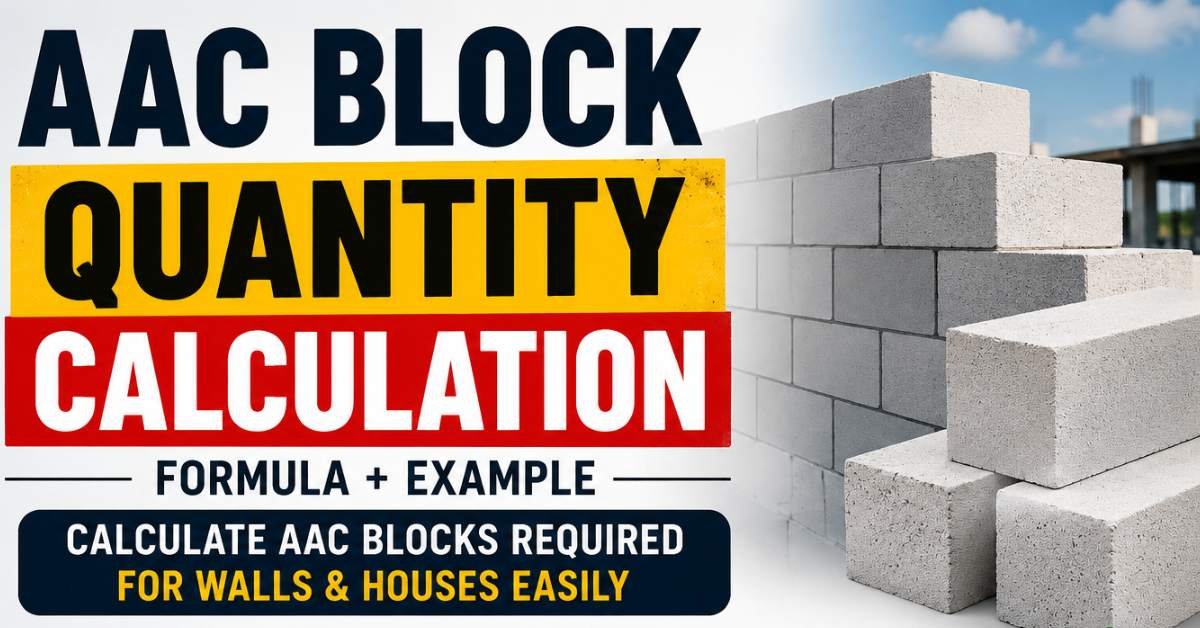
In modern construction, AAC blocks are widely used because they are lightweight, easy to handle, and provide better insulation compared to traditional bricks. However, before starting any block work, it is very important to estimate the number of blocks required. This is where the AAC block calculation formula becomes useful.
Accurate calculation helps avoid material shortage, reduces wastage, and keeps construction costs under control. Whether you are working on a small house or a large building project, understanding AAC block quantity calculation is essential for proper planning.
In this article, we will explain the AAC Block Calculation Formula, how to calculate AAC blocks for a wall, and a practical example to make the concept easy to understand. This guide is useful for civil engineering students, contractors, and site engineers.
Table of Contents
What Is AAC Block Calculation Formula
The AAC Block Calculation Formula is used to estimate the number of AAC blocks required for a wall or structure.
In block masonry, we calculate:
- Wall area or volume
- Block size
- Number of blocks required
The basic idea is to divide the wall area by the area of one block. This method is commonly used in block work calculation and construction estimation.
Standard AAC Block Size
Before applying the AAC Block Calculation Formula, it is important to know the standard AAC Block size.
Common AAC block sizes in India:
- 600 mm × 200 mm × 200 mm
- 600 mm × 200 mm × 150 mm
- 600 mm × 200 mm × 100 mm
In feet (approx):
- Length = 2 ft
- Height = 0.67 ft
This standard size is used in most AAC block wall calculation processes.
AAC Block Calculation Formula For Wall
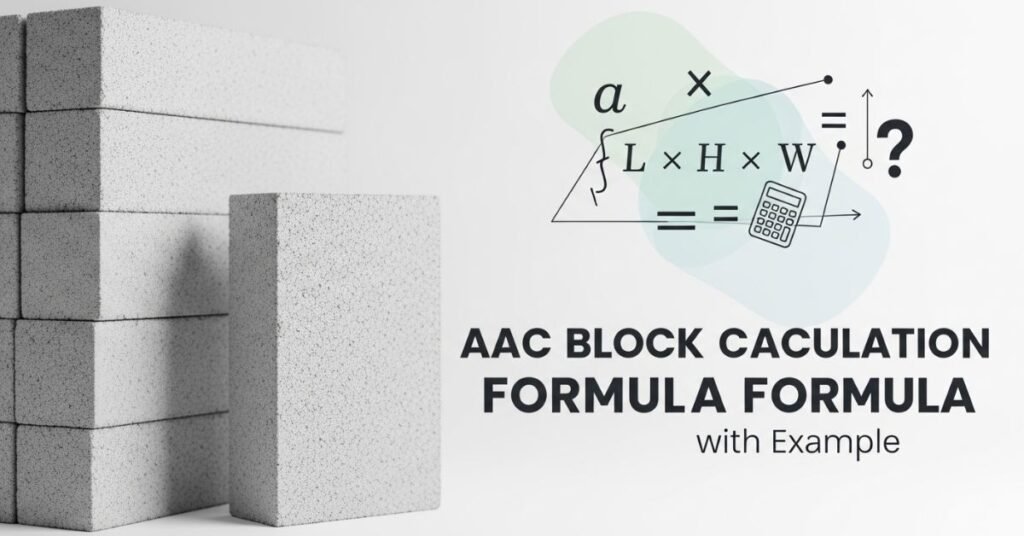
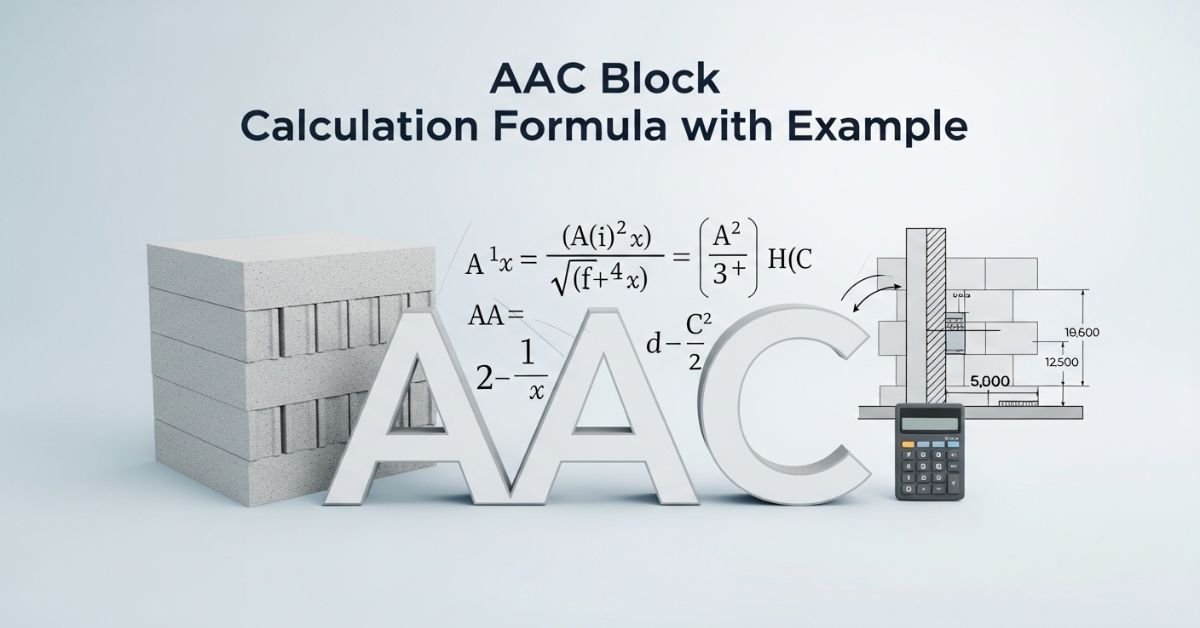
The basic AAC Block Calculation Formula is:
Number of Blocks = Wall Area ÷ Block Area
Where:
Wall Area = Length × Height
Block Area = Length × Height of one block
This formula is widely used in block masonry estimation and site calculations.
How To Calculate AAC Block Quantity (Step-By-Step Example)
Let’s understand the AAC Block Calculation Formula with a simple example.
Suppose we have a wall:
- Length = 20 ft
- Height = 10 ft
Step 1: Calculate Wall Area
Wall Area =
20 × 10 = 200 sq ft
Step 2: Calculate Block Area
Standard AAC block size:
2 ft × 0.67 ft
Block Area =
2 × 0.67 = 1.34 sq ft
Step 3: Calculate Number Of Blocks
Apply the AAC Block Calculation Formula:
Number of blocks =
200 ÷ 1.34
≈ 149 blocks
Add 5–10% extra for wastage:
Final blocks required ≈ 160 blocks
This is how how to calculate AAC block quantity works in real construction.
AAC Block Calculator Square Feet Method
For quick estimation, many engineers use the AAC block calculator square feet method.
Basic rule:
- 1 AAC block covers approx 1.3 to 1.4 sq ft area
So,
For 100 sq ft wall:
Blocks required ≈
100 ÷ 1.34 ≈ 75 blocks
This method is helpful for fast AAC block quantity calculation on site.
How Many AAC Blocks In 1 Square Feet
This is a common question in construction.
Typically:
- 1 sq ft area requires approx 0.75 AAC blocks
This value helps in quick estimation during block work calculation.
How Many AAC Blocks In 100 Square Feet
Using the standard method:
100 ÷ 1.34 ≈ 75 blocks
So, around 75 AAC blocks are required for 100 sq ft wall.
How Many AAC Blocks Required For 1000 Sq Ft House
Let’s estimate using average calculation.
Assuming total wall area ≈ 1200 sq ft
Blocks required:
1200 ÷ 1.34 ≈ 895 blocks
Add wastage:
Final ≈ 950–1000 AAC blocks
This type of estimation is useful in block masonry estimation for residential projects.
Calculate The Exact Number Of Bricks, Cement, And Sand Required For Your Walls. Use our free Brickwork Estimator to minimize wastage and plan your budget.
How To Calculate AAC Block In Cubic Meter
Another method used in construction is volume-based calculation.
AAC block volume:
0.6 × 0.2 × 0.2 = 0.024 cubic meters
Number of blocks in 1 cubic meter:
1 ÷ 0.024 ≈ 41 blocks
This method is used in detailed AAC block wall calculation and estimation.
Practical Use In Construction
The AAC Block Calculation Formula is used by:
- Civil engineers
- Contractors
- Quantity surveyors
- Site supervisors
It helps in:
- Material planning
- Cost estimation
- Reducing wastage
- Efficient construction workflow
Understanding this formula improves overall block work calculation accuracy.
Benefits Of AAC Block Calculation
Knowing the AAC Block Calculation Formula offers many advantages:
- Accurate material estimation
- Cost control in construction
- Reduced material wastage
- Better project planning
- Faster construction execution
Because of these benefits, AAC block quantity calculation is an essential skill in civil engineering.
Common Mistakes In AAC Block Calculation
Some common mistakes include:
- Ignoring mortar thickness
- Using incorrect block size
- Not adding wastage factor
- Wrong area calculation
Proper use of the AAC block calculation formula helps avoid these errors.
Frequently Asked Questions
What Is AAC Block Calculation Formula?
The AAC Block Calculation Formula is used to calculate the number of blocks required by dividing wall area by block area.
How Many AAC Blocks In 100 Square Feet?
Approximately 75 AAC blocks are required for 100 square feet wall area.
How To Calculate AAC Block Quantity?
Calculate wall area and divide it by block area. Then add 5–10% extra for wastage.
What Is Standard AAC Block Size?
Common AAC block size is 600 mm × 200 mm × 200 mm, which is widely used in construction.
Conclusion
The AAC block calculation formula is an important concept used in modern construction for estimating block quantity accurately. By calculating wall area and dividing it by block area, engineers can easily determine the number of blocks required.
Whether you are working on a small wall or a complete house, understanding AAC block quantity calculation helps in proper planning, cost control, and efficient construction. Using this formula along with practical examples makes block estimation simple and reliable.
Read More: Plaster Material Calculation Formula: Step-by-Step Guide with Example