

Introduction
One Thing That Often Confuses Beginners Is Cement Density. Cement Is One Of The Most Commonly Used Construction Materials In The World. From Small Home Projects To Massive Bridges And Skyscrapers, Cement Plays A Huge Role Everywhere. But When It Comes To Construction Calculations,
If You Are A Civil Engineering Student, Contractor, Mason, Homeowner, Or Someone Simply Curious About Construction Basics, Understanding Cement Density Is Actually Very Important. It Helps In Concrete Mix Design, Material Estimation, And Maintaining Construction Quality.
In Simple Words, Cement Density Tells Us How Much Cement Is Present In A Particular Volume. Sounds Technical At First, But Honestly, It’s Not That Complicated Once You Understand The Basics.
In This Article, You’ll Learn The Definition Of Cement Density, Its Formula, Standard Values, Calculation Method, Importance, And Much More In A Very Simple And Easy-To-Understand Way.
Table of Contents

What Is Cement Density ?
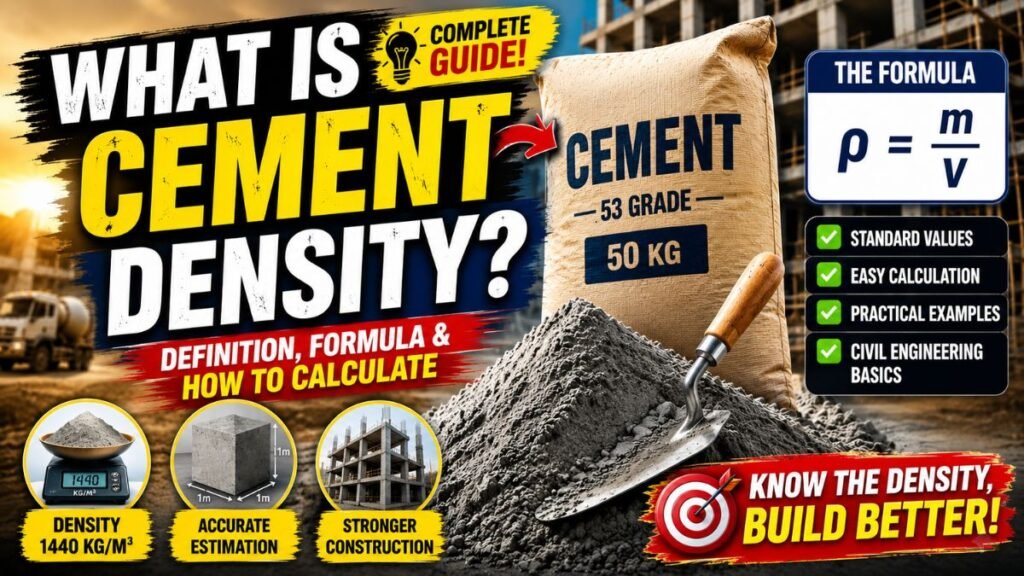
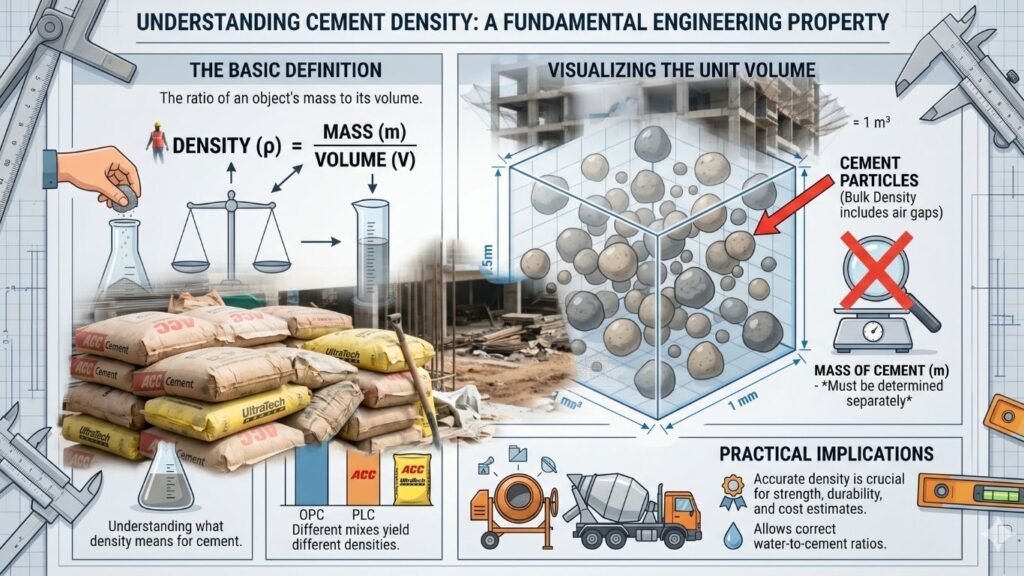
Cement Density Simply Means The Mass Of Cement Present In A Unit Volume. In Construction, Density Helps Determine How Much Cement Is Required For Concrete Or Mortar Work.
The Standard Density Of Cement Is Generally Considered:
- 1440 Kg/M³ For Loose Cement
- 3150 Kg/M³ For Actual Cement Particle Density
Many People Think Density And Weight Are The Same Thing, But They’re Actually Different. Density Depends On Both Mass And Volume.
Definition Of Cement Density
Cement Density Can Be Defined As:
“The Mass Of Cement Contained In A Unit Volume.”
It Is Usually Measured In:
- Kilograms Per Cubic Meter (Kg/M³)
- Grams Per Cubic Centimeter (G/Cm³)
This Property Is Very Important In Civil Engineering And Construction Calculations.
Cement Density Formula
The Formula Used To Calculate Cement Density Is:
ρ=Vm=2.4kg/L
Where:
- Ρ = Density Of Cement
- M = Mass Of Cement
- V = Volume Of Cement
This Formula Is Quite Simple. You Just Divide The Mass Of Cement By Its Volume.
Standard Density Of Cement
Different Conditions Of Cement Can Have Different Density Values.
| Type Of Cement | Density |
|---|---|
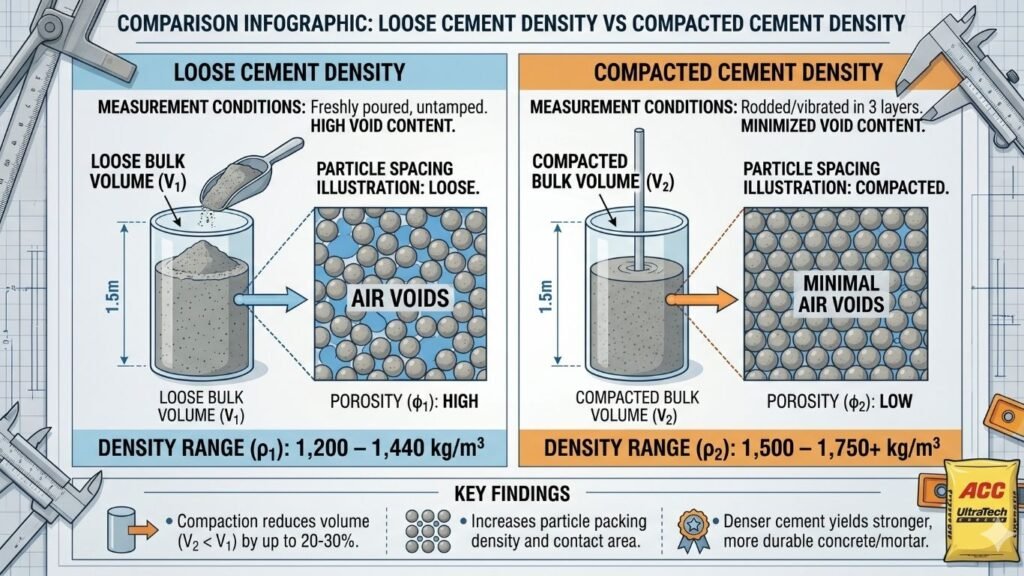
| Loose Cement | 1440 Kg/M³ |
| Compacted Cement | 1680 Kg/M³ |
| Actual Cement Particle Density | 3150 Kg/M³ |
Loose Cement Density
Fresh Cement Contains Tiny Air Gaps Between Particles, Which Lowers The Density Slightly.
Compacted Cement Density
When Cement Is Compacted Properly, Air Voids Reduce And Density Increases.
True Density Of Cement
This Is The Density Of Actual Cement Particles Without Air Spaces.
Why Cement Density Is Important
Honestly, Cement Density May Look Like A Small Topic, But It Has A Huge Impact In Construction Work.
1. Accurate Material Estimation
Density Helps Calculate The Correct Quantity Of Cement Required For Projects.
2. Concrete Mix Design
Engineers Use Density Values While Preparing Concrete Mixes.
3. Quality Control
Changes In Density May Indicate Moisture Absorption Or Improper Storage.
4. Structural Strength
Proper Cement Quantity Ensures Better Bonding And Stronger Structures.
5. Transportation And Storage
Density Also Affects Transportation Calculations And Storage Capacity.
How To Calculate Cement Density
Calculating Cement Density Is Actually Pretty Easy If You Know The Weight And Volume.
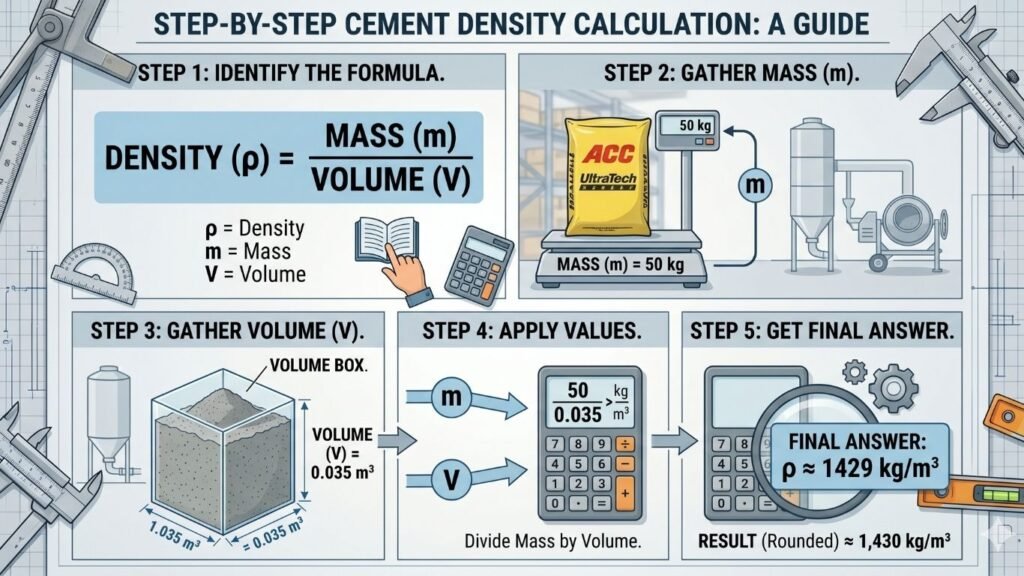
Step 1: Measure Cement Weight
Suppose The Cement Weight Is:
- 50 Kg
Step 2: Measure Volume
Assume The Cement Occupies:
- 0.0347 M³
Step 3: Apply The Formula
ρ=0.034750
Step 4: Final Result
Density = 1440 Kg/M³
This Is The Approximate Bulk Density Of Cement Used In Construction.
Cement Density In Different Units
Different Countries And Engineering Standards Use Different Units For Density.
| Unit | Cement Density |
|---|---|
| Kg/M³ | 1440 Kg/M³ |
| G/Cm³ | 1.44 G/Cm³ |
| Lb/Ft³ | 89.9 Lb/Ft³ |
These Unit Conversions Are Commonly Used In Construction Industries Worldwide.
Factors Affecting Cement Density
Several Factors Can Affect The Density Of Cement.
Moisture Content
Cement Absorbs Moisture From Air, Which Changes Its Properties And Density.
Storage Condition
Improper Storage May Cause Lumps And Reduce Cement Quality.
Compaction
More Compaction Means Fewer Air Gaps And Higher Density.
Cement Type
Different Cement Types Can Have Slightly Different Densities.
Age Of Cement
Old Cement May Lose Freshness Over Time.

Difference Between Density And Specific Gravity Of Cement
A Lot Of Beginners Confuse Density With Specific Gravity. But Both Are Different Concepts.
| Property | Density | Specific Gravity |
|---|---|---|
| Meaning | Mass Per Unit Volume | Ratio Compared To Water |
| Unit | Kg/M³ | No Unit |
| Standard Value | 1440 Kg/M³ | 3.15 |
Specific Gravity Compares Cement With Water Density, While Density Measures Actual Mass Per Volume.
Bulk Density Vs True Density Of Cement
Bulk Density
Bulk Density Includes Air Spaces Between Cement Particles.
- Approximate Value: 1440 Kg/M³
True Density
True Density Excludes Air Gaps And Measures Only Cement Particles.
- Approximate Value: 3150 Kg/M³
Both Values Are Useful In Different Engineering Calculations.
Cement Density Test
In Laboratories, Cement Density Is Measured Using Special Testing Methods.
Common Testing Methods
- Le Chatelier Flask Method
- Pycnometer Method
- Density Bottle Method
These Tests Help Determine Cement Quality And Physical Properties.

Uses Of Cement Density In Construction
Cement Density Is Used In Many Construction Activities, Including:
- Concrete Mix Proportioning
- Quantity Estimation
- Structural Design
- Mortar Calculations
- Material Quality Checking
- Transportation Planning
Without Proper Density Calculations, Construction Quality Can Get Affected.
Common Mistakes While Calculating Cement Density
Here Are Some Common Mistakes People Make:
- Using Wrong Units
- Ignoring Moisture Content
- Measuring Incorrect Volume
- Confusing Density With Specific Gravity
- Using Old Or Lumped Cement
Even Small Calculation Mistakes Can Affect Construction Quality.
Tips To Maintain Cement Quality
To Maintain Proper Cement Density And Quality:
- Store Cement In A Dry Area
- Keep Bags Away From Moisture
- Use Cement Before Expiry Date
- Avoid Direct Floor Contact
- Stack Cement Bags Properly
Good Storage Practices Help Maintain Cement Strength And Durability.
Conclusion
Cement Density Is One Of The Basic Yet Very Important Concepts In Construction And Civil Engineering. It Helps Calculate Material Quantities, Prepare Accurate Concrete Mixes, And Maintain Overall Construction Quality.
The Standard Bulk Density Of Cement Is Around 1440 Kg/M³, While The True Density Is Approximately 3150 Kg/M³. Once You Understand The Formula And Calculation Method, The Topic Becomes Much Easier.
Whether You’re A Student, Engineer, Contractor, Or Homeowner, Having Proper Knowledge Of Cement Density Can Definitely Help You Make Better Construction Decisions.
Frequently Asked Questions (FAQ)
What Is The Standard Density Of Cement ?
The Standard Bulk Density Of Cement Is Approximately 1440 Kg/M³.
What Is The True Density Of Cement ?
The True Density Of Cement Particles Is Around 3150 Kg/M³.
Why Is Cement Density Important ?
Cement Density Helps In Quantity Estimation, Mix Design, And Quality Control.
H3: What Is The Formula For Cement Density ?
ρ = Vm
ρ=Vm=2.4kg/L
Does Moisture Affect Cement Density ?
Yes, Moisture Absorption Can Change Cement Density And Reduce Quality.
What Is The Unit Of Cement Density ?
The Most Commonly Used Unit Is Kilograms Per Cubic Meter (Kg/M³).
Read More Concrete Quantity Calculation For Slab Volume & Material Formula Guide
