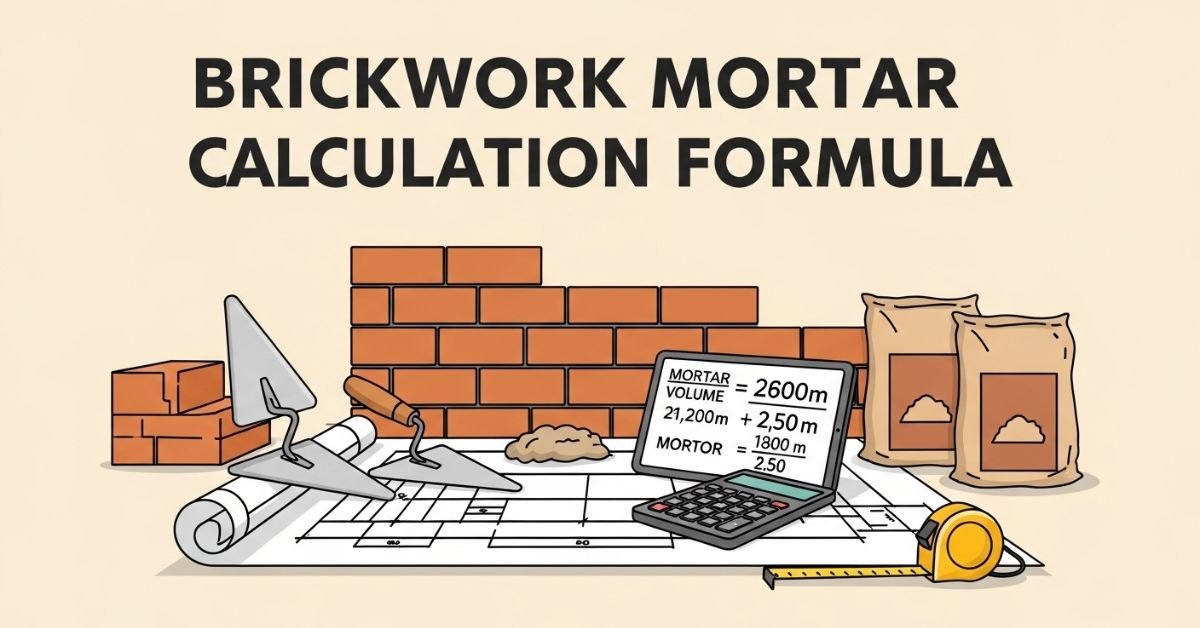
In construction projects, brickwork is one of the most common activities, and along with bricks, mortar plays a very important role. Mortar is used to bind bricks together and provide strength to the structure. To estimate materials correctly, engineers use the brickwork mortar calculation formula.
If mortar quantity is not calculated properly, it can lead to material shortages, delays, or unnecessary extra costs. That is why understanding how to calculate mortar for brick work is essential for civil engineers, contractors, and site supervisors.
In this article, we will explain the Brickwork Mortar Calculation Formula, the cement-sand ratio used in brickwork, and a step-by-step example to calculate mortar quantity easily. This guide will help you understand brick mortar quantity and improve your construction estimation skills.
Table of Contents
What Is Brickwork Mortar Calculation Formula
The Brickwork Mortar Calculation Formula is used to estimate the quantity of mortar required for brick masonry.
In brickwork, mortar fills the gaps between bricks and provides bonding strength. While calculating brickwork, engineers also calculate the volume of mortar in brickwork.
Basic concept:
Mortar Volume = Total Brickwork Volume – Volume of Bricks
This is the fundamental brick masonry mortar formula used in construction estimation.
Brick Work Mortar Ratio As Per IS Code
In India, the commonly used mortar ratio for brickwork is:
- 1:6 (Cement : Sand)
This ratio is widely used for general brick masonry as per standard construction practices.
In this ratio:
- 1 part cement
- 6 parts sand
This ratio is important while applying the Brickwork Mortar Calculation Formula to determine cement and sand quantities.
Brickwork Calculation Formula
Before calculating mortar, we first need to calculate brickwork volume.
Brickwork Volume Formula:
Volume = Length × Height × Thickness
For example:
- Length = 5 m
- Height = 3 m
- Thickness = 0.23 m
Volume =
5 × 3 × 0.23 = 3.45 cubic meters
This value is used in brickwork mortar calculation formula.
Volume Of Mortar In Brickwork
To calculate mortar volume, we subtract brick volume from total brickwork volume.
Standard assumption:
- Volume of bricks ≈ 75–80%
- Volume of mortar ≈ 20–25%
So,
Mortar Volume ≈ 25% of brickwork volume
Example:
Brickwork volume = 1 m³
Mortar volume = 0.25 m³
After that, dry volume is calculated using a factor.
Brickwork Mortar Calculation Formula
The standard Brickwork Mortar Calculation Formula is:
Dry Volume of Mortar = Wet Volume × 1.33
Where:
- Wet Volume = 0.25 × Brickwork Volume
- 1.33 = Dry volume factor
This formula is widely used in mortar calculation brickwork.
How To Calculate Mortar For Brick Work (Step-By-Step Example)
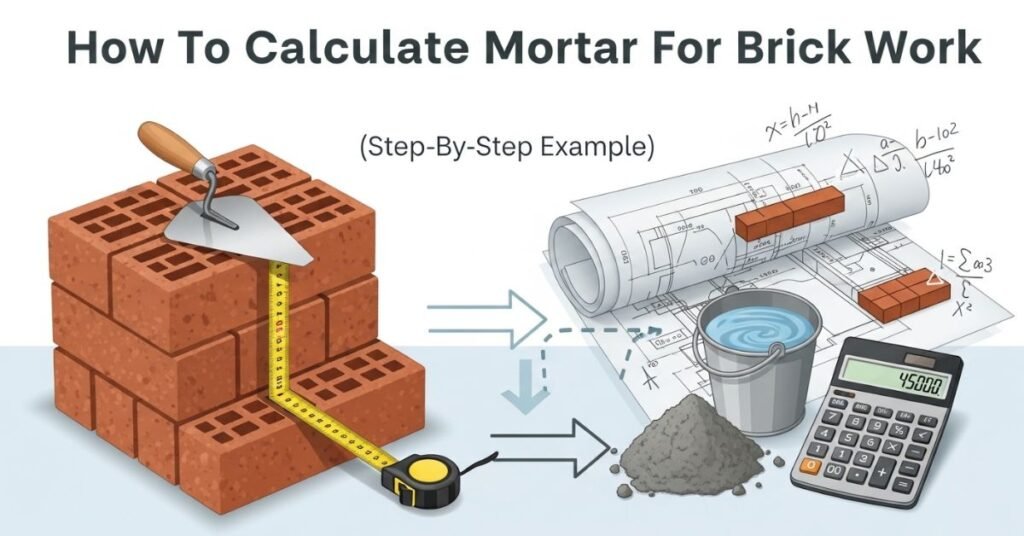
Let’s understand the Brickwork Mortar Calculation Formula with an example.
Given:
Brickwork volume = 1 cubic meter
Step 1: Calculate Wet Mortar Volume
Mortar = 25% of brickwork
= 0.25 × 1
= 0.25 m³
Step 2: Convert To Dry Volume
Dry Volume =
0.25 × 1.33
= 0.3325 m³
Step 3: Apply Cement Sand Ratio (1:6)
Total parts = 7
Cement = 1/7 × 0.3325 = 0.0475 m³
Sand = 6/7 × 0.3325 = 0.285 m³
Step 4: Convert Cement To Bags
1 cement bag = 0.035 m³
Cement required:
0.0475 ÷ 0.035 ≈ 1.36 bags
So,
- Cement ≈ 1.4 bags
- Sand ≈ 0.285 m³
This is the complete Brickwork Mortar Calculation Formula explained with a practical example.
Cement Required For 1 Cubic Meter Brickwork 1:6
For 1 m³ brickwork using 1:6 mortar ratio:
- Cement ≈ 1.3 to 1.5 bags
- Sand ≈ 0.28 to 0.30 m³
These values are widely used in cement brickwork mortar calculation formula explained for estimation.
How To Calculate Mortar Quantity In Brickwork
To calculate mortar quantity, follow these steps:
- Calculate brickwork volume
- Take 25% of volume for mortar
- Multiply by 1.33 for dry volume
- Apply cement-sand ratio
- Convert cement into bags
This method is used in how to calculate mortar quantity in brickwork.
Practical Use In Construction
The Brickwork Mortar Calculation Formula is used in:
- Construction estimation
- Material planning
- Cost calculation
- Quantity surveying
Engineers use this formula to estimate brick mortar quantity accurately and avoid wastage.
Benefits Of Understanding Mortar Calculation
Understanding the Brickwork The mortar calculation formula provides many advantages:
- Accurate cement and sand estimation
- Reduced material wastage
- Better cost control
- Efficient project planning
- Smooth construction workflow
This is why mortar calculation brickwork is an essential skill.
Common Mistakes In Mortar Calculation
Some common mistakes include:
- Not considering mortar percentage
- Ignoring dry volume factor
- Wrong ratio calculation
- Incorrect unit conversion
Proper use of the brickwork mortar calculation formula helps avoid these issues.
Frequently Asked Questions
What Is Brickwork Mortar Calculation Formula?
The Brickwork Mortar Calculation Formula is used to calculate mortar quantity by taking 25% of brickwork volume and multiplying it by 1.33 for dry volume.
How To Calculate Mortar Quantity In Brickwork?
First calculate brickwork volume, take 25% as mortar, convert to dry volume, and apply the cement-sand ratio.
What Is Mortar Ratio For Brickwork?
The commonly used ratio is 1:6 (cement : sand) for general brick masonry.
How Much Cement Is Required For 1 Cubic Meter Brickwork?
Approximately 1.3 to 1.5 bags of cement are required for 1 cubic meter brickwork using 1:6 ratio.
Conclusion
The Brickwork Mortar Calculation Formula is an important concept in civil engineering used to estimate the quantity of cement and sand required in brickwork. By calculating mortar volume and applying the correct ratio, engineers can accurately plan materials for construction.
Understanding how to calculate mortar for brick work helps improve construction efficiency, reduce wastage, and control project costs. With proper calculation methods and examples, mortar estimation becomes simple and reliable.