In construction projects, accurate material estimation is one of the most important steps before starting any work. Whether you are building a small house or a large structure, knowing the exact amount of concrete required helps in proper planning and cost control. This is where concrete quantity calculation becomes essential.
Concrete is used in slabs, beams, columns, and foundations, and each structure requires a specific amount of material. If the quantity is not calculated properly, it can lead to material shortages, delays, or extra expenses. That is why civil engineers always use proper methods and formulas for concrete slab calculation.
In this article, we will explain the Concrete Quantity Calculation, how to calculate concrete volume for slabs, and how to estimate cement, sand, and aggregates using a simple step-by-step example. This guide is useful for students, contractors, and site engineers.
Table of Contents
What Is Concrete Quantity Calculation
Concrete Quantity Calculation is the process of determining how much concrete is required for a particular structure.
It involves calculating:
- Volume of concrete
- Quantity of cement
- Quantity of sand
- Quantity of aggregates
This calculation is based on the concrete volume calculation and mix ratio used in construction.
Concrete Volume Calculation Formula
The basic concrete estimation formula used in construction is:
Volume = Length × Width × Thickness
This formula is used for slab, footing, and other structures.
For slab:
Concrete Volume =
Length × Width × Thickness
This is the first step in Concrete Quantity Calculation.
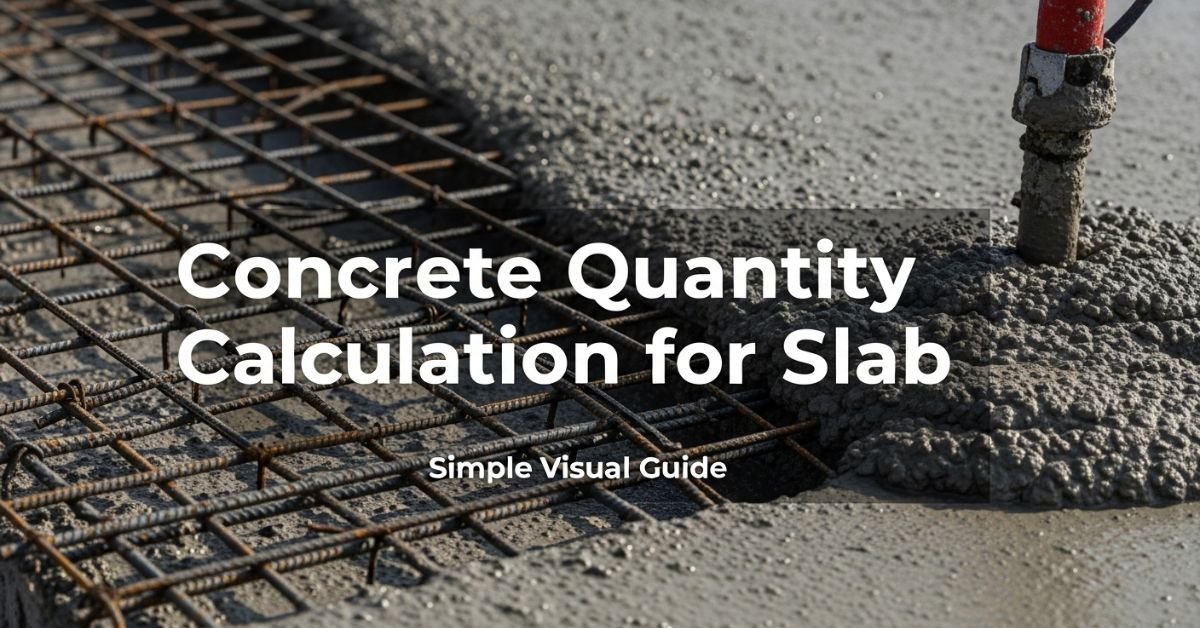
Concrete Quantity Calculation For Slab
Let’s understand Concrete Quantity Calculation for a slab using a practical example.
Given:
- Length = 5 meters
- Width = 4 meters
- Thickness = 0.15 meters
Step 1: Calculate Concrete Volume
Volume =
5 × 4 × 0.15
Volume = 3 cubic meters
This is the wet volume of concrete required for the slab.
Step 2: Convert Wet Volume To Dry Volume
To calculate materials, we convert wet volume into dry volume.
Dry Volume =
3 × 1.54
Dry Volume = 4.62 cubic meters
Step 3: Cement Sand Aggregate Calculation
Assume mix ratio = 1 : 2 : 4
Total parts = 7
Cement Quantity
Cement = 1/7 × 4.62
= 0.66 m³
Convert to bags:
0.66 ÷ 0.035 ≈ 19 bags
Sand Quantity
Sand = 2/7 × 4.62
= 1.32 m³
Aggregate Quantity
Aggregate = 4/7 × 4.62
= 2.64 m³
This is the complete Concrete Quantity Calculation example for a slab.
Concrete Mix Calculator (1:2:4 Ratio)
For quick estimation, engineers use the 1:2:4 concrete mix calculator method.
For 1 cubic meter concrete:
- Cement ≈ 6.3 bags
- Sand ≈ 0.44 m³
- Aggregate ≈ 0.88 m³
This helps in fast cement sand aggregate calculation on site.
Sand And Cement Calculator Method
In many construction sites, a sand and cement calculator is used for quick calculations.
Steps:
- Calculate concrete volume
- Apply dry volume factor
- Divide according to mix ratio
This method simplifies Concrete Quantity Calculation.
Concrete Quantity Calculation For Circular Column
The Concrete Quantity Calculation method can also be applied to circular columns.
Formula:
Volume = π × r² × height
Example:
- Radius = 0.2 m
- Height = 3 m
Volume =
3.14 × (0.2)² × 3
Volume ≈ 0.38 cubic meters
This shows how concrete volume calculation works for different structures.
Concrete Weight Calculator Concept
Sometimes engineers also calculate the weight of concrete.
Approximate value:
- 1 cubic meter concrete ≈ 2400 kg
So for 3 m³ concrete:
Weight =
3 × 2400 = 7200 kg
This is useful in structural design and load calculation.
Practical Use In Construction
Concrete Quantity Calculation is used in:
- Slab construction
- Beam and column work
- Foundation work
- Cost estimation
- Material planning
Engineers use this method to ensure proper supply of materials and avoid delays.
Benefits Of Concrete Quantity Calculation
Understanding Concrete Quantity Calculation provides many advantages:
- Accurate material estimation
- Reduced wastage
- Better cost control
- Efficient construction planning
- Improved project management
This is why it is a basic concept in civil engineering.
Common Mistakes In Concrete Calculation
Some common mistakes include:
- Using incorrect dimensions
- Ignoring dry volume factor
- Wrong mix ratio
- Unit conversion errors
Proper use of the Concrete Quantity Calculation method helps avoid these issues.
Frequently Asked Questions
What Is Concrete Quantity Calculation?
Concrete Quantity Calculation is the process of calculating the volume of concrete and required materials like cement, sand, and aggregates.
How To Calculate Concrete For Slab?
Use the formula:
Volume = Length × Width × Thickness
Then convert to dry volume and calculate materials.
What Is The Dry Volume Factor For Concrete?
The dry volume factor is 1.54, used to calculate material quantities.
How Many Cement Bags Are Required For 1 Cubic Meter Concrete?
For 1:2:4 mix, around 6 to 7 bags of cement are required.
Conclusion
Concrete Quantity Calculation is an essential part of construction planning. By calculating concrete volume and applying the correct mix ratio, engineers can estimate the required cement, sand, and aggregates accurately.
Whether you are working on a slab, column, or foundation, understanding concrete slab calculation helps in better material planning and cost control. With simple formulas and examples, this process becomes easy and reliable for any construction project.
Read More: Steel Bar Weight Calculation Formula Excel – Free Download & Easy Calculation Guide