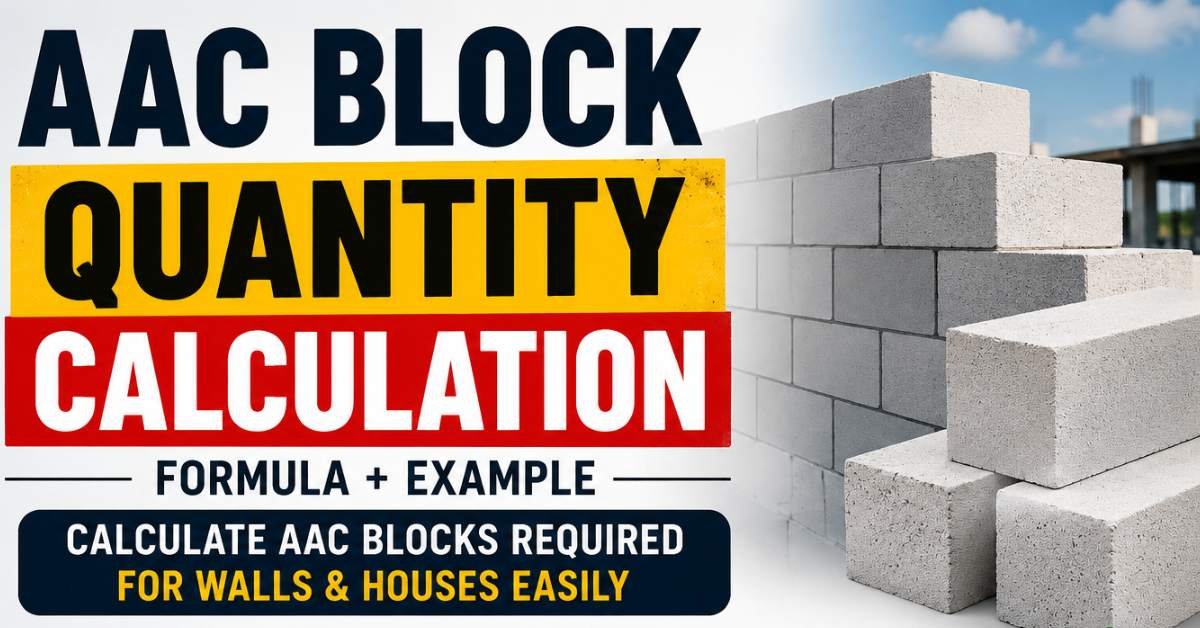
AAC blocks have become one of the most widely used construction materials in modern building projects because they are lightweight, durable, and thermally efficient. Compared to traditional clay bricks, AAC blocks reduce structural load and improve construction speed. This is why understanding AAC block quantity calculation is extremely important before starting block masonry work.
Many contractors and homeowners face problems during construction because they do not estimate AAC block quantity properly. Incorrect estimation can lead to material shortages, increased transportation cost, and unnecessary wastage. That is why engineers always perform proper AAC block calculation formula before ordering materials.
In this article, we will explain the complete AAC block quantity calculation method, block wall estimation formulas, square feet calculations, cubic meter calculations, and practical examples used in India. This guide is useful for contractors, civil engineering students, site engineers, and homeowners planning construction projects.
What Is AAC Block Quantity Calculation
AAC block quantity calculation is the process of determining the number of AAC blocks required for constructing walls based on wall dimensions and block size.
This calculation includes:
- Wall area calculation
- AAC block size calculation
- Number of blocks required
- Mortar joint consideration
- Wastage estimation
Proper AAC block estimation helps reduce material wastage and improves project planning.
Why AAC Block Calculation Is Important
Accurate block work calculation is important because AAC blocks are supplied in fixed sizes and transportation costs are high. If quantity estimation is incorrect, construction work may stop due to shortage of materials.
Proper AAC block calculation helps in:
- Better budgeting
- Reduced material wastage
- Faster construction planning
- Accurate transportation planning
- Improved masonry workflow
Professional engineers always use proper block quantity formula before starting wall construction.
Standard AAC Block Sizes
Before performing AAC block quantity calculation, it is important to know standard AAC block dimensions.
Common AAC block sizes used in India:
| Block Size (mm) | Block Size (feet) |
|---|---|
| 600 × 200 × 100 | 2 ft × 8 in × 4 in |
| 600 × 200 × 150 | 2 ft × 8 in × 6 in |
| 600 × 200 × 200 | 2 ft × 8 in × 8 in |
These dimensions are commonly used in AAC Block Calculator India methods.
AAC Block Calculation Formula
The standard AAC block calculation formula is:
Number Of Blocks = Wall Volume ÷ Block Volume
Where:
- Wall Volume = Length × Height × Thickness
- Block Volume = Length × Height × Width of one AAC block
This is the most commonly used AAC block quantity calculation method in construction projects.
AAC Block Quantity Calculation With Example
Let’s understand the AAC block quantity calculation process step-by-step with a practical example.
Given Data
Wall Dimensions:
- Length = 10 meters
- Height = 3 meters
- Wall Thickness = 0.2 meters
AAC Block Size:
- 600 × 200 × 200 mm
- Convert into meters:
- Length = 0.6 m
- Height = 0.2 m
- Width = 0.2 m
Step 1: Calculate Wall Volume
Wall Volume =
10 × 3 × 0.2
= 6 cubic meters
Step 2: Calculate AAC Block Volume
Block Volume =
0.6 × 0.2 × 0.2
= 0.024 cubic meters
Step 3: Calculate Number Of Blocks
Blocks Required =
6 ÷ 0.024
= 250 blocks
Step 4: Add Wastage Percentage
Usually, 5% additional blocks are added for breakage and cutting.
Extra Blocks =
250 × 5% = 12.5 ≈ 13 blocks
Final Result
Total AAC blocks required =
250 + 13 = 263 blocks
This is a practical AAC block quantity calculation formula with example used in real construction work.
AAC Block Wall Calculation
The AAC block wall calculation process is commonly used in residential and commercial projects. Engineers calculate total wall area first and then estimate block quantity based on wall thickness and block dimensions.
This method helps in:
- Material planning
- Transportation management
- Construction scheduling
- Cost estimation
Proper wall calculation improves construction efficiency and reduces wastage.
How Many AAC Blocks In 1 Cubic Meter
One of the most common questions in construction is:
How many AAC blocks in 1 cubic meter?
For standard 600×200×200 mm blocks:
Block Volume =
0.024 cubic meters
Blocks in 1 cubic meter =
1 ÷ 0.024
≈ 42 blocks
This value may slightly vary depending on mortar joint thickness.
How Many AAC Blocks In 100 Square Feet
To estimate how many AAC blocks in 100 square feet, wall thickness must be considered.
For a standard 8-inch AAC block wall:
Approximately:
90 to 100 AAC blocks
are required for 100 sq ft wall area.
This value depends on block size and mortar thickness.
How Many AAC Blocks Required For 1000 Sq Ft House
The total AAC block quantity for a house depends on:
- Built-up area
- Number of rooms
- Wall thickness
- Floor height
Generally:
3500 to 5000 AAC blocks
may be required for a standard 1000 sq ft house.
Actual quantity varies based on structural design.
AAC Block Calculator Square Feet Method
Many contractors use AAC Block calculator square feet tools for quick estimation. These calculators estimate block quantity based on:
- Wall area
- Block dimensions
- Wall thickness
These tools help save time during project planning.
AAC Block Size In Cubic Meter Calculator
Professional engineers often use AAC Block Size in cubic meter calculator methods to estimate block quantities for large commercial projects.
This calculation is based on:
Wall Volume ÷ Block Volume
This method provides more accurate results compared to square feet estimation.
AAC Block Construction Cost Calculator
AAC blocks are generally more expensive than traditional bricks, but they reduce overall structural load and construction time.
An AAC block construction cost calculator helps estimate:
- Block quantity
- Transportation cost
- Mortar consumption
- Masonry labor cost
This improves project budgeting and financial planning.
Advantages Of AAC Blocks
AAC blocks provide several advantages compared to traditional bricks.
Benefits Include:
- Lightweight construction
- Faster wall construction
- Better thermal insulation
- Reduced structural load
- Improved fire resistance
- Lower dead load on foundation
This is why AAC blocks are widely used in modern construction.
Practical Use In Construction
The AAC block quantity calculation method is widely used in:
- Residential buildings
- Apartments
- Commercial projects
- Industrial buildings
Engineers and contractors use it for accurate material estimation and cost planning.
Common Mistakes In AAC Block Estimation
Some common mistakes include:
- Ignoring mortar thickness
- Incorrect block size conversion
- Wrong wall measurements
- Not adding wastage percentage
- Ignoring openings like doors and windows
Avoiding these mistakes improves estimation accuracy.
Benefits Of Accurate AAC Block Calculation
Understanding proper AAC block estimation provides several advantages:
- Better material planning
- Reduced wastage
- Improved budgeting
- Faster construction work
- Accurate transportation planning
This makes AAC block quantity estimation an important part of modern masonry work.
Frequently Asked Questions (FAQ)
What Is AAC Block Quantity Calculation
It is the process of estimating the number of AAC blocks required for wall construction.
What Is AAC Block Calculation Formula
Number Of Blocks = Wall Volume ÷ Block Volume
How Many AAC Blocks In 1 Cubic Meter
Approximately 42 standard AAC blocks.
How Many AAC Blocks Required For 1000 Sq Ft House
Generally 3500 to 5000 AAC blocks depending on design.
Conclusion
The AAC block quantity calculation method is one of the most important calculations in modern masonry construction because it helps estimate block quantity accurately and reduce material wastage.
By understanding AAC block calculation formula, wall volume estimation, and block size conversion, engineers and contractors can improve project planning and construction efficiency. Proper AAC block estimation also helps reduce overall construction cost and improve workflow.