
Bricks Calculation Formula in Feet/Sq Ft Exact Numbers for 4.5″ & 9″ Walls
Learn the exact bricks calculation formula in feet/sq ft for Indian walls. Get simple step-by-step methods, 4.5-inch vs 9-inch tables, worked examples for 100 sq ft, wastage rules, and IS code references so beginners can order the right quantity every time.
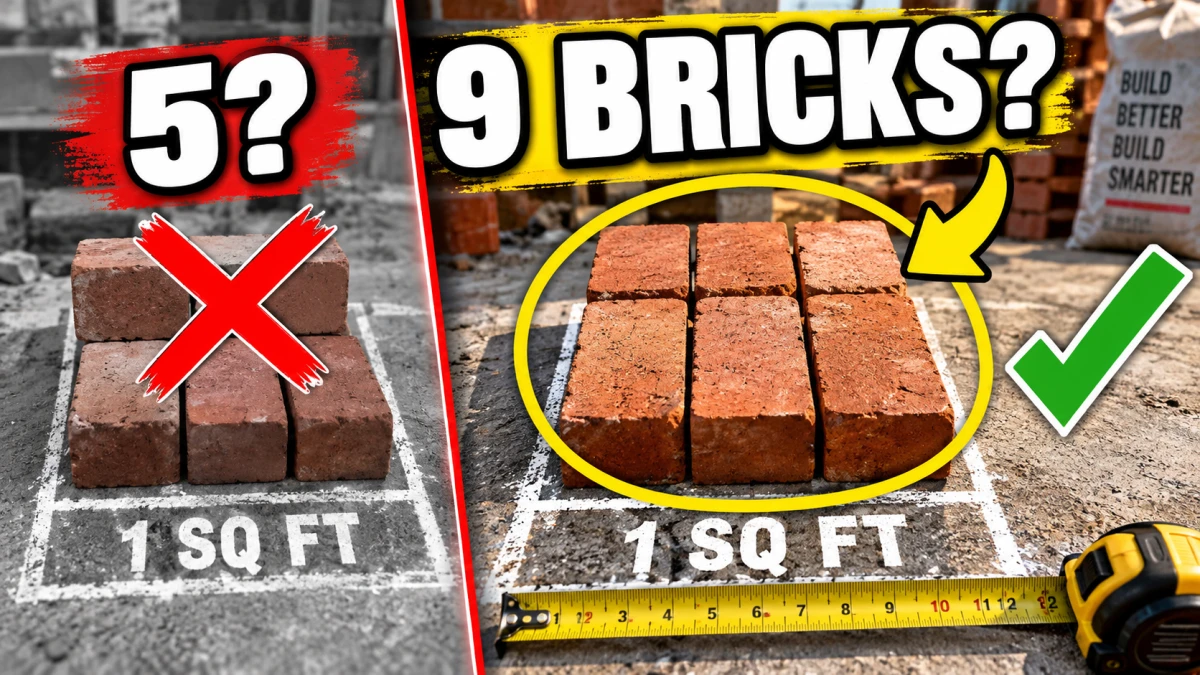
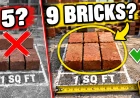
The standard bricks calculation formula in feet/sq ft for Indian conventional bricks (230 × 115 × 75 mm) with 10 mm mortar is simple: 4.5 bricks per square foot for a 4.5-inch (half-brick) wall and 9 bricks per square foot for a 9-inch (full-brick) wall. For 100 square feet of 9-inch wall you need about 900 bricks before wastage; add 10 % and order 990.
These numbers come from the face area of one brick plus mortar and match the daily practice used by site engineers across India. Modular bricks (190 × 90 × 90 mm) shift the figures slightly higher around 5 and 10 bricks per sq ft so always confirm the brick size delivered to your site.
Why the Formula Starts with Brick Size and Mortar
Indian construction uses two common brick sizes under IS 1077:1992.
- Conventional (non-modular): 230 mm × 115 mm × 75 mm
- Modular: 190 mm × 90 mm × 90 mm
Mortar joints are normally 10 mm as recommended in IS 2212:1991 (Code of practice for brickwork). When you add the joint, the “working” face of a conventional brick becomes roughly 240 mm × 85 mm. That single change decides how many bricks fit into one square foot of wall face.
Most beginners forget the mortar and under-order. The formula below already includes the joint so you get a realistic number on the first try.
Simple Bricks Calculation Formula in Feet/Sq Ft
Method 1 – Thumb-Rule Face Area (Fastest for Beginners)
For conventional Indian bricks:
- 4.5-inch wall (half brick / partition):
Bricks needed = Wall area in sq ft × 4.5 - 9-inch wall (full brick / load-bearing):
Bricks needed = Wall area in sq ft × 9 - 13.5-inch wall:
Bricks needed = Wall area in sq ft × 13.5
Add 5–10 % wastage for cutting, breakage and handling.
Method 2 – Exact Face-Area Formula
- Convert everything to inches.
- Effective brick length = actual length + mortar joint
- Effective brick height = actual height + mortar joint
- Bricks per sq ft = 144 ÷ (effective length × effective height)
For a conventional brick with 10 mm (≈0.4 inch) joint:
Effective face ≈ 9.4 in × 3.4 in
144 ÷ (9.4 × 3.4) ≈ 4.5 bricks per sq ft for single-wythe (4.5-inch) wall.
Double it for a 9-inch wall.
Method 3 – Volume Method (Most Accurate for Thick Walls)
- Wall volume in cubic feet = Length (ft) × Height (ft) × Thickness (ft)
- Volume of one brick with mortar ≈ 0.074 cft (conventional) or 0.07 cft (modular)
- Number of bricks = Wall volume ÷ brick volume
- Add 5–10 % wastage
This method automatically handles any wall thickness and is the one preferred for bill-of-quantities work.
Comparison Table Bricks per Sq Ft by Wall Thickness
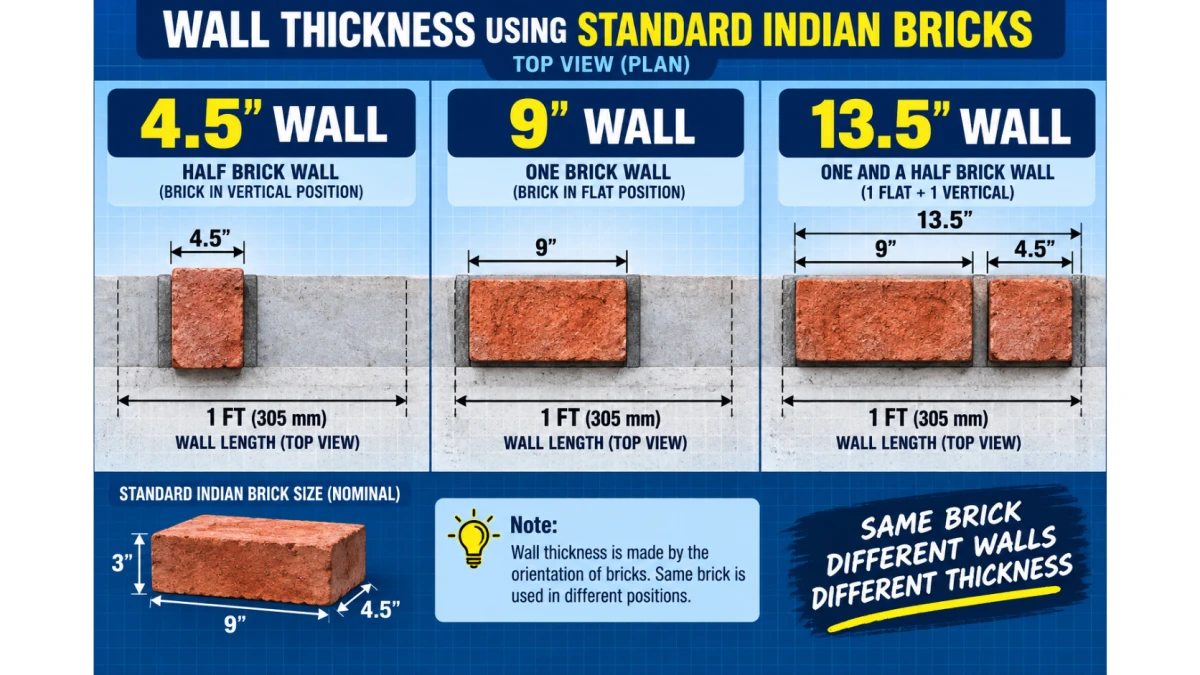
| Wall Type | Thickness | Conventional Brick (230×115×75 mm) | Modular Brick (190×90×90 mm) | Order Qty (with 10 % wastage) |
|---|---|---|---|---|
| Half-brick / Partition | 4.5 inch | 4.5 bricks/sq ft | 5.0 bricks/sq ft | 5.0 / 5.5 |
| Full-brick / External | 9 inch | 9 bricks/sq ft | 10 bricks/sq ft | 10 / 11 |
| 1.5-brick | 13.5 inch | 13.5 bricks/sq ft | 15 bricks/sq ft | 15 / 16.5 |
These figures already include the 10 mm mortar joint required by IS 2212.
Worked Example 1: 100 Square Feet of 9-Inch Wall
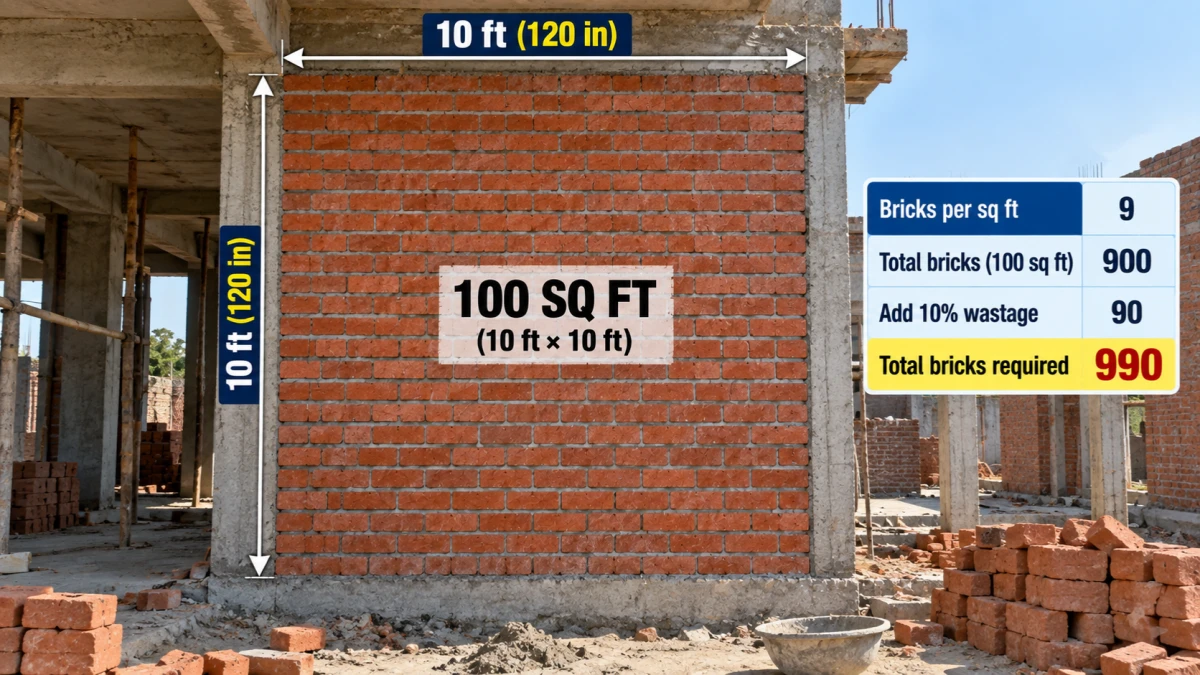
Assume a straight external wall, no openings, conventional bricks.
Step 1: Area = 100 sq ft
Step 2: Bricks (thumb rule) = 100 × 9 = 900
Step 3: Add 10 % wastage = 900 × 1.10 = 990
Step 4: Order 1,000 bricks (round up to next 50 or full load).
Volume check:
Thickness = 0.75 ft
Volume = 100 × 0.75 = 75 cft
Bricks ≈ 75 ÷ 0.074 ≈ 1,014 (very close; small difference comes from exact brick dimensions).
You will also need roughly 0.25–0.30 m³ of mortar (cement + sand) for this volume.
Worked Example 2: Partition Wall Inside a Room (Different Scenario)
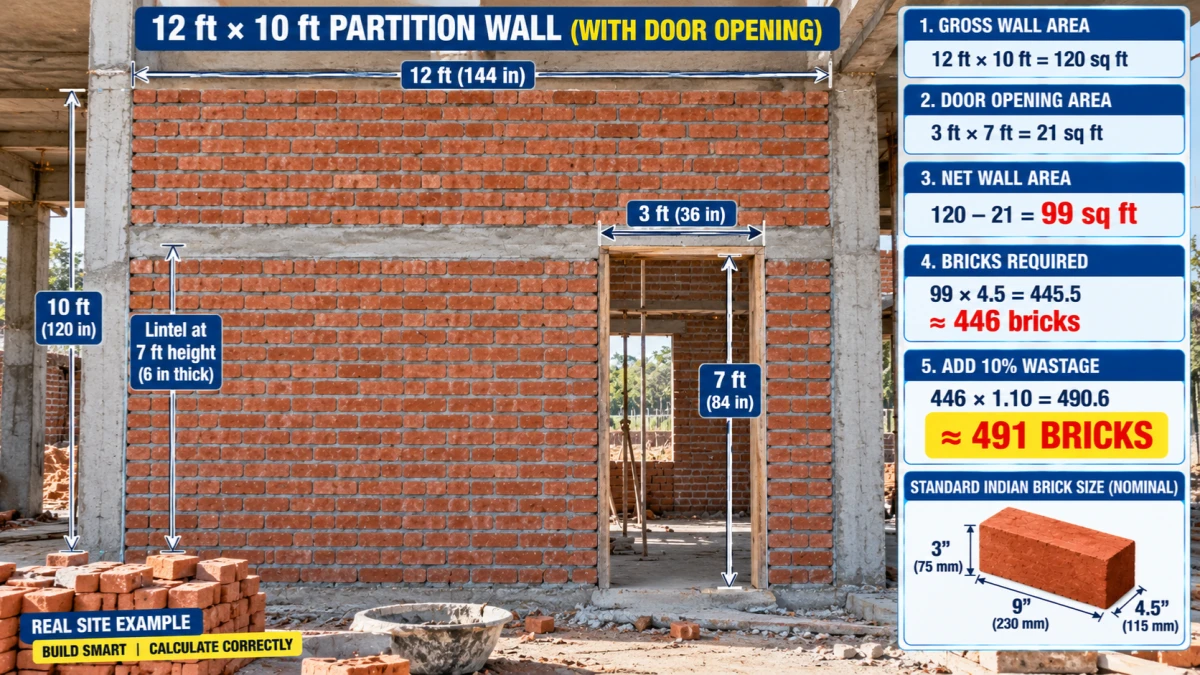
A 12 ft long × 10 ft high internal partition, 4.5-inch thick, with one 3 ft × 7 ft door opening. Conventional bricks.
Step 1: Gross area = 12 × 10 = 120 sq ft
Step 2: Door opening = 3 × 7 = 21 sq ft
Step 3: Net area = 120 – 21 = 99 sq ft
Step 4: Bricks = 99 × 4.5 = 445.5 ≈ 446
Step 5: Add 10 % wastage = 446 × 1.10 ≈ 491
Order 500 bricks.
This second example shows how openings reduce the count and why you must subtract doors and windows before multiplying by the factor.
How Many Bricks in 100 Square Feet Quick Reference
| Wall Thickness | Net Bricks (no wastage) | With 5 % Wastage | With 10 % Wastage |
|---|---|---|---|
| 4.5 inch | 450 | 473 | 495 |
| 9 inch | 900 | 945 | 990 |
| 13.5 inch | 1,350 | 1,418 | 1,485 |
Always measure the actual brick size on site. Local kilns sometimes supply slightly different dimensions; a 5 mm change can shift the count by 3–4 %.
Common Mistakes That Cause Shortages
- Forgetting to add mortar joint thickness
- Using modular numbers on conventional bricks (or vice versa)
- Ignoring openings and then running short
- Ordering exact calculated quantity with zero wastage
- Measuring wall length in metres but using the feet formula
Double-check the brick stamp or ask the supplier for the exact size before you finalise the order.
Practical Tips from Site Experience
Keep a small sample of the delivered bricks and measure 10 of them. Average length and height give you the true effective face size.
For boundary walls longer than 50 ft, add an extra 2–3 % for corners and piers.
Store bricks close to the work face; long carrying distances increase breakage.
Water the bricks for at least two hours before laying dry bricks suck moisture from the mortar and weaken the joint (IS 2212 requirement).
Mortar Quantity Linked to Brick Count
For every 1,000 bricks you roughly need:
- Cement (1:6 mix) ≈ 2.5–3 bags (50 kg)
- Sand ≈ 0.3 m³
Adjust the mix ratio according to the wall’s exposure and load. External walls usually take 1:4 or 1:5; internal partitions can use 1:6.
When to Switch from Thumb Rule to Exact Calculation
Use the simple 4.5 / 9 factor for small residential jobs and quick estimates.
Switch to the volume method or the exact face-area formula when:
- The wall is curved or has many openings
- You are preparing a formal bill of quantities
- The brick size is non-standard
- The project is multi-storey and material cost is critical
Final Check Before You Order
- Confirm brick size (conventional or modular).
- Decide wall thickness.
- Calculate net wall area after openings.
- Apply the correct factor.
- Add 5–10 % wastage.
- Round up to the next practical delivery quantity.
Follow these six steps and the bricks calculation formula in feet/sq ft will give you a reliable order every time.
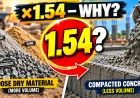
Also Read Dry Volume of Concrete Why the 1.54 Factor Is Used
Frequently Asked Questions

Prince Badaik is the founder of CivilCost, a platform dedicated to making civil engineering calculations simple and accurate for students, engineers, contractors, and homeowners across India.





Comments (0)