
Round Water Tank Capacity Calculation Formula
Learn the exact round water tank capacity calculation formula used by site engineers and homeowners. Get the simple πr²h method, two fully worked examples in litres, a ready comparison table of common sizes, unit conversions, measurement tips, and the most frequent mistakes that lead to wrong capacity figures. Everything explained in plain language for beginners.
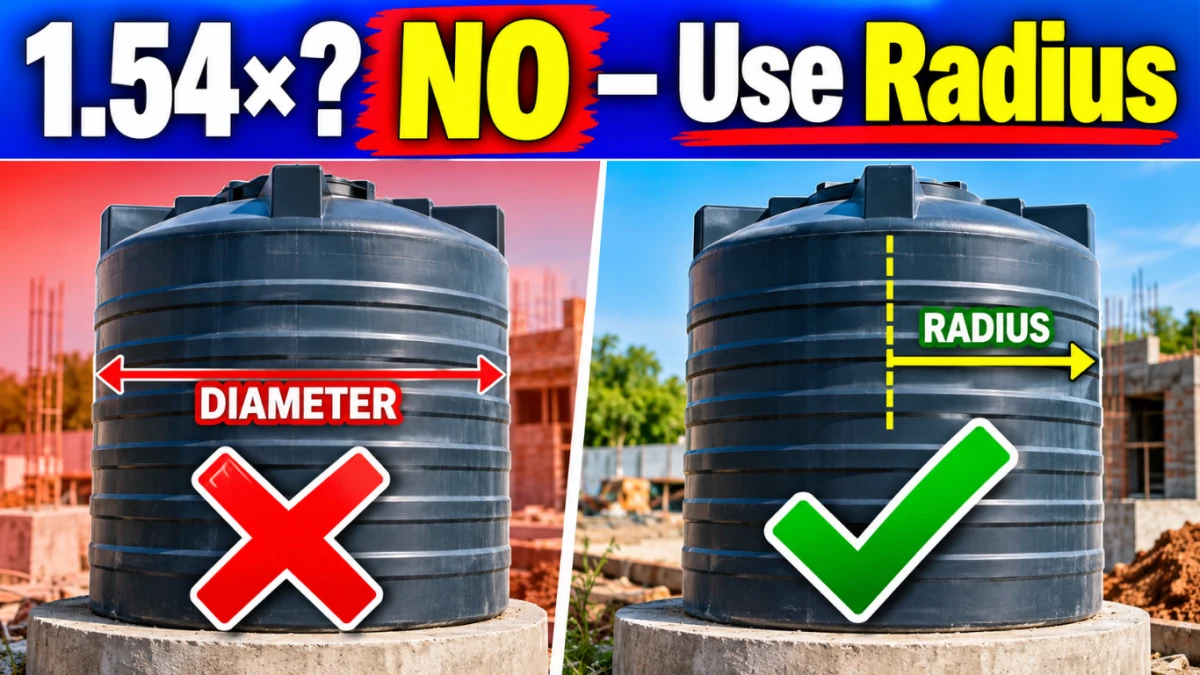
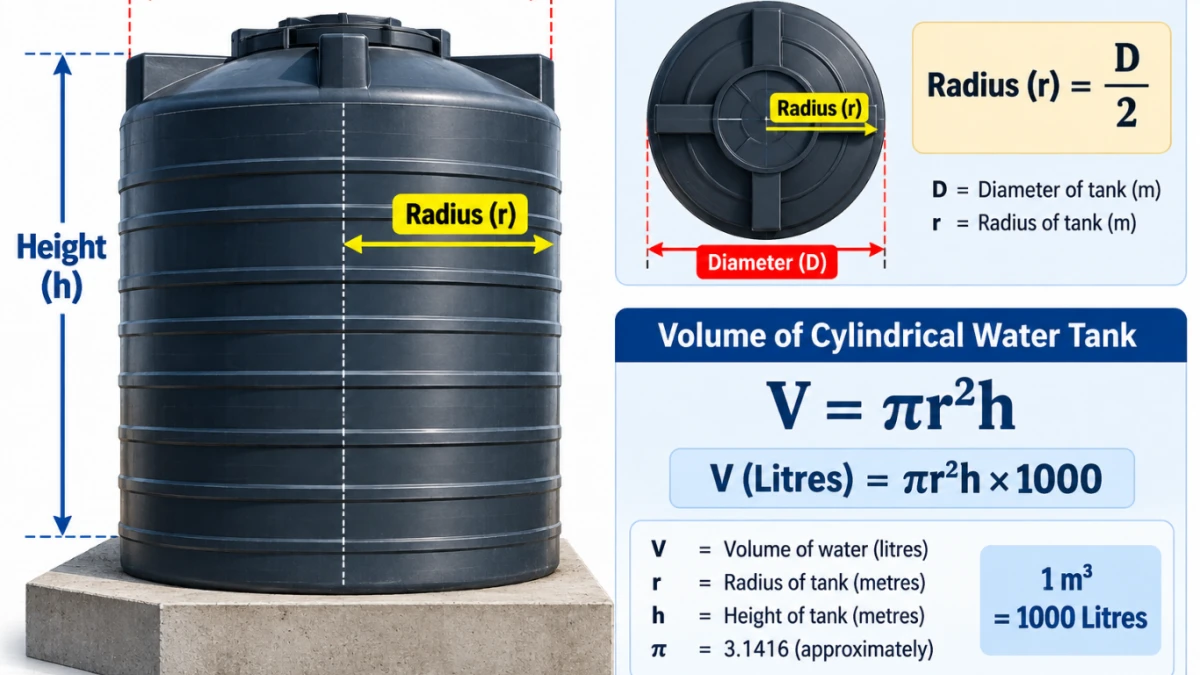
The capacity of a round (cylindrical) water tank is calculated with the formula V = π × r² × h. When radius (r) and height (h) are measured in metres, multiply the result by 1000 to get capacity in litres. That single formula is all you need for vertical round tanks used as overhead or ground-level storage.
A round water tank is simply a cylinder standing upright. Its base is a perfect circle. Once you know the radius of that circle and the internal height of the tank, the volume (and therefore the water capacity) follows directly from school-level geometry.
Why the Formula Matters on Site
Wrong capacity numbers cause real problems. A tank that is smaller than planned runs dry during supply cuts. A tank that is larger than needed wastes money on extra structure, extra steel, and extra waterproofing. On Indian residential and small commercial projects the most common shape for overhead tanks is still the vertical cylinder, so this calculation comes up almost every week.
The Exact Round Water Tank Capacity Calculation Formula
Volume of cylinder (m³) = π × r² × h
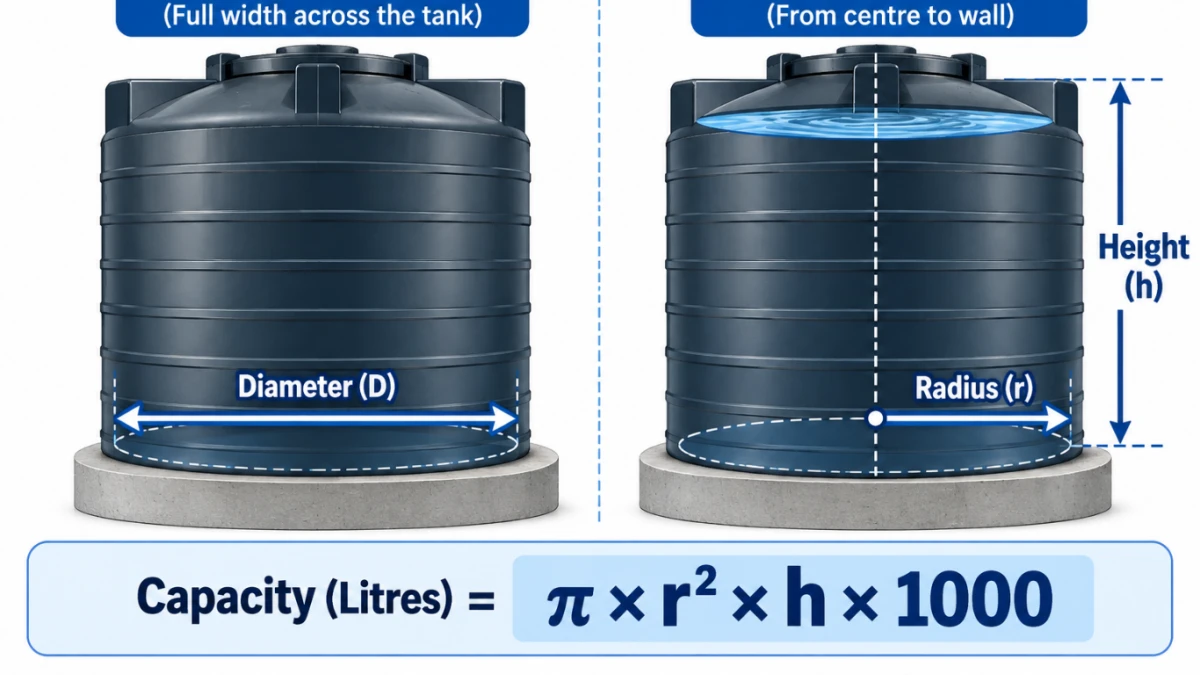
Capacity in litres = π × r² × h × 1000
Where:
- π (pi) = 3.14 (or 22/7 if you prefer fractions)
- r = internal radius of the tank in metres (half of the internal diameter)
- h = internal height (or water depth) in metres
You can also write the same formula using diameter (D):
Capacity in litres = (π × D² × h × 1000) / 4
Both versions give identical results. Use the one that matches the measurement you have taken.
Step-by-Step Calculation Method
- Measure the internal diameter of the tank with a tape.
- Divide the diameter by 2 to get the radius (r).
- Measure the internal height from the floor of the tank to the maximum water level (or to the underside of the roof if freeboard is already decided).
- Square the radius (r × r).
- Multiply by π (3.14).
- Multiply by the height (h).
- Multiply by 1000. The final number is the capacity in litres.
Always use internal dimensions. Wall thickness does not hold water.
Worked Example 1 Typical Residential Overhead Tank
A circular overhead tank has an internal diameter of 1.5 m and an internal height of 1.8 m. Find the capacity in litres.
Radius r = 1.5 / 2 = 0.75 m
r² = 0.75 × 0.75 = 0.5625
π × r² = 3.14 × 0.5625 = 1.76625
Volume in m³ = 1.76625 × 1.8 = 3.17925 m³
Capacity = 3.17925 × 1000 = 3179 litres
Rounded practical figure: approximately 3180 litres.
Worked Example 2 Larger Ground-Level Storage Tank
A circular ground-level tank has an internal diameter of 3.0 m and an internal water depth of 2.5 m. Calculate the capacity.
Radius r = 3.0 / 2 = 1.5 m
r² = 1.5 × 1.5 = 2.25
π × r² = 3.14 × 2.25 = 7.065
Volume in m³ = 7.065 × 2.5 = 17.6625 m³
Capacity = 17.6625 × 1000 = 17 663 litres
Rounded practical figure: approximately 17 660 litres (or 17.66 kl).
These two examples use different real-world situations – one small overhead tank and one larger ground tank – so the same formula is shown applied twice.
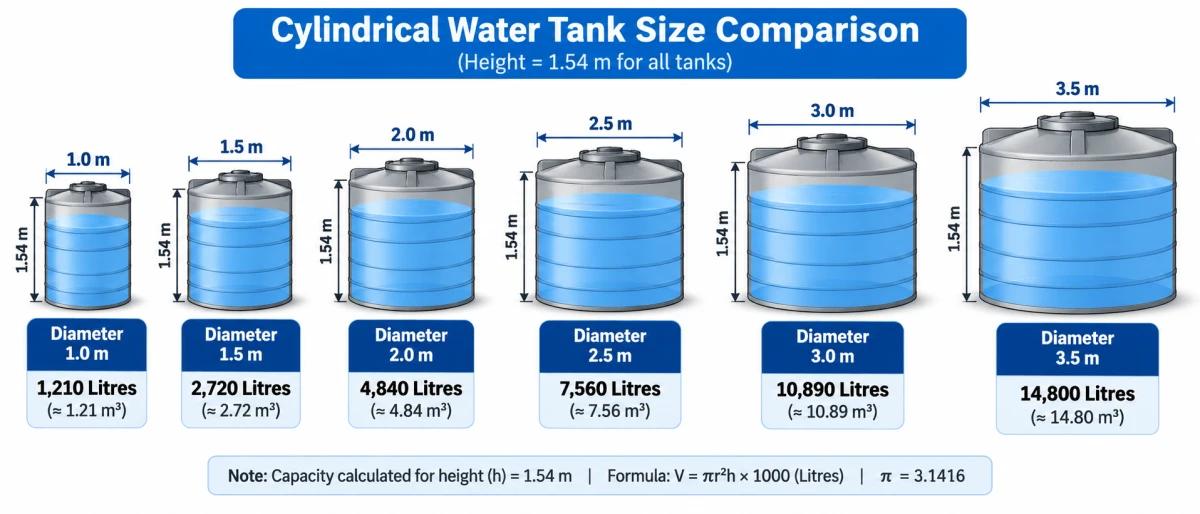
Quick Comparison Table Common Round Tank Sizes
| Internal Diameter (m) | Height (m) | Capacity (litres) | Approx. Capacity (kl) |
|---|---|---|---|
| 1.0 | 1.2 | 942 | 0.94 |
| 1.2 | 1.5 | 1 696 | 1.70 |
| 1.5 | 1.8 | 3 179 | 3.18 |
| 2.0 | 2.0 | 6 280 | 6.28 |
| 2.5 | 2.5 | 12 272 | 12.27 |
| 3.0 | 2.5 | 17 663 | 17.66 |
| 3.5 | 3.0 | 28 863 | 28.86 |
All values use π = 3.14 and internal dimensions only. Manufacturers of plastic tanks often round these numbers up or down slightly for marketing.
Unit Conversions You Will Need
- 1 m³ = 1000 litres
- 1 litre = 0.001 m³
- 1 US gallon ≈ 3.785 litres
- 1 UK gallon ≈ 4.546 litres
- Capacity in US gallons = litres ÷ 3.785
- Capacity in cubic feet = litres ÷ 28.317
For Indian site work, litres and kilolitres (kl) are the standard units.
How to Measure Correctly on Site
- Use a steel tape, not a cloth measuring tape that can stretch.
- Measure diameter at several places; tanks are rarely perfect circles. Take the average.
- For height, measure from the finished internal floor to the planned maximum water level.
- If the tank already has a roof, leave freeboard (usually 150–300 mm) so the calculated height is less than the full internal height.
- For plastic moulded tanks, check the manufacturer’s stamped capacity, then verify with the formula if dimensions look different.
Freeboard and Actual Usable Capacity
Most design codes and good practice leave freeboard – empty space above the maximum water level. A common value is 150 mm to 300 mm. Always calculate capacity on the water depth, not the total wall height. If you ignore freeboard you will overstate the usable volume.
Common Mistakes That Give Wrong Answers
- Using diameter instead of radius. This multiplies the volume by four and is the single most frequent error.
- Measuring external diameter and treating it as internal. Wall thickness of RCC tanks is often 150–200 mm; plastic tanks also have significant wall thickness.
- Mixing units (cm with metres). Convert everything to metres first.
- Forgetting to multiply by 1000 and reporting the answer in cubic metres instead of litres.
- Ignoring freeboard and claiming the full geometric volume as usable capacity.
- Using 3.142 or 22/7 inconsistently between calculations.
Practical Tips for Beginners
Keep a simple calculator or phone app ready. Write the formula on a small card until it becomes automatic. When you design a new tank, decide the required capacity first (based on daily demand and days of storage), then work backwards to find a convenient diameter and height that fit the available space and structural constraints. For residential buildings the daily demand is commonly taken as 135 litres per person (IS 1172 guidance). Storage is then sized for one to two days of demand depending on the reliability of municipal supply.
Concrete tanks should follow the structural and watertightness rules in IS 3370. Plastic tanks should comply with IS 12701. The volume formula itself remains pure geometry in both cases.
When the Tank Is Not a Perfect Cylinder
Some tanks have a conical bottom or a domed roof. In those cases calculate the cylindrical portion with the formula above, then add or subtract the volume of the cone or dome separately. For everyday vertical round tanks with flat or nearly flat bottoms the basic πr²h formula is sufficient and accurate.
The round water tank capacity calculation formula is short, reliable and used every day on construction sites. Measure internal radius and height carefully, apply V = πr²h × 1000, and you will get a capacity figure you can trust.
Frequently Asked Questions

Prince Badaik is the founder of CivilCost, a platform dedicated to making civil engineering calculations simple and accurate for students, engineers, contractors, and homeowners across India.







Comments (0)