
Dry Volume of Concrete Why the 1.54 Factor Is Used
Learn how to calculate the dry volume of concrete using the commonly used 1.54 factor, understand wet-to-dry conversion, see worked slab and footing examples, and avoid common quantity-estimation mistakes. The article also explains an important limitation: 1.54 is a practical estimating factor, not a universal IS Code constant.
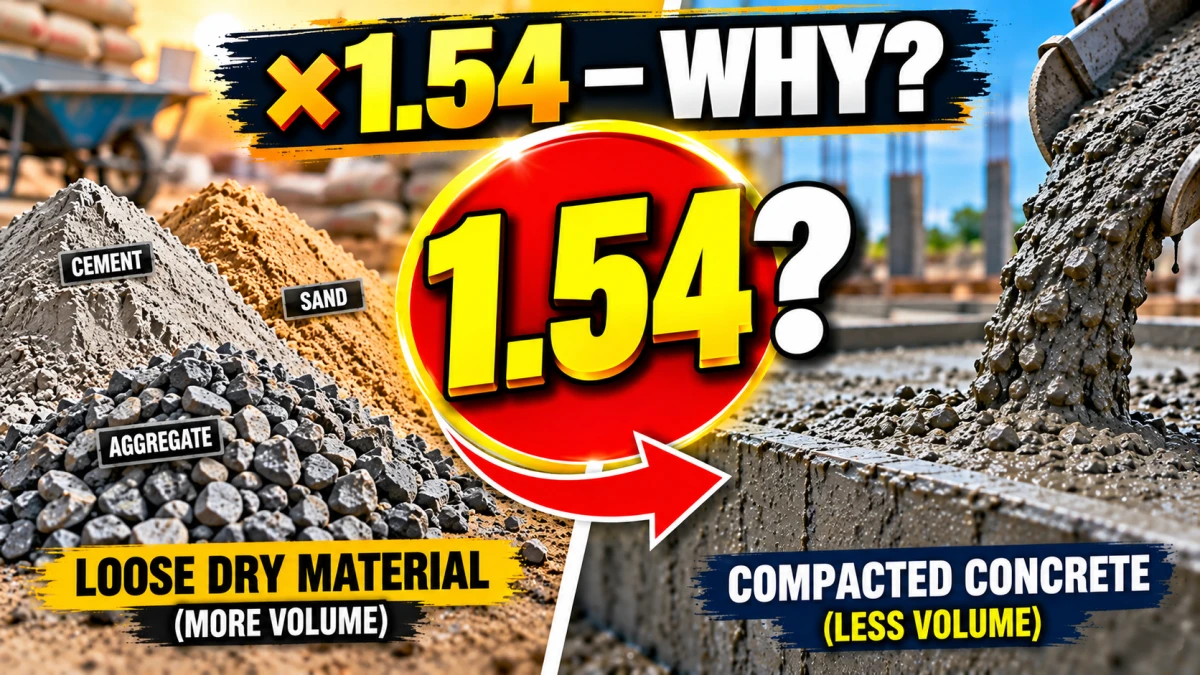
Dry volume of concrete = wet or finished concrete volume × 1.54 when the 1.54 factor is adopted as a preliminary estimating assumption. For example, 1.00 m³ of finished concrete gives 1.54 m³ of estimated dry ingredient volume before the cement, sand, and coarse aggregate are split according to the selected estimating method.
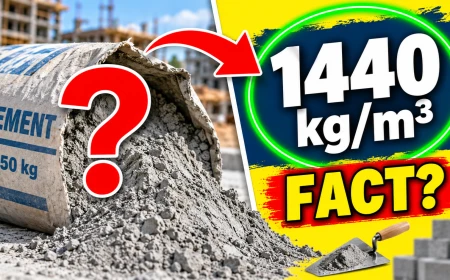
The important point is that 1.54 is a practical estimating factor, not a universal physical constant or a mandatory IS 456 value. Actual yield depends on material properties, aggregate grading, moisture, batching, mixing and compaction.
If you are calculating concrete quantities for a slab, footing, beam, column or other element, understanding this distinction can prevent a surprisingly common mistake: treating the 1.54 factor as though it were a fixed code requirement.
What Is Dry Volume of Concrete ?
Dry volume is the estimated volume of loose ingredients required before mixing to produce a specified volume of finished, compacted concrete.
The basic relationship is:
Dry Volume = Wet Volume × Dry Volume Factor
For the commonly used 1.54 factor:
Dry Volume = Wet Volume × 1.54
The terms can be understood like this:
- Wet volume: The volume of concrete required after mixing, placing and compaction.
- Dry volume: The estimated combined volume used for the loose ingredients during preliminary quantity calculation.
- 1.54 factor: A commonly used conversion factor for estimating concrete ingredient volume.
- Cement, sand and aggregate: The principal ingredients considered when using a conventional volumetric calculation.
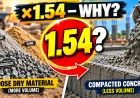
The dry volume is higher because loose particles contain spaces between them. During mixing and compaction, particles rearrange and those voids are reduced. The final concrete therefore occupies less volume than the sum of the loose ingredient volumes initially considered.
This is why simply taking the finished concrete volume and dividing it directly among cement, sand and aggregate can produce an incorrect material estimate.
Dry Volume of Concrete Formula Using the 1.54 Factor
The most commonly used formula is:
Dry Volume = Wet Volume × 1.54
Where:
- Dry Volume = estimated dry ingredient volume
- Wet Volume = finished concrete volume
- 1.54 = adopted dry-volume estimating factor
For example, if the required finished concrete volume is 2.00 m³:
Dry Volume = 2.00 × 1.54
Dry Volume = 3.08 m³
The 3.08 m³ figure is the estimated dry ingredient volume under this assumption. It is not saying that the finished concrete will occupy 3.08 m³ after compaction.
The reverse conversion
If you already know the dry volume and want to estimate the corresponding finished volume using the same factor:
Wet Volume = Dry Volume ÷ 1.54
For example:
Wet Volume = 3.08 ÷ 1.54 = 2.00 m³
This reverse calculation is useful when checking whether two quantity calculations are internally consistent.
Why Is 1.54 Used for Dry Volume of Concrete?
The 1.54 factor is widely used in preliminary concrete quantity estimation because loose cement, sand and aggregate do not pack together in the same way as the final compacted concrete.
Imagine a container filled with dry coarse aggregate. There are gaps between individual stones. Sand occupies some of those spaces. Cement particles occupy still smaller spaces. When water is added and the concrete is mixed and compacted, the particles rearrange and the air voids are reduced.
That produces a practical relationship in which the loose dry-material volume is greater than the final compacted volume.
So, for preliminary estimating:
1.00 m³ wet concrete → 1.54 m³ estimated dry material volume
The key word is estimated.
The 1.54 factor should not be described as a universal law of concrete. It can vary with aggregate grading, moisture, particle shape, packing, batching method and compaction. Modern concrete mix proportioning uses actual material properties and a controlled mix design procedure rather than relying on one generic multiplier.
Is 1.54 an IS Code Requirement ?
This is one of the most important points to understand.
No. The 1.54 dry-volume factor should not be presented as a universal requirement specified by IS 456.
IS 456:2000 addresses concrete proportioning and permits nominal mix concrete up to M20 under its specified conditions. Its Table 9 gives nominal-mix proportions on a mass basis, including maximum total dry aggregate per 50 kg of cement and maximum water quantities. It does not establish “1.54” as a universal dry-volume multiplier.
For designed concrete, IS 10262:2019 Concrete Mix Proportioning Guidelines provides guidance for proportioning concrete to achieve specified strength, workability and durability requirements using the actual concrete-making materials.
That distinction matters when using online concrete calculators.
A calculator can legitimately use:
Dry Volume = Wet Volume × 1.54
as a stated estimating assumption.
But the result should not be presented as though IS 456 says every concrete mix must use 1.54.
Wet Volume vs Dry Volume of Concrete
The difference becomes easier to understand when the two terms are placed side by side.
| Parameter | Wet Volume | Dry Volume |
| Meaning | Finished concrete volume | Estimated loose ingredient volume |
| Typical stage | After mixing and compaction | Before mixing |
| Includes | Concrete as placed | Cement, sand and aggregate quantities |
| Common calculation | L × W × D | Wet volume × 1.54 |
| Example | 1.00 m³ | 1.54 m³ |
| Main purpose | Measure required concrete | Estimate ingredients |
A common mistake is to treat these two volumes as interchangeable.
They are not.
If a slab requires 2.00 m³ of finished concrete, using 2.00 m³ as the total dry-material volume would ignore the estimating conversion being used. With a 1.54 assumption, the calculation becomes:
2.00 × 1.54 = 3.08 m³
1.54 vs 1.33 vs 1.00: Which Factor Should You Use ?
Different construction-material calculations can use different assumptions. The factor should match the material and calculation method.
| Calculation | Common estimating factor | Formula | Important point |
| Concrete | 1.54 | Wet volume × 1.54 | Common preliminary concrete estimate |
| Mortar/plaster | 1.33 | Wet volume × 1.33 | Common site estimating convention |
| No conversion | 1.00 | Wet volume × 1.00 | Only when no dry-volume adjustment is intended |
The 1.33 value is commonly encountered for mortar and plaster, but it should not automatically be transferred into concrete calculations. Likewise, 1.54 should not automatically be applied to mortar or plaster.
The correct factor depends on the material and the estimating method being used.
How to Calculate Dry Volume of Concrete Step by Step
The calculation is straightforward if the units and assumptions are kept consistent.
Step 1: Calculate the wet volume
For a rectangular concrete member:
Wet Volume = Length × Width × Thickness
All dimensions should be in the same unit.
For metres:
Volume = m × m × m = m³
For feet:
Volume = ft × ft × ft = ft³
Step 2: Apply the 1.54 factor
Once the finished concrete volume is known:
Dry Volume = Wet Volume × 1.54
Step 3: Identify the mix or approved design
If you are using a conventional nominal-mix calculation, identify the adopted ratio and its basis.
Do not assume that a website's ratio is automatically an approved structural mix.
For structural concrete, follow the project specification and approved mix design.
Step 4: Split the dry volume
For a simple volumetric estimating method:
Material Volume = Dry Volume × Ratio Part ÷ Total Ratio Parts
For example, if a calculation adopts a 1:2:4 cement:sand ratio:
Total Parts = 1 + 2 + 4 = 7
Then:
- Cement = Dry Volume × 1/7
- Sand = Dry Volume × 2/7
- Aggregate = Dry Volume × 4/7
This is a calculation method, not a substitute for a project-approved mix design.
Step 5: Convert units where required
You may need to convert:
- m³ to ft³
- cement volume to cement mass
- cement mass to 50 kg bags
- aggregate volume to site purchasing units
Keep each conversion separate so that an error in one step does not become hidden inside another.
Worked Example 1: Dry Volume for a Concrete Slab
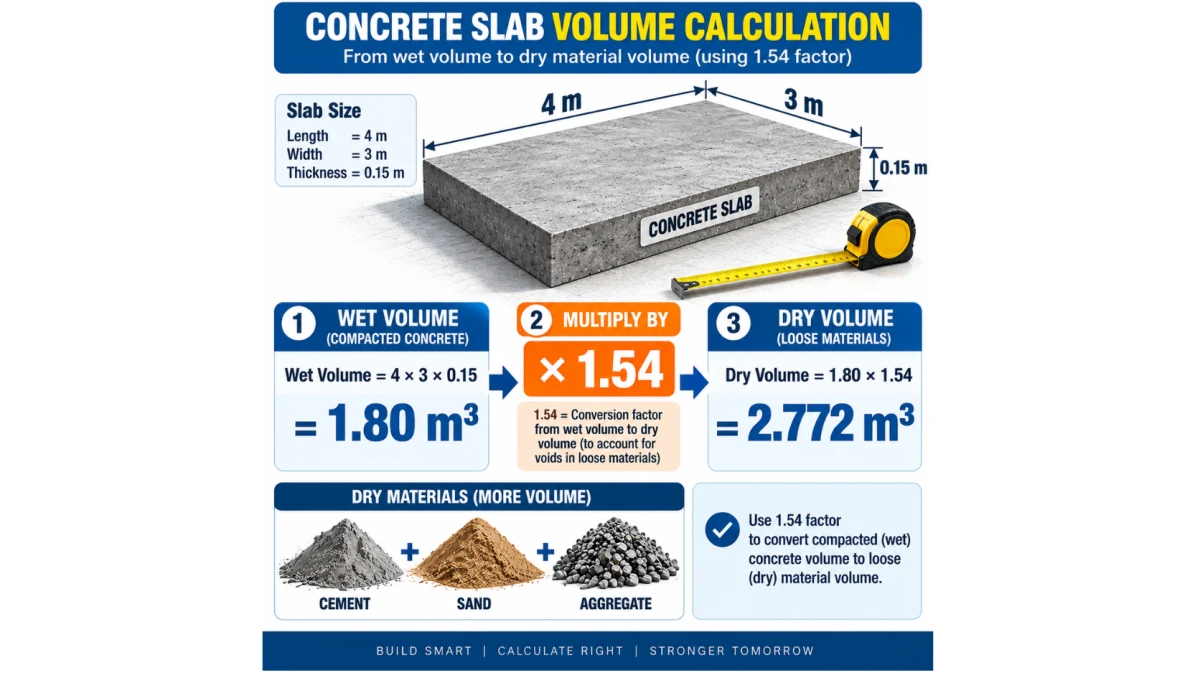
Consider a rectangular slab with:
- Length = 4 m
- Width = 3 m
- Thickness = 0.15 m
Step 1: Calculate wet volume
Wet Volume = 4 × 3 × 0.15
Wet Volume = 1.80 m³
Step 2: Convert wet volume to dry volume
Using the 1.54 estimating factor:
Dry Volume = 1.80 × 1.54
Dry Volume = 2.772 m³
So, under the stated 1.54 assumption, the estimated dry volume is:
2.772 m³
That is the central wet-to-dry conversion.
If you are only asked to calculate the dry volume, you can stop here.
What does the 2.772 m³ mean?
It does not mean that the finished slab will occupy 2.772 m³.
The finished slab volume remains:
1.80 m³
The 2.772 m³ figure is the estimated dry-material volume used by the chosen calculation method.
Worked Example 2: Dry Volume for a Concrete Footing
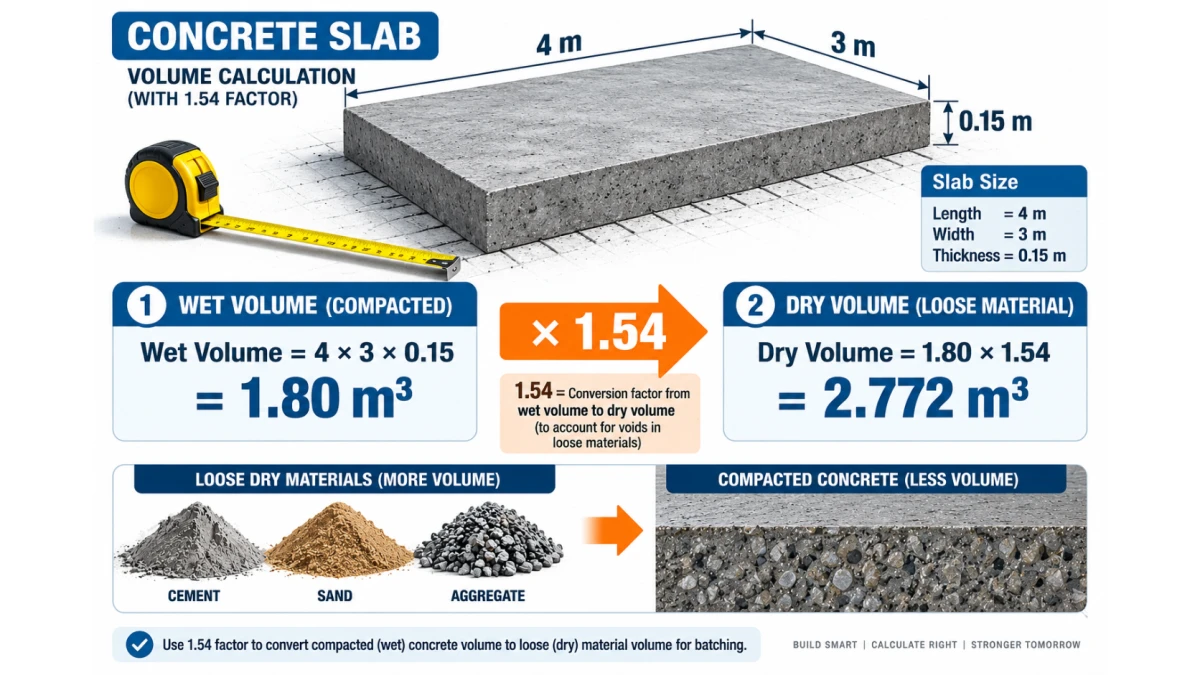
The second example uses a different real-world element so the same formula is not tied only to slabs.
Consider a rectangular footing with:
- Length = 2 m
- Width = 1.5 m
- Thickness = 0.30 m
Step 1: Calculate wet volume
Wet Volume = 2 × 1.5 × 0.30
Wet Volume = 0.90 m³
Step 2: Apply the 1.54 factor
Dry Volume = 0.90 × 1.54
Dry Volume = 1.386 m³
Therefore:
Finished footing volume = 0.90 m³
Estimated dry volume = 1.386 m³
The same formula works because the geometry changed, but the wet-to-dry conversion assumption did not.
Why use two examples?
Because a formula should work across different concrete elements.
For the slab:
1.80 m³ → 2.772 m³
For the footing:
0.90 m³ → 1.386 m³
Both calculations use:
Dry Volume = Wet Volume × 1.54
The factor is applied once.
How to Calculate Cement, Sand and Aggregate After Dry Volume
Once the dry volume has been calculated, a conventional ratio-based estimate can be made if that method is appropriate for the project.
The general formula is:
Material Volume = Dry Volume × Individual Ratio ÷ Total Ratio
Suppose a calculation uses a 1:2:4 cement:sand ratio.
The total parts are:
1 + 2 + 4 = 7
For any calculated dry volume:
Cement = Dry Volume × 1/7
Sand = Dry Volume × 2/7
Aggregate = Dry Volume × 4/7
Notice what happens here.
The 1.54 factor converts the finished concrete volume into the assumed dry-material volume.
The mix ratio then divides that dry volume among the ingredients.
These are two separate steps.
Do not multiply by 1.54 again after splitting the materials.
Why You Should Not Blindly Use Online Mix-Ratio Tables
A lot of concrete-calculation articles present familiar ratios such as 1:2:4 or 1:1.5:3 as though they are universal code-defined recipes.
That is an oversimplification.
IS 456:2000 Table 9 specifies nominal mixes using the total quantity of dry aggregate by mass per 50 kg of cement, along with the fine-to-coarse aggregate proportion and maximum water quantity. The table gives, for example, a maximum total dry aggregate quantity of 330 kg per 50 kg of cement for M15 and 250 kg per 50 kg of cement for M20.
The fine-to-coarse aggregate proportion is also subject to adjustment based on fine-aggregate grading and coarse-aggregate size.
That means a simple online ratio should be treated as an estimating convention, not as proof that a particular concrete mix satisfies the project specification.
For designed concrete, IS 10262:2019 provides the framework for mix proportioning based on required performance and actual materials.
Common Concrete Grade and Ratio Variants
The following table is useful for understanding commonly encountered estimating ratios, but it should not be confused with the complete requirements of IS 456 Table 9.
| Grade | Commonly encountered nominal estimating ratio | Total parts | Status |
| M5 | 1:5:10 | 16 | Conventional nominal estimate |
| M7.5 | 1:4:8 | 13 | Conventional nominal estimate |
| M10 | 1:3:6 | 10 | Conventional nominal estimate |
| M15 | 1:2:4 | 7 | Conventional nominal estimate |
| M20 | 1:1.5:3 | 5.5 | Common site estimating ratio |
IS 456 Table 9 itself presents nominal mixes on a mass basis rather than simply defining the above volumetric ratios as universal recipes. It also limits nominal mix use to M20 or lower under the conditions stated in the code.
For structural work, always check the drawings, specifications, engineer's requirements and approved mix documentation before using a ratio-based estimate.
What Happens If You Forget the 1.54 Factor ?
Suppose the required finished concrete volume is:
1.80 m³
If the calculation simply treats 1.80 m³ as the dry-material volume, it ignores the adopted 1.54 conversion.
Using the factor gives:
1.80 × 1.54 = 2.772 m³
The difference between those two figures is:
2.772 − 1.80 = 0.972 m³
That does not mean exactly 0.972 m³ of material will physically disappear on every site. It demonstrates why the estimating factor materially changes the quantity calculation.
The actual yield must be controlled through the selected batching and mix-design method.
Is 1.54 the Same as Concrete Wastage ?
No.
This distinction is important.
The 1.54 factor is used to convert finished concrete volume into an estimated dry-material volume under a particular calculation convention.
Wastage is a separate allowance for material losses or project-specific quantity uncertainty.
Examples of actual site losses can include:
- Spillage during handling
- Material left in equipment
- Over-excavation or irregular geometry
- Formwork leakage
- Handling losses
- Cutting or trimming-related losses where applicable
- Procurement and batching losses
Do not automatically hide wastage inside the 1.54 factor.
If a project specification requires a separate wastage allowance, record it separately so the calculation remains traceable.
Does Sand Moisture Affect Concrete Quantity Calculation?
Yes.
Moisture in fine aggregate can change the apparent volume and also contribute water to the concrete mix.
This is particularly important when volume batching is used.
IS 456 includes provisions relating to batching and material control, while aggregate moisture and bulking need to be considered when appropriate to the batching method. The objective is to maintain the intended material proportions and water content rather than blindly relying on a dry-volume multiplier.
This is one reason professional concrete work should not depend only on a simple online formula.
The formula is useful for understanding and preliminary estimation.
The approved mix and site controls govern actual structural concrete production.
1.54 Factor: Common Mistakes to Avoid
1. Applying 1.54 twice
Wrong:
Wet volume × 1.54 × 1.54
The factor should be applied according to the selected calculation method, not repeatedly at every stage.
2. Calling 1.54 an IS 456 constant
Avoid statements such as:
“IS 456 says the dry volume factor is 1.54.”
That is misleading.
A better statement is:
“A 1.54 factor is commonly used for preliminary concrete dry-volume estimation.”
3. Confusing dry volume with wastage
The dry-volume conversion and wastage allowance are different concepts.
4. Using the concrete factor for mortar
A concrete calculation commonly uses 1.54 in preliminary estimates, while mortar/plaster calculations often use another convention such as 1.33.
5. Ignoring units
Do not calculate:
4 m × 3000 mm × 150 mm
without converting the dimensions first.
Use consistent units.
6. Treating a nominal ratio as a design mix
A ratio found on a website does not establish strength, durability or compliance.
7. Using 1.54 for ready-mix ordering
If ready-mix concrete is being purchased, the supplier normally works with the required finished concrete volume and approved mix specification.
You should not take the supplier's finished-volume quantity and multiply it by 1.54 simply because that number appears in a site-calculation formula.
Dry Volume of Concrete in Cubic Feet
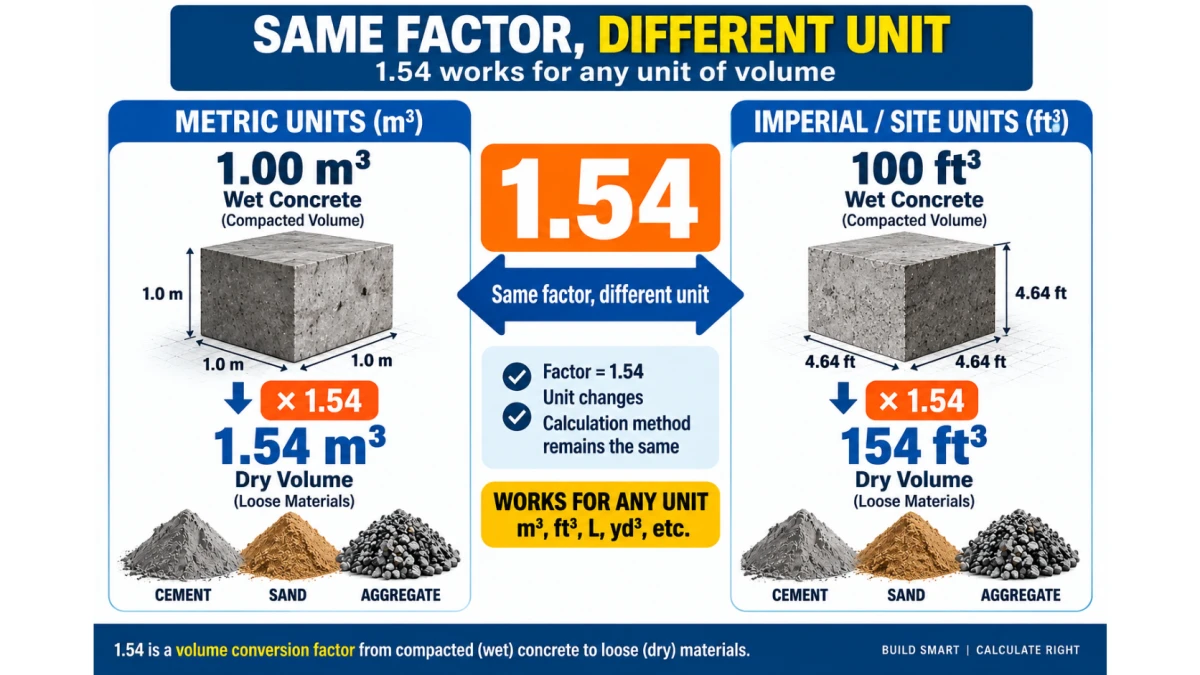
The same principle can be used in cubic feet.
The formula remains:
Dry Volume = Wet Volume × 1.54
Suppose the finished concrete volume is 100 ft³.
Then:
Dry Volume = 100 × 1.54
Dry Volume = 154 ft³
The unit does not change the factor.
Only the volume unit changes.
This is useful on Indian construction sites where sand and aggregate may be discussed in cubic feet or brass while concrete quantities are often recorded in cubic metres.
The safest practice is to perform the complete calculation in one unit system and convert only when needed.
Dry Volume and Brass Calculation
On sites where 1 brass = 100 ft³ is used as the purchasing convention, the same volume relationship can be applied after the wet volume has been established.
For example:
1 brass = 100 ft³
Using the 1.54 estimating factor:
Dry volume = 100 × 1.54 = 154 ft³
Therefore, under the stated assumption:
100 ft³ wet concrete corresponds to 154 ft³ estimated dry volume.
This is an estimating relationship, not a statement that the final concrete will occupy 154 ft³.
When Should You Use a Concrete Dry Volume Calculator ?
A calculator is useful when you repeatedly need to:
- Calculate slab concrete volume
- Calculate footing volume
- Estimate beam concrete quantity
- Estimate column concrete quantity
- Convert wet volume to dry volume
- Split dry volume by a selected ratio
- Convert cement quantity into bags
- Compare quantities between different concrete elements
But the calculator output is only as reliable as its assumptions.
Before accepting the result, check:
- Are the dimensions correct?
- Are all dimensions in the same unit?
- Is the 1.54 factor being used as an explicit estimating assumption?
- Is the mix ratio appropriate?
- Is the concrete design mix approved?
- Has aggregate moisture been considered where required?
- Is wastage being added separately?
- Is the result being used for preliminary estimation or actual structural batching?
A calculator should make the calculation easier to audit, not make the assumptions invisible.
When 1.54 Should Not Be Used as Your Final Mix-Design Method
There are situations where a simple dry-volume multiplier is not enough.
For example:
- Structural design-mix concrete
- High-strength concrete
- Ready-mix concrete
- Concrete with mineral admixtures
- Concrete with chemical admixtures
- Self-compacting concrete
- Mass concrete
- Projects with strict material testing and batching requirements
- Work governed by an approved project mix design
IS 10262:2019 covers concrete mix proportioning for ordinary, standard and high-strength grades and also includes provisions for self-compacting and mass concrete.
In these cases, use the approved mix-design documents and batch quantities rather than replacing the mix design with a generic 1.54 calculation.
Quick Reference: Dry Volume of Concrete
| Item | Formula / Value |
| Wet volume | L × W × D |
| Dry volume | Wet volume × 1.54 |
| Reverse conversion | Dry volume ÷ 1.54 |
| Common concrete estimating factor | 1.54 |
| Common mortar/plaster estimating factor | 1.33 |
| Example: 1.80 m³ wet | 2.772 m³ dry |
| Example: 0.90 m³ wet | 1.386 m³ dry |
| 100 ft³ wet | 154 ft³ dry |
The two worked examples above use the same formula:
Dry Volume = Wet Volume × 1.54
That consistency is the easiest way to catch a calculation error.
Frequently Asked Questions

Prince Badaik is the founder of CivilCost, a platform dedicated to making civil engineering calculations simple and accurate for students, engineers, contractors, and homeowners across India.



Comments (0)