
How to Calculate Construction Site Capacity
Learn how to calculate construction site capacity with the simple formula Site Capacity = Productivity × Number of Workers × Time. This beginner-friendly guide covers labour productivity, material storage, equipment factors, worked examples for brickwork and concrete, comparison tables of typical rates from CPWD norms, common mistakes, and practical steps so you can plan site output accurately and avoid congestion or delays.
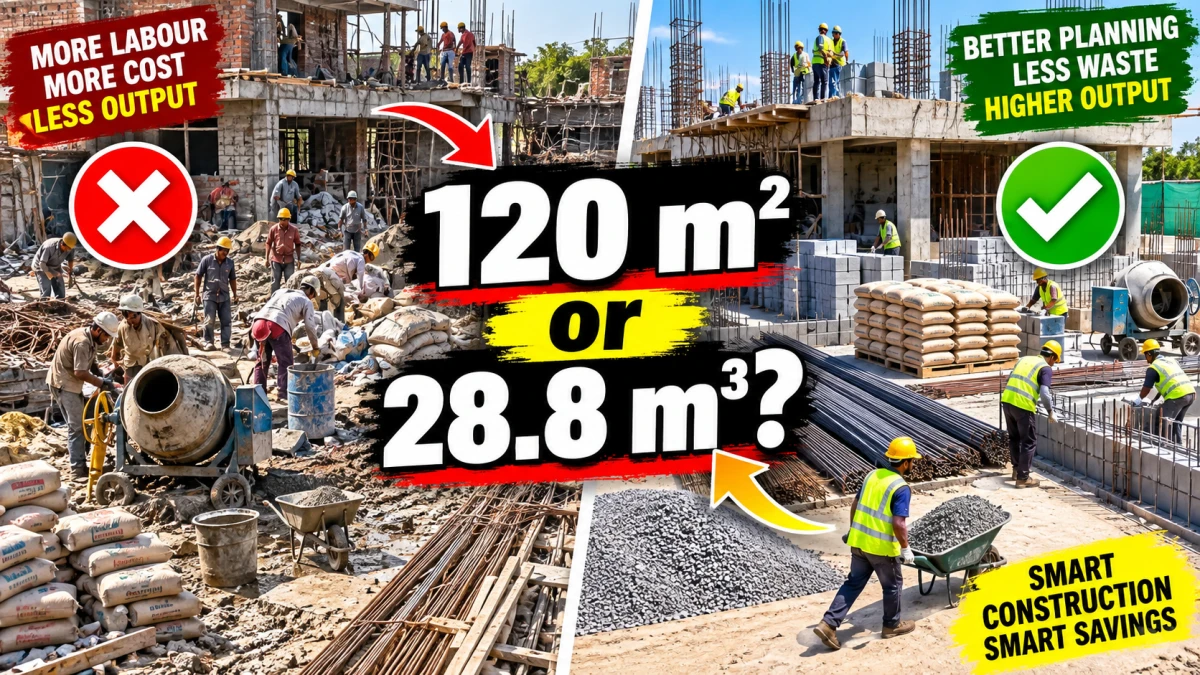
Construction site capacity is the maximum amount of work a site can complete efficiently in a given time using available workers, equipment, materials and space. The core formula is Site Capacity = Productivity × Number of Workers × Time.
When site capacity is calculated correctly, work flows smoothly. When it is ignored, sites become crowded, materials pile up in the wrong places, equipment sits idle, and schedules slip. This guide shows beginners exactly how to calculate it using simple numbers, real examples and practical checks.
What Is Construction Site Capacity ?
Construction site capacity means the highest volume of work a construction site can handle efficiently in a set period usually one day or one week without congestion or wasted resources.
It answers one clear question: How much brickwork, concrete, plastering or excavation can this site finish today with the people and machines we have?
Typical site outputs might look like:
- 120–180 m² of brickwork per day
- 25–50 m³ of concrete per day
- 200–350 m² of plastering per day
These numbers change with site size, worker skill, equipment and weather. Capacity is not a fixed number; it is calculated from the resources actually present on that site.
Main Factors That Affect Construction Site Capacity
Four factors control almost every capacity calculation.
Site Area and Layout
A larger clear area allows more workers and machines to operate at the same time. Tight sites force sequential work and lower daily output. Space must also be reserved for material storage, access roads and safety zones.
Labour Productivity
Productivity is the amount of finished work one worker (or one crew) completes in one hour or one day. It is the most important number in the capacity formula. Typical values used in Indian practice (based on CPWD and IS 7272 guidance) appear later in the comparison table.
Equipment Availability
Excavators, mixers, pumps and cranes raise capacity far above pure manual labour. One concrete pump can place 30–50 m³ per hour under good conditions, while a manual crew may manage only a few cubic metres.
Material Storage Capacity
If storage space runs out, work stops even when workers and machines are ready. Storage capacity is calculated separately and must match the daily consumption rate.
Construction Site Capacity Formula
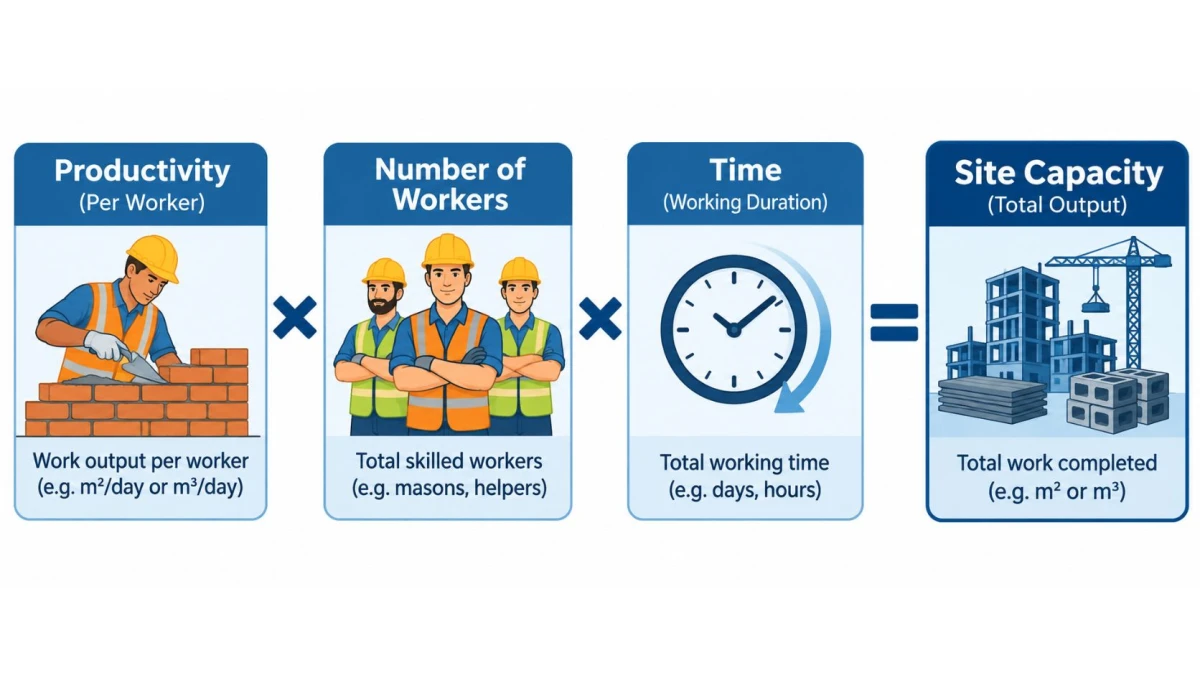
The basic formula used by site engineers is:
Site Capacity = Productivity × Number of Workers × Time
Where:
- Productivity = finished work done by one worker in one hour (or one day)
- Number of Workers = total productive workers available for that activity
- Time = working hours (usually 8 hours)
This gives the theoretical maximum output. Real output is usually 70–85 % of theoretical after allowing for breaks, material waits and supervision.
Worked Example 1 Brickwork Capacity
Suppose a site has:
- 12 masons
- Each mason lays 1.25 m² of 230 mm brick wall per hour (including mortar and jointing)
- Working day = 8 hours
Step 1: Daily productivity per mason
1.25 m²/hour × 8 hours = 10 m² per mason per day
Step 2: Total site capacity
10 m² × 12 masons = 120 m² of brickwork per day
If the wall is half-brick (115 mm), productivity rises and capacity increases accordingly. Always match the productivity figure to the actual wall thickness and mortar mix.
Worked Example 2 Concrete Capacity (Different Scenario)
Now consider a different activity on the same site:
- 8 workers in the concreting crew (1 mason + helpers)
- Productivity = 0.45 m³ of RCC per worker per hour (machine mixed, vibrated and finished)
- Working day = 8 hours
- One concrete mixer is available and keeps pace with the crew
Step 1: Daily productivity per worker
0.45 m³/hour × 8 hours = 3.6 m³ per worker per day
Step 2: Total site capacity
3.6 m³ × 8 workers = 28.8 m³ of concrete per day
If a concrete pump is added, the limiting factor often shifts from labour to pump output or formwork readiness. Always identify the bottleneck.
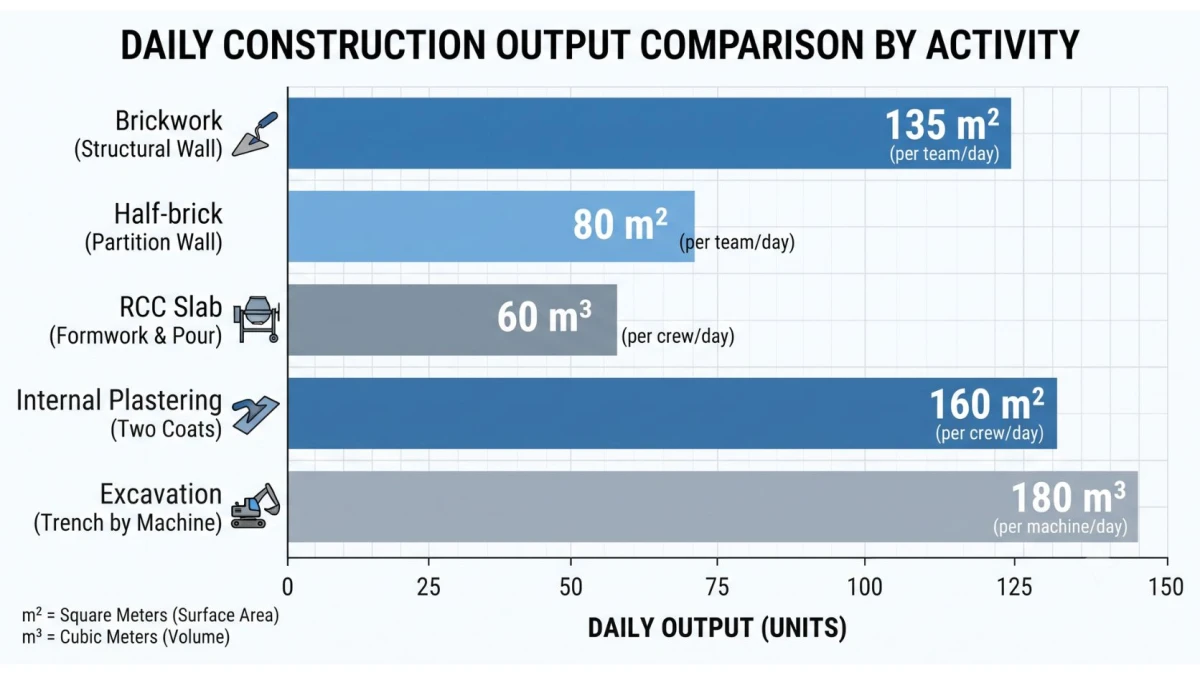
Comparison Table of Typical Daily Productivities
|
Activity |
Typical Output (per skilled worker or crew) |
Unit |
Notes (CPWD / field range) |
|
Brickwork 230 mm (superstructure) |
1.0 – 1.5 |
m³/day |
1 mason + 2 helpers |
|
Half-brick wall 115 mm |
8 – 10 |
m²/day |
1 mason + 1 helper |
|
RCC slab (machine mixed) |
3.0 – 4.0 |
m²/day |
1 mason + 4 labourers |
|
RCC column |
1.5 – 2.5 |
m²/day |
Vertical pour, more handling |
|
Cement plaster 12 mm |
8 – 12 |
m²/day |
1 mason |
|
Manual excavation (ordinary soil) |
2.5 – 3.5 |
m²/day |
Per labourer |
|
Machine excavation (JCB) |
60 – 100 |
m²/day |
Per machine |
These figures are benchmarks. Adjust ±20–30 % for skill level, weather, height of work and site congestion.
Material Storage Capacity Formula
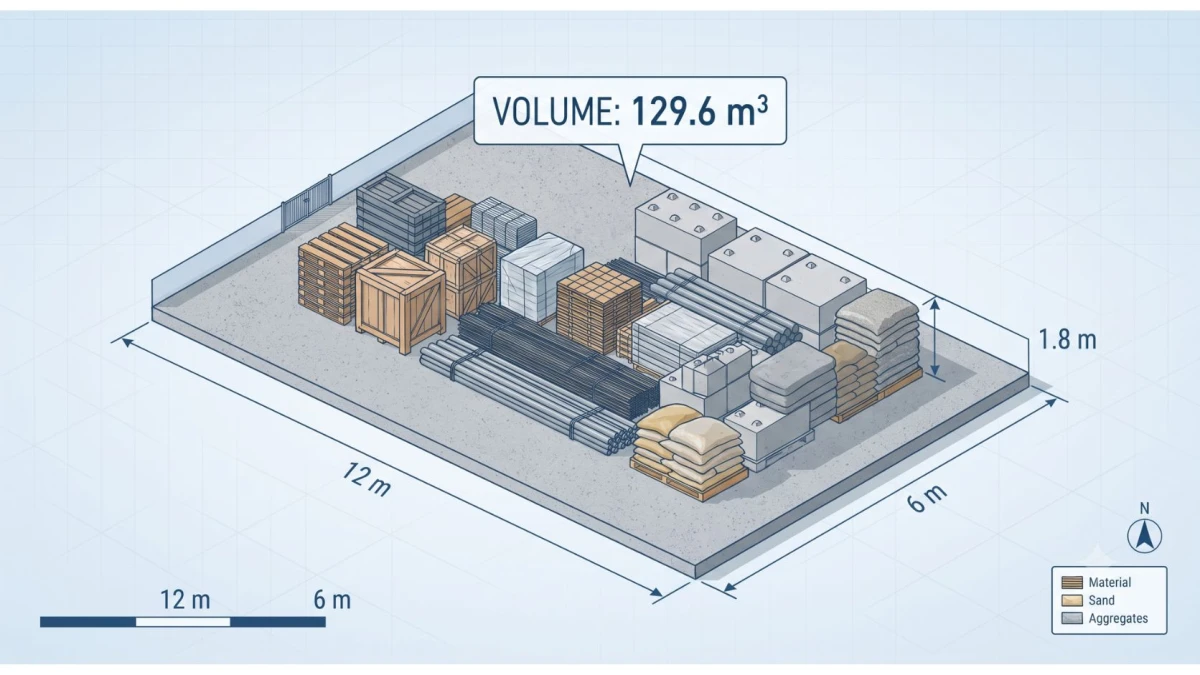
Storage capacity is calculated independently:
Material Storage Capacity = Storage Area × Safe Stacking Height
Example:
Length = 12 m, Width = 6 m, Safe height = 1.8 m
Area = 12 × 6 = 72 m²
Capacity = 72 × 1.8 = 129.6 m³
This volume must be enough for at least 2–3 days of material consumption so that work never stops for lack of cement, sand or aggregates.
Step-by-Step Method to Calculate Site Capacity on Any Project
- Measure the usable work area and storage area.
- List the main activities (brickwork, concrete, plaster, etc.).
- Obtain realistic productivity rates for each activity from site records or CPWD / IS 7272 norms.
- Count productive workers and equipment available for each activity.
- Apply the formula: Capacity = Productivity × Workers × Hours.
- Reduce the theoretical figure by 15–30 % for real-world efficiency.
- Check that storage capacity and access roads can support the calculated daily output.
- Identify the bottleneck (labour, equipment, space or material) and adjust.
Common Mistakes That Reduce Site Capacity
- Using textbook productivity without checking actual site output.
- Overcrowding the work front so workers interfere with each other.
- Ignoring storage and access materials arrive but cannot be placed.
- Counting all workers instead of only productive ones.
- Forgetting weather, height and learning-curve reductions.
- Running equipment below its practical capacity because of poor sequencing.
Avoiding these mistakes often raises actual output by 20 % or more without hiring extra labour.
Benefits of Calculating Construction Site Capacity Early
- Accurate labour and equipment planning.
- Fewer delays caused by congestion or material shortage.
- Better cash-flow prediction because daily progress becomes predictable.
- Safer sites because space and traffic routes are planned.
- Clearer communication with clients and subcontractors about realistic daily targets.
Practical Tips for Beginners
Keep a simple daily log of actual output versus planned capacity for the first two weeks of every new activity. The difference quickly shows the real efficiency factor for that site. Use that factor for the rest of the project.
Always calculate capacity for the critical path activity first. If brickwork capacity is 120 m²/day but the following plastering capacity is only 80 m²/day, the overall site progress is limited by plastering.
Reference standard labour constants given in IS 7272 (Recommendation for Labour Output Constants for Building Work) and CPWD Analysis of Rates when no site-specific data exists. These documents provide the accepted starting points used across government and private works in India.
Conclusion
Calculating construction site capacity starts with one clear formula: Site Capacity = Productivity × Number of Workers × Time. Apply it to each major activity, cross-check with storage space and equipment, and adjust for real site conditions. The two worked examples (brickwork and concrete) and the productivity comparison table give you ready numbers to start with.
When capacity is known in advance, planning becomes realistic, delays drop and the site runs more smoothly. Use the steps and checks in this guide on your next project and refine the numbers with actual daily output. That is how experienced site engineers keep work moving at a steady, efficient pace.
Frequently Asked Questions

Prince Badaik is the founder of CivilCost, a platform dedicated to making civil engineering calculations simple and accurate for students, engineers, contractors, and homeowners across India.





Comments (0)