
Water Tank Capacity Calculator Formula to Calculate Capacity in Litres (135 LPCD Method)
A beginner-friendly guide explaining how to calculate water tank capacity in litres for rectangular, cylindrical, and spherical tanks, including the IS 1172 (135 LPCD) sizing method, two worked examples, a shape comparison table, standard Indian tank sizes, and common calculation mistakes.
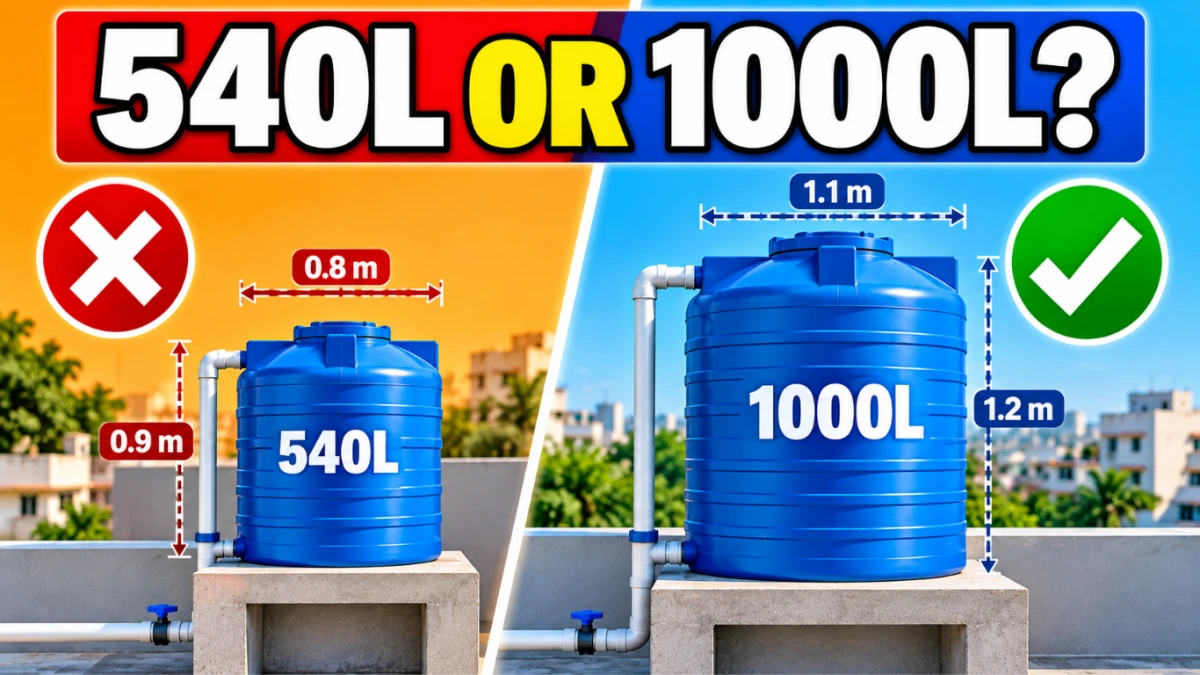
To calculate water tank capacity in litres, multiply the tank's internal Length × Width × Height (in metres) by 1000 for a rectangular tank, or use π × Radius² × Height × 1000 for a cylindrical tank. To size a new tank, multiply the number of users by 135 litres per person per day (as per IS 1172:1993) and add your required backup days.
That single line answers most of what people search for. But getting the number right and not overestimating it takes a bit more care. Let's break it down properly.
Why Water Tank Capacity Calculation Actually Matters
A wrongly sized tank causes two very different problems. Too small, and you're refilling every few hours or running dry during a municipal supply gap. Too large, and you're paying for a bigger tank, more structural support, and more standing water than you'll ever use which isn't great for water quality either.
Most homeowners either guess the size or copy whatever their neighbour installed. A quick calculation, done once, avoids both problems.
Water Tank Capacity Calculator Formula (By Shape)
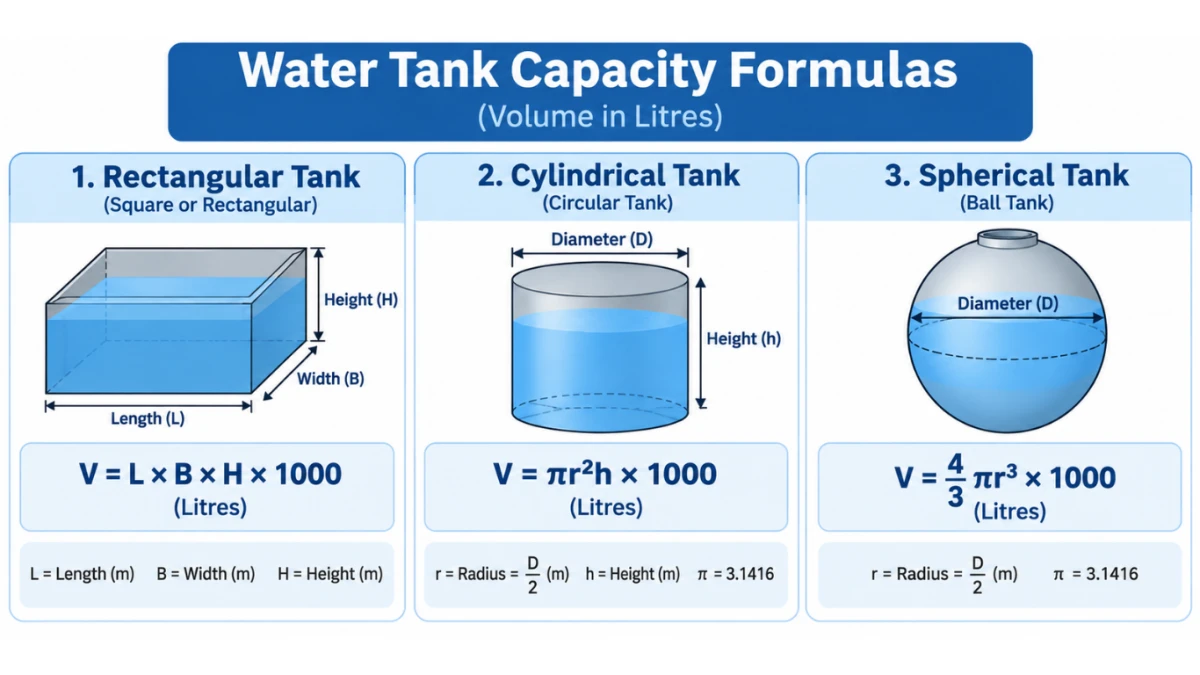
The formula you use depends entirely on the tank's shape. All three formulas below give the answer in cubic metres first, which you then multiply by 1000 to get litres, since 1 m³ = 1000 litres.
Rectangular or Square Tank Formula
Volume (m³) = Length × Width × Height
Capacity (litres) = Length × Width × Height × 1000
This is the formula used for most underground sumps and RCC overhead tanks, since rectangular shapes are easier to cast and fit into a fixed plot corner.
Cylindrical Tank Formula
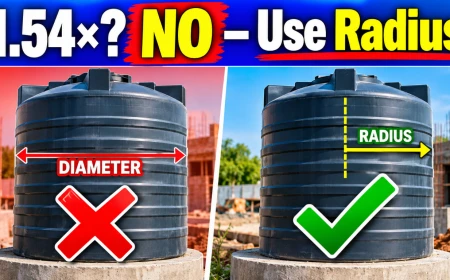
Volume (m³) = π × Radius² × Height
Capacity (litres) = 3.1416 × Radius² × Height × 1000
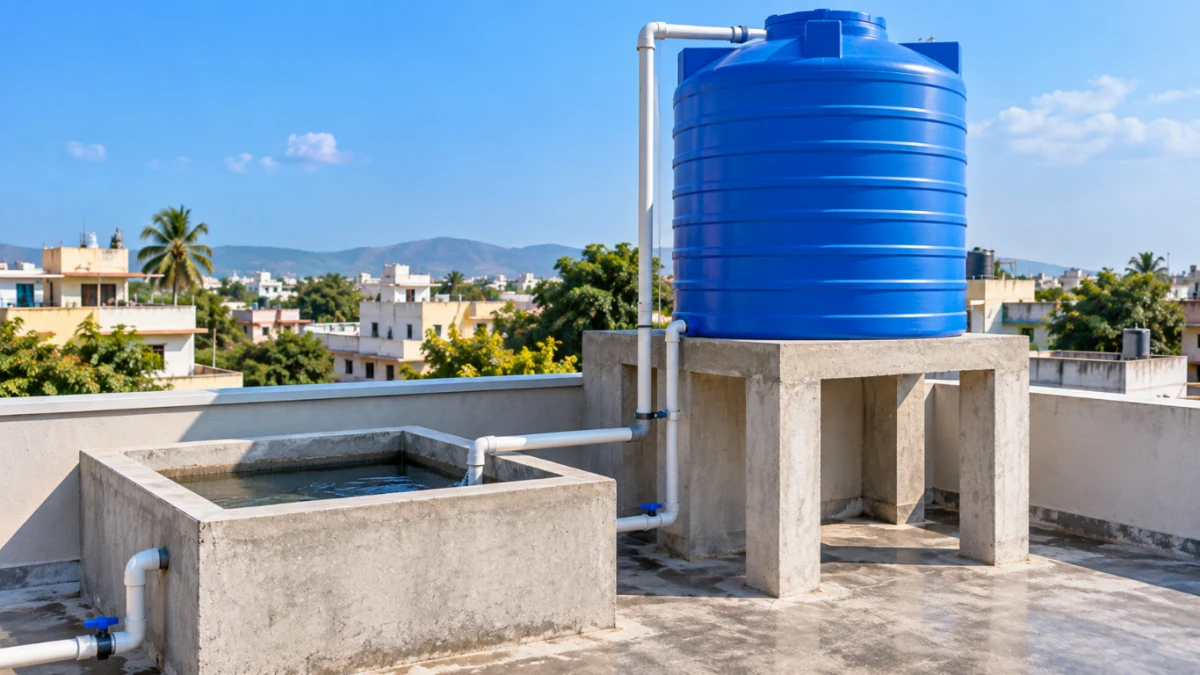
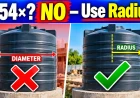
Radius = Diameter ÷ 2. This is the formula for almost every plastic overhead tank sold in India — Sintex, Vectus, Penguin, and similar brands all use a cylindrical shape.
Spherical or Hemispherical Tank Formula
Volume (m³) = (4/3) × π × Radius³ [full sphere]
Capacity (litres) = (4/3) × 3.1416 × Radius³ × 1000
Spherical tanks are uncommon in home construction — you'll mostly see them on elevated municipal water towers, not residential rooftops.
Tank Shape Comparison Table
| Tank Shape | Formula (litres) | Where It's Used | Practical Note |
|---|---|---|---|
| Rectangular | L × W × H × 1000 | RCC sumps, custom overhead tanks | Fits corners well; easy to cast on site |
| Cylindrical | 3.1416 × r² × h × 1000 | Plastic overhead tanks (Sintex, Vectus) | Most common residential choice in India |
| Spherical | (4/3) × 3.1416 × r³ × 1000 | Elevated water towers | Rare in homes; complex to fabricate |
| Hemispherical bottom cylinder | Cylinder volume + half-sphere volume | Industrial storage tanks | Used where a rounded base helps drainage |
Step-by-Step: How to Calculate Water Tank Capacity in Litres
- Measure internal dimensions, not external ones. External dimensions overstate the real capacity by roughly 5–10% because they include the wall thickness of the tank.
- Convert everything to the same unit metres is easiest, since 1 m³ converts directly to 1000 litres.
- Pick the formula matching your tank's shape from the section above.
- Multiply the result by 1000 to convert cubic metres into litres.
- Cross-check against your daily water need using the 135 LPCD method below, so the tank size actually matches your household, not just the box you bought.
Worked Example 1 Sizing a Rectangular Tank for a 4 Member Family
This is the calculation most Indian households actually need not "what's my tank's capacity," but "what size tank should I build."
As per IS 1172:1993, the standard domestic water requirement is 135 litres per person per day (LPCD) for a home with a full flushing system, broken down roughly as: drinking (5L), cooking (5L), bathing and toilet (85L), washing clothes and utensils (30L), and house cleaning (10L).
Step 1 — Total daily requirement Family of 4 × 135 litres = 540 litres/day
Step 2 — Assume a practical depth Most residential sumps and overhead tanks use a depth of 0.6 m, since going deeper isn't always possible on a rooftop or in a shallow sump pit.
Step 3 — Find the required base area Area = Volume ÷ Depth = 0.54 m³ ÷ 0.6 m = 0.9 m²
Step 4 — Solve for length and width Assume Length = 2 × Width (a common, space-efficient ratio): 2B × B = 0.9 → B² = 0.45 → B = 0.67 m, so L = 1.34 m
Final tank size: Length 1.34 m × Width 0.67 m × Depth 0.6 m = 540 litres, matching the family's daily need exactly.
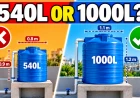
In practice, you'd round up to the nearest standard size a 1000-litre tank to build in a day's buffer against supply interruptions.
Worked Example 2 Reading the Capacity of an Existing Cylindrical Tank
Say you already have a round plastic overhead tank and want to know exactly how much it holds, not how to size a new one.
Given: Diameter = 1 m (so Radius = 0.5 m), Height = 1.5 m
Capacity (litres) = 3.1416 × (0.5)² × 1.5 × 1000 = 3.1416 × 0.25 × 1.5 × 1000 = 1178 litres
So a cylindrical tank with these dimensions holds close to 1178 litres practically sold and marketed as a "1000-litre tank," since manufacturers round down slightly to account for the fill line sitting a little below the rim.
Cubic Metre to Litre Conversion Cheat Sheet
| Unit | Equals |
|---|---|
| 1 m³ | 1000 litres |
| 1 cm³ | 0.001 litres |
| 1000 cm³ | 1 litre |
| 1 litre | 1 kg (fresh water) |
That last row is useful for structural planning since 1 litre of water weighs 1 kg, a 1000-litre tank on your roof means designing for roughly 1000 kg (1 tonne) of extra load once full.
Standard Water Tank Sizes Used in India
| Capacity | Typical Use |
|---|---|
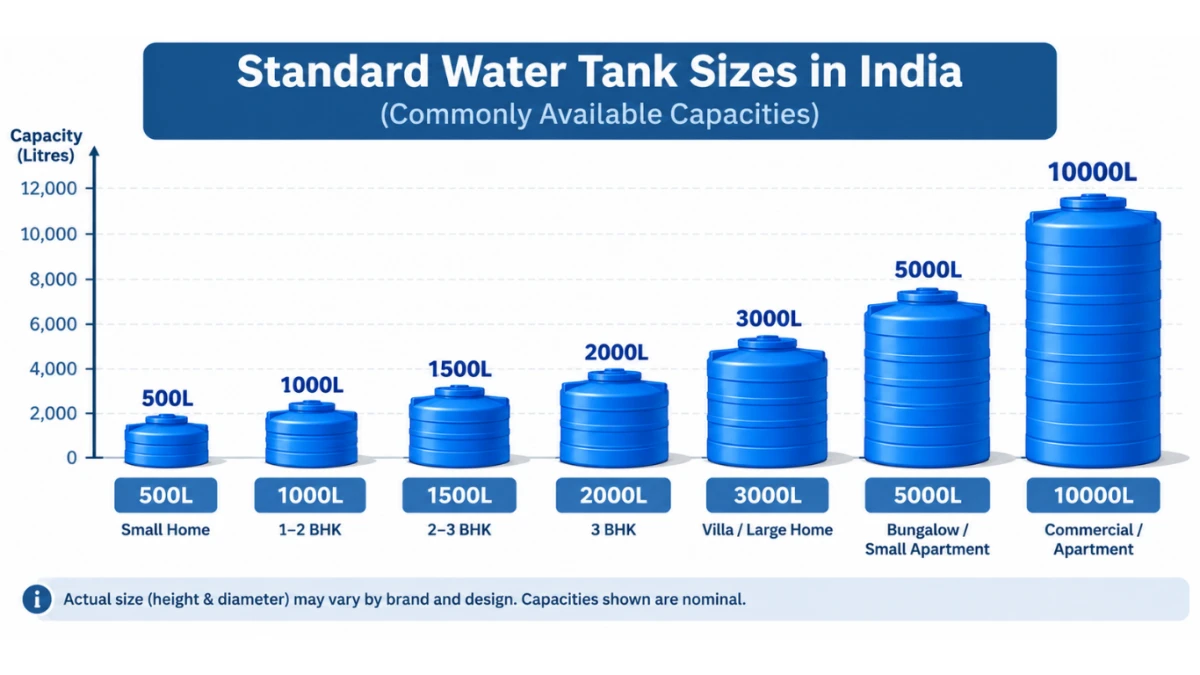
| 500 L | 1–2 person household, short backup |
| 1000 L | 3–4 member family, 1-day backup (most common) |
| 1500 L | Larger family or 2-day backup for a small home |
| 2000 L | Independent house with garden/washing needs |
| 3000 L | Small apartment block or higher backup requirement |
| 5000 L | Multi-storey residential building |
| 10,000 L | Large building or commercial setup; usually a custom RCC sump beyond this |
Common Mistakes in Water Tank Capacity Calculation
Using external dimensions instead of internal ones. This is the single biggest source of error. Wall thickness on a plastic tank or RCC sump can easily shave 5–10% off the real capacity, so always measure from inside the tank.
Forgetting the fill line. Manufacturers leave a small gap below the rim so the tank doesn't overflow when the float valve reacts late. Don't assume the tank fills right up to the top edge.
Mixing units mid-calculation. Measuring length in feet and height in metres, then multiplying directly, is a common site-level mistake. Convert everything to one unit metres before you calculate.
Ignoring backup days. Calculating only the daily requirement (135 LPCD) without adding a buffer for supply gaps is how households end up with a tank that's technically "correct" on paper but empty by evening during a water cut.
Assuming all cylindrical tanks are the same shape. Some overhead tanks have a slightly tapered or domed top, which changes the true volume slightly from a plain cylinder formula. For quick sizing this difference is small enough to ignore, but for exact fill-level readings it matters.
IS Code and NBC Guidelines for Water Tank Sizing
The 135 litres per person per day figure isn't arbitrary it comes from IS 1172:1993 Code of Basic Requirements for Water Supply, Drainage and Sanitation, which sets domestic water demand between 135 and 225 LPCD depending on the level of sanitation facilities provided. For buildings without full flushing systems, this can be relaxed to a lower figure for economically weaker sections.
The National Building Code of India (NBC), Part 9 Plumbing Services, extends this into practical plumbing and storage design, including guidance on overhead versus underground storage splits for multi-storey buildings.
For RCC water tanks specifically where the tank itself is structurally designed, not just sized IS 3370: Code of Practice for Concrete Structures for the Storage of Liquids governs crack width limits and reinforcement detailing, since a water-retaining structure has stricter requirements than a normal RCC slab.
If you're designing a tank for a building rather than sizing a plastic tank for a home, always route the final structural design through a qualified engineer referencing these codes directly this calculator and guide are for capacity planning, not structural design sign-off.
Conclusion
Whether you're using a water tank capacity calculator online or working it out by hand, the process comes down to two things: picking the right formula for your tank's shape, and checking that number against your household's actual 135 LPCD water demand. Get the internal dimensions right, round up to a standard tank size, and you'll avoid both the too-small and too-large mistakes that trip up most first-time calculations.
Frequently Asked Questions

Prince Badaik is the founder of CivilCost, a platform dedicated to making civil engineering calculations simple and accurate for students, engineers, contractors, and homeowners across India.



Comments (0)