
Density of Cement The Exact 1440 kg/m³ Value and How to Use It
A comprehensive guide on the density of cement, explaining the standard bulk density of 1440 kg/m³, true density, bag volume calculations, and why these values matter for construction projects.

The standard bulk density of ordinary Portland cement is 1440 kg/m³, meaning one cubic meter of loosely packed or commercial cement weighs exactly 1440 kilograms. This crucial number helps engineers and builders convert cement weight into volume when planning construction materials.
If you are stepping into civil engineering, building your own house, or trying to understand how construction estimates work, understanding cement density is your first big milestone. Without knowing this single number, you cannot accurately calculate material quantities, mix ratios, or storage space requirements. Let's break down everything you need to know in simple, practical terms.
What Is the Density of Cement?
Density is a simple scientific concept. It tells you how heavy a material is for a given amount of space. In mathematical terms, density is mass divided by volume.
When applied to construction, the density of cement tells you how much a specific box of cement (measuring one meter by one meter by one meter) will weigh. But cement is a powdery, fine material filled with tiny air pockets. Because of these air gaps, how you pack the cement changes its measured weight. This brings us to the two main ways density is measured in the real world.
The Two Types of Cement Density You Must Know
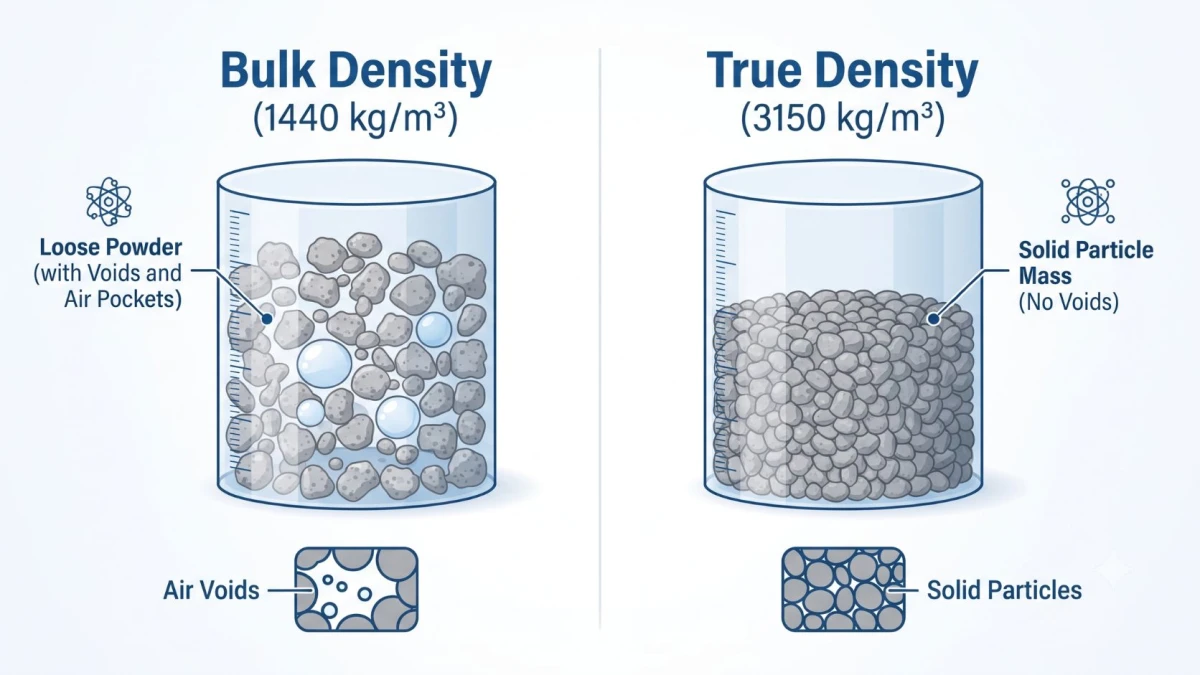
Most beginners get confused because they hear two completely different numbers for cement density: 1440 kg/m³ and 3150 kg/m³. Both numbers are correct, but they describe two different states of the material.
| Property | Bulk Density (Loose / Commercial) | True Density (Absolute / Specific Gravity) |
| Standard Value | 1440 kg/m³ | 3150 kg/m³ |
| What It Measures | Weight of cement including all the air gaps between powder particles. | Weight of the solid cement particles only, excluding air voids. |
| Primary Use | Site mixing, concrete volume estimation, and ordering material bags. | Laboratory mix designs, absolute volume calculations, and quality control. |
| Metric Equivalent | 1.44 g/cm³ | 3.15 g/cc |
Understanding Bulk Density
Bulk density includes the air trapped between the fine cement grains. When you open a fresh bag of cement and pour it into a container, it settles loosely, trapping a large amount of air. This bulk density is universally taken as 1440 kg/m³ for everyday site work.
Understanding True Density (Specific Gravity)
True density ignores the air gaps entirely. Imagine crushing every single speck of cement so there is zero empty space left. The solid material itself is much heavier. The specific gravity of cement is 3.15, which means its absolute density is 3150 kg/m³. Laboratories use this value to verify cement quality and run precise absolute volume mix designs.
Why Is the Density of Cement 1440 kg/m³ ?
You might wonder why 1440 kg/m³ is the accepted industry benchmark across construction sites worldwide.
Cement is manufactured in massive rotary kilns, ground into a superfine powder, and packed into bags. When handled, transported, and stored on site, it settles under its own weight into a semi-compacted state. Extensive laboratory testing and field measurements over decades showed that a standard cubic meter of this loose, commercial powder consistently hovers around 1440 kilograms.
Because field workers deal with loose powder rather than solid blocks, site engineers use 1440 kg/m³ for all practical estimation tasks.
How to Calculate the Volume of One Cement Bag
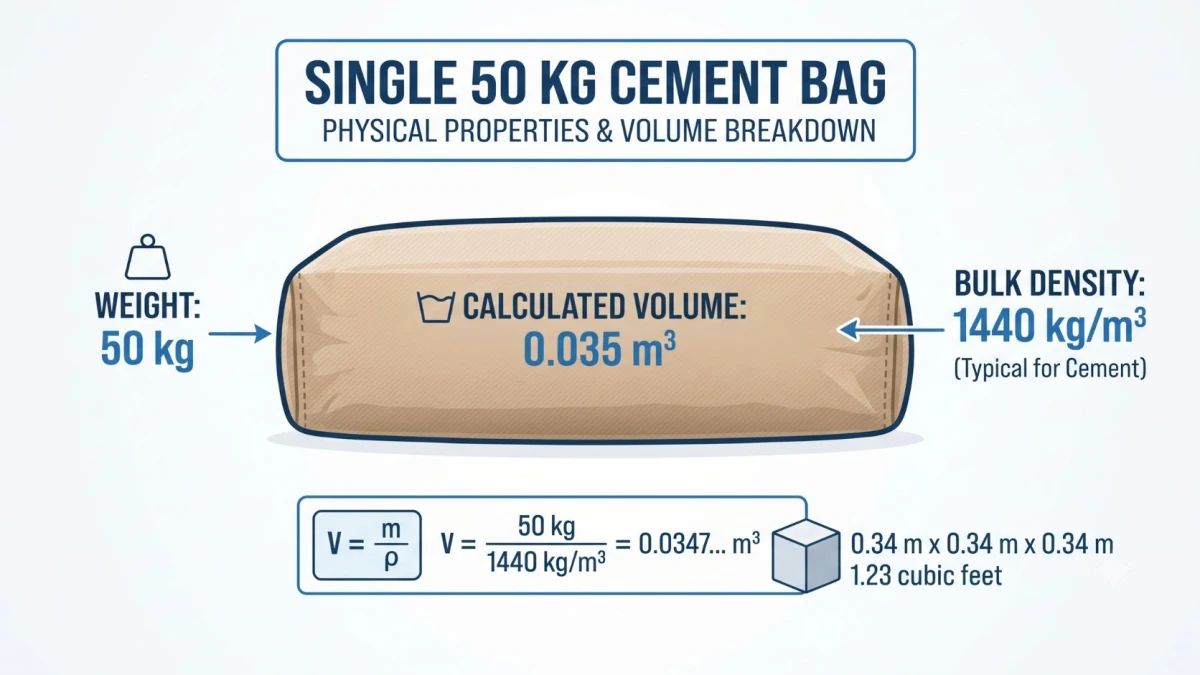
One of the most common practical applications of cement density is finding out how much space a single bag occupies. Standard cement bags sold globally weigh 50 kg. Let us calculate the volume of one bag using simple math.
Worked Example 1: Finding the Volume of a 50 kg Cement Bag
-
Given Data:
-
Mass of cement = 50 kg
-
Bulk density of cement = 1440 kg/m³
-
-
Formula:
-
Volume = Mass ÷ Density
-
-
Step-by-Step Calculation:
-
Volume = 50 kg ÷ 1440 kg/m³
-
Volume = 0.0347 m³
-
To make it easier to visualize on site, let us convert cubic meters into cubic feet:
-
1 m³ = 35.3147 cubic feet
-
Volume in cubic feet = 0.0347 × 35.3147 = 1.226 cubic feet
So, one 50 kg bag of cement takes up roughly 0.035 cubic meters or 1.23 cubic feet of space. Knowing this helps contractors plan storage godowns and calculate dry volume adjustments for concrete mixes.
Practical Worked Examples for Construction Sites
Let us look at a second real-world scenario to see how cement density is applied outside of simple bag storage. Suppose you are casting a structural concrete beam and need to figure out how many bags of cement to order.
Worked Example 2: Cement Quantity for a Beam Casting Project
-
Project Scenario: You need to cast a concrete beam with a wet volume of 3 cubic meters using a standard mix ratio.
-
Step 1: Determine Dry Volume. Concrete shrinks when water is added. To get the required dry volume of materials, multiply the wet volume by the standard dry volume factor of 1.54.
-
Dry Volume = 3 m³ × 1.54 = 4.62 m³
-
-
Step 2: Apply Mix Proportions. Assume a standard nominal mix ratio like M20 (1 : 1.5 : 3), where cement is 1 part out of a total of 1 + 1.5 + 3 = 5.5 parts.
-
Volume of Cement = (1 ÷ 5.5) × 4.62 m³ = 0.84 m³
-
-
Step 3: Convert Volume to Weight Using Density. Using our standard bulk density of 1440 kg/m³:
-
Weight of Cement = Volume × Density
-
Weight of Cement = 0.84 m³ × 1440 kg/m³ = 1209.6 kg
-
-
Step 4: Find the Number of Bags. Since each bag contains 50 kg:
-
Number of Bags = 1209.6 kg ÷ 50 kg/bag = 24.19 bags (Order 25 bags)
-
You will need to order 25 bags of cement for the beam project. This step-by-step method ensures you never run short of material on casting day.
Common Mistakes When Measuring Cement Density
Even experienced workers sometimes make errors when handling cement quantities because they overlook material conditions.
-
Ignoring Moisture Absorption: Cement is hygroscopic, meaning it absorbs moisture from the air. Old or damp cement lumps together, increasing its apparent bulk weight and ruining mix proportions. Always use fresh, dry cement.
-
Confusing Bulk and True Density: Using the true density value (3150 kg/m³) for normal site batching will result in massive under-calculations of cement bags because it ignores air voids. Always use 1440 kg/m³ for loose material calculations.
-
Incorrect Unit Conversions: Mixing up cubic meters, cubic feet, and litres leads to costly estimation errors. Always double-check your unit conversions before ordering raw materials.
Industry Standards and Guidelines
Civil engineering projects rely heavily on standardized testing methods to ensure structural integrity.
The determination of cement density and specific gravity in laboratories is governed by official codes. For instance, IS 4031 (Part 11) specifies the exact procedure using a Le Chatelier flask and non-reactive liquid like kerosene to find true density. Furthermore, structural safety requirements and mix design guidelines are regulated by IS 456, ensuring that the physical properties of cement translate into durable concrete structures.
Conclusion
Mastering the density of cement is a foundational skill for anyone involved in construction. Remembering the magic number of 1440 kg/m³ for bulk density and 3150 kg/m³ for true density gives you the power to calculate material bags, estimate costs accurately, and avoid costly site mistakes. Keep these formulas handy, verify your material quality, and plan your projects with confidence.
Frequently Asked Questions

Prince Badaik is the founder of CivilCost, a platform dedicated to making civil engineering calculations simple and accurate for students, engineers, contractors, and homeowners across India.









Comments (0)