
Floor Tiles Calculation Formula Step By Step Guide for Beginners
Learn the exact floor tiles calculation formula to find out how many tiles and boxes you need for any room, including step-by-step room measuring and wastage allowances.
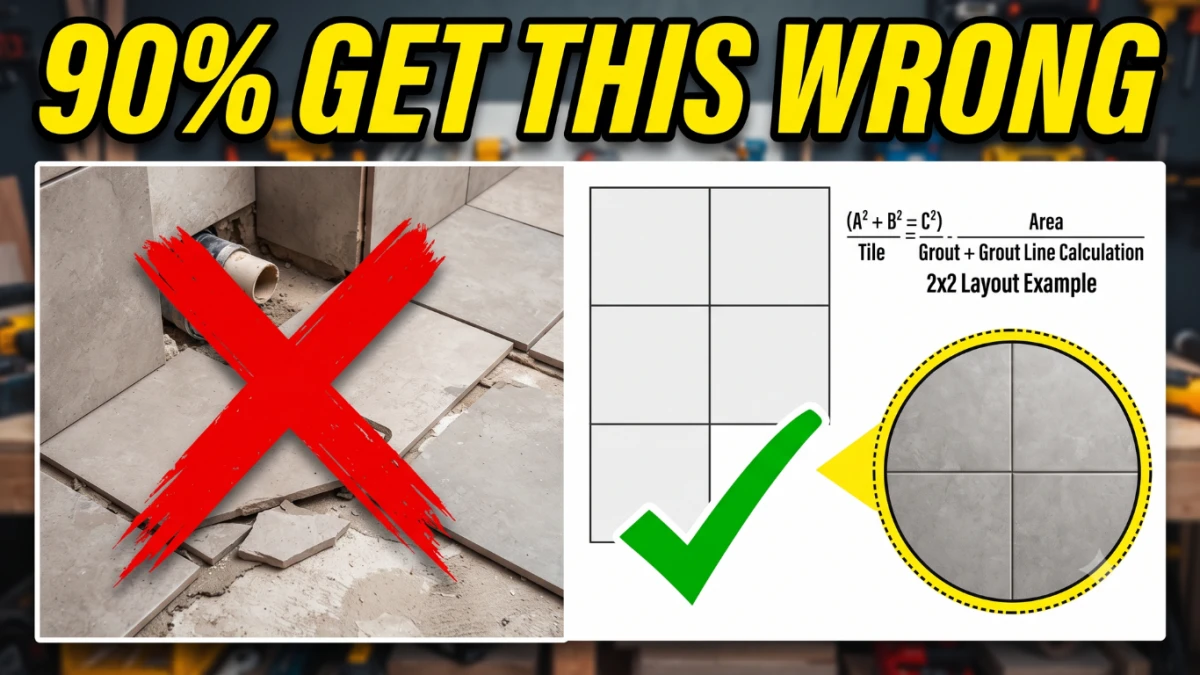
Floor tiles calculation formula is simple: divide the total room area by the area of a single tile, then add 5% to 10% extra for cutting wastage.
Buying tiles for a home construction or renovation project can feel confusing. If you buy too few, your mason has to stop work mid-way, and matching the exact shade from a new batch later can become a headache. If you buy too many, boxes of extra ceramic lie around wasting hard-earned money.
This guide breaks down the exact math used on real sites. You will learn how to measure your rooms, apply standard formulas, compute tile box quantities, and avoid costly mistakes.
Step 1 Measure Room Dimensions Accurately
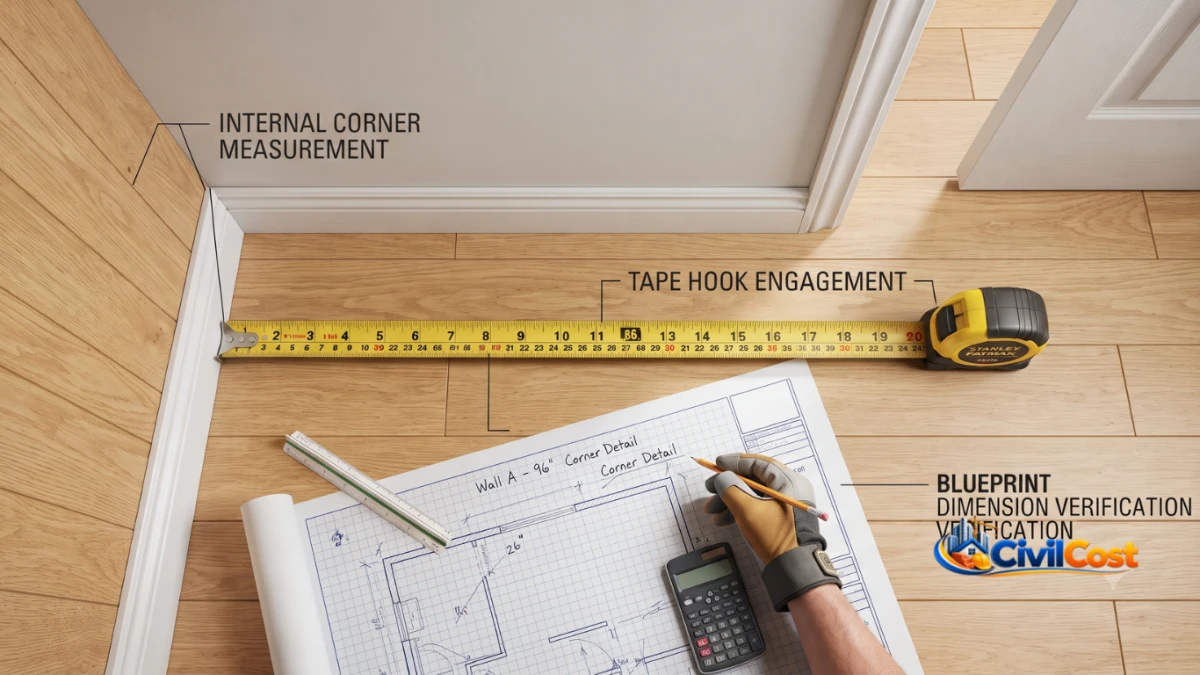
Before doing any math, grab a reliable measuring tape. Accuracy here dictates everything else.
Measure the length and width of your floor space in feet and inches. For irregular rooms, split the layout into simple rectangular sections (labeling them Section A and Section B) and calculate each part separately.
- Example Room Let us take a standard bedroom measuring 12 feet long by 10 feet wide.
Step 2 Calculate the Total Floor Area
To find out how much surface space you need to cover, multiply the room length by the room width.
Room Area = Length × Width
Using our bedroom example:
Room Area = 12 ft × 10 ft = 120 sq. ft.
So, your total flooring coverage space is 120 square feet.
Step 3 Determine Single Tile Area
Next, look at the size of the tile you want to purchase. Floor tiles come in various standard dimensions like 2 feet by 2 feet (24 inches x 24 inches), 1 foot by 1 foot, or large format slabs.
Multiply the length of one tile by its width to find its individual area.
- Example Tile: Let us choose a popular 2 ft × 2 ft tile.
Tile Area = 2 ft × 2 ft = 4 sq. ft.
Step 4 Apply the Floor Tiles Calculation Formula
Now comes the core step. Divide the total room area by the area of a single tile.
Total Number of Tiles = Room Area / Tile Area
Total Number of Tiles = 120 sq. ft. / 4 sq. ft. = 30 tiles
Without waste, you need exactly 30 pieces. But construction reality is different.
Step 5 Account for Wastage and Cutting (The Crucial Step)
Tiles near walls must be cut to fit, and corners or doorways cause breakage. Experienced masons always add a safety buffer.
- Standard Straight Layout: Add 5% extra tiles.
- Diagonal or Herringbone Layout: Add 10% extra tiles because diagonal cuts create more offcut waste.
Using a standard 5% wastage buffer for our 30 tiles:
Wastage Tiles = 30 × 0.05 = 1.5 tiles
Round up to the nearest whole number (2 tiles).
Final Tiles Required = 30 + 2 = 32 tiles
Worked Example 2 Kitchen Floor Using Smaller Tiles
To make sure the formula is fully clear, let us look at a second real-world scenario: a compact kitchen floor.
- Kitchen Dimensions: 8 feet long by 6 feet wide.
- Room Area: 8 ft × 6 ft = 48 sq. ft.
- Tile Size Chosen: 1 foot by 1 foot (12 inches x 12 inches).
- Single Tile Area: 1 ft × 1 ft = 1 sq. ft.
- Base Tile Count: 48 / 1 = 48 tiles.
- Wastage Allowance (10% for tight kitchen corners and cabinets): 48 × 0.10 = 4.8 (round up to 5 tiles).
- Final Requirement: 48 + 5 = 53 tiles.
Tile Size vs. Coverage Comparison Table
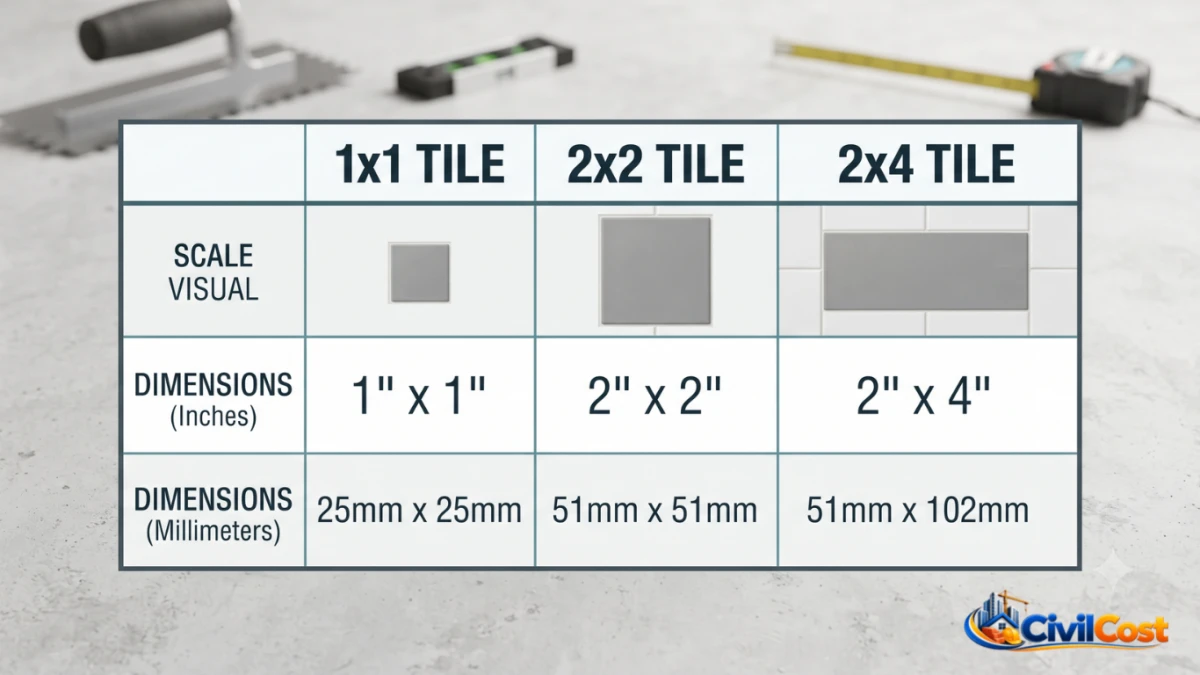
Different tile sizes change how many pieces you handle, though the total square footage remains identical for a 120 sq. ft. room.
| Tile Size (Feet) | Area of One Tile | Base Tiles for 120 Sq. Ft. Room | Tiles with 5% Wastage |
|---|---|---|---|
| 1 ft × 1 ft | 1 sq. ft. | 120 tiles | 126 tiles |
| 2 ft × 2 ft | 4 sq. ft. | 30 tiles | 32 tiles |
| 2 ft × 4 ft | 8 sq. ft. | 15 tiles | 16 tiles |
| 4 ft × 4 ft | 16 sq. ft. | 7.5 tiles | 8 tiles (approx) |
How to Calculate Tile Boxes Needed
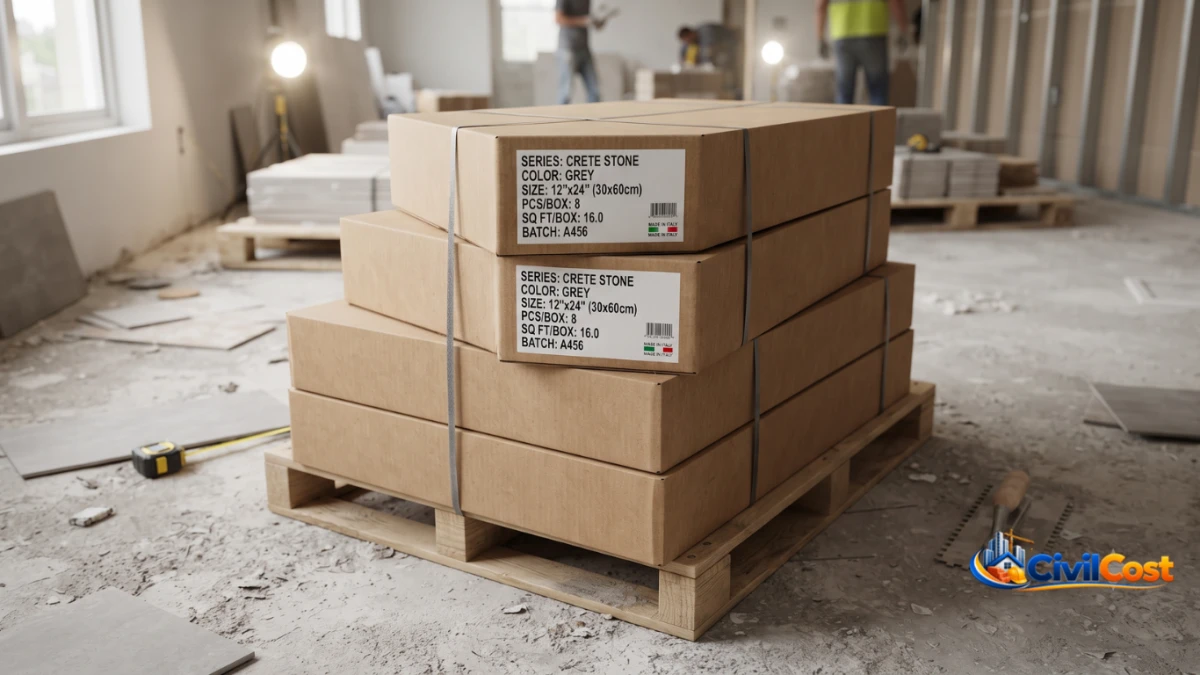
Tiles are sold in boxes, not individual pieces. Check the box label to see how many square feet or pieces a single box contains.
If a box of 2 ft × 2 ft tiles contains 4 pieces (covering 16 square feet):
Total Boxes = Total Tiles Needed / Pieces per Box = 32 / 4 = 8 boxes
Always buy complete boxes because hardware shops rarely accept returns for open, loose single tiles.
Common Mistakes to Avoid During Tile Calculation
- Ignoring Grout Lines: Grout lines usually range from 2 mm to 4 mm. While small, across a large hall, they save a tiny fraction of tiles. Do not subtract grout gaps from your primary calculation; let that minor savings act as part of your safety buffer.
- Forgetting Skirting: If you are running floor tiles up the lower wall as skirting, measure that perimeter separately and add it to your total square footage.
- Not Buying Extra Batch Numbers: Tiles manufactured in different factory batches have slight color variations. Always buy all your tiles (plus wastage) from the exact same batch number.
Frequently Asked Questions

Prince Badaik is the founder of CivilCost, a platform dedicated to making civil engineering calculations simple and accurate for students, engineers, contractors, and homeowners across India.








Comments (0)